On this page
Around 2680 BCE, the Egyptian king Djoser built a monument at Saqqara that has endured for millennia. His official, Imhotep, is traditionally credited as the architect of the Step Pyramid (Wikipedia). Standing approximately 60 metres tall, it is considered the first large-scale cut stone structure in history (PLOS ONE).
But how do you lift 0.69 million tons of stone before the invention of the crane? A 2024 study published in *PLOS ONE* proposes an answer: Imhotep may have used water pressure.
Who was Imhotep?
Imhotep was a high-ranking official during the Third Dynasty of ancient Egypt. He held an array of powerful titles, including Chancellor to the King and High Priest of the sun god Ra at Heliopolis. While his tomb has never been found, his legacy is etched into the stone at Saqqara.
Thousands of years after his death, his impact on architecture and medicine was considered so profound that he was deified by the Egyptians. He became one of the few non-royal Egyptians to be worshipped as a god, and was later equated with the Greek god of healing, Asclepius (Wikipedia).
Why is the Step Pyramid of Djoser an engineering milestone?
Before the Step Pyramid, Egyptian kings were typically buried in *mastabas*—flat-roofed, rectangular tombs made largely of sun-dried mudbrick and wood (Wikipedia). Mudbrick is a reliable material for low walls, but it decays over time and cannot support the massive vertical weight required for true monumental architecture.
Imhotep took a massive leap by stacking six decreasing tiers on top of a mastaba base, creating a stepped shape that soared upwards. More importantly, he changed the material entirely. The Step Pyramid comprises over 2.3 million limestone blocks, with an average weight of 300 kg per block (PLOS ONE). To extract, transport, and build a total volume of roughly 330,400 cubic metres in stone required an entirely new scale of project management and structural engineering.
If you are calculating the volume of structures like this in your own studies, you can find step-by-step methods in our guide to Combined solids in Class 10: surface area and volume, worked.
Did Imhotep use a hydraulic lift system?
The traditional view among historians is that the pyramid was built using ramps, rollers, and sheer human labour. However, the 2024 *PLOS ONE* study suggests the ancient architects might have used an internal hydraulic elevator to ease the burden.
During the Old Kingdom, the climate was different. The researchers estimate ancient rainfall in the area was between 50 and 150 millimetres per year, which generated significant flash floods. By mapping the nearby watersheds, the study authors proposed that a massive, previously unexplained stone footprint—measuring 360 by 620 metres and known as the Gisr el-Mudir—functioned as a check dam to trap water and sediment from these floods (PLOS ONE).
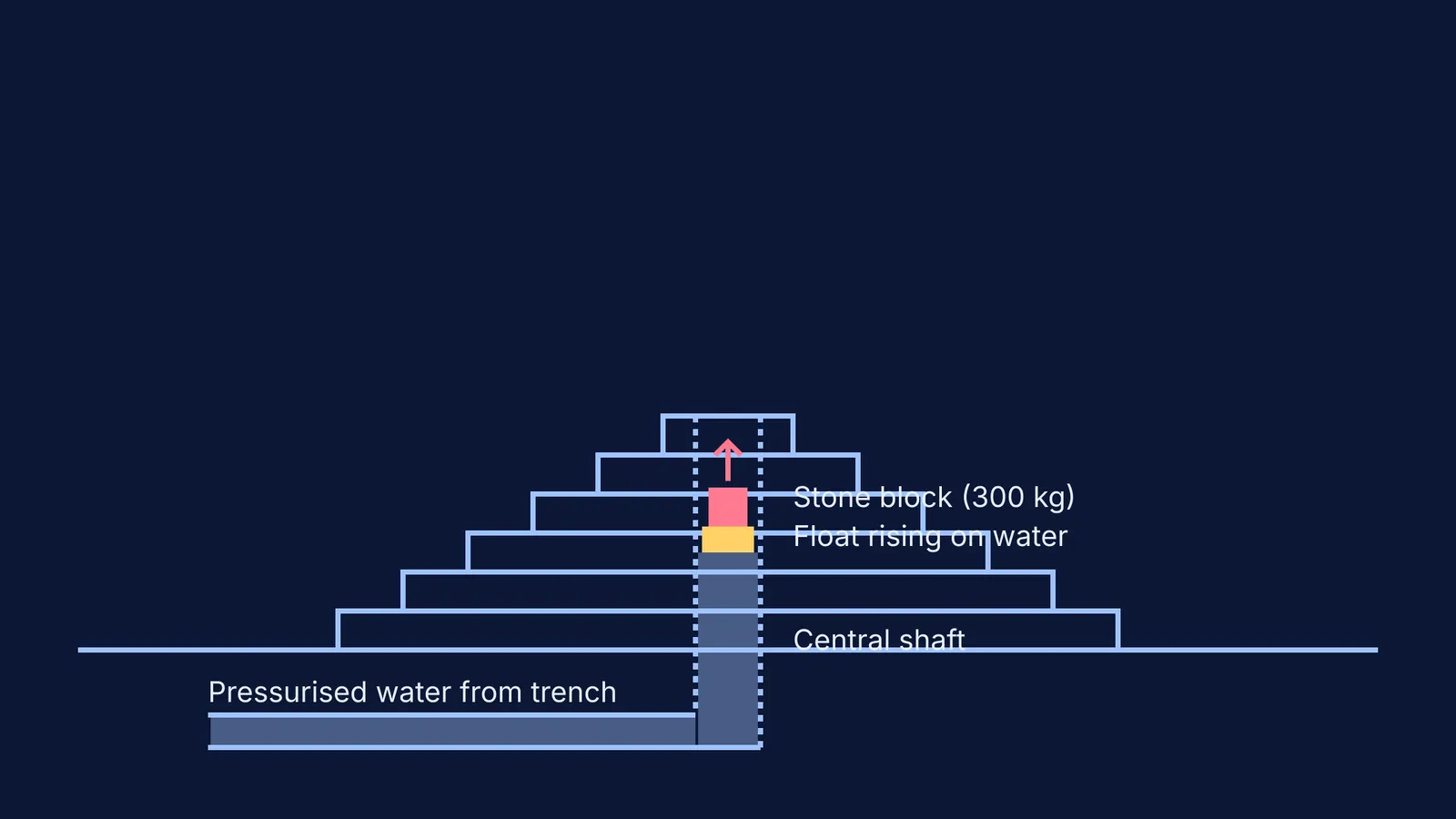
This trapped water was then channelled through a deep trench measuring nearly 3 kilometres long. This trench acted as a water treatment facility, using deep compartments to settle out mud and purify the water before piping it into the pyramid's 6.8 kilometres of subterranean shafts (PLOS ONE).
Inside the pyramid, water flowed into a deep central twin-shaft system. By regulating the water level, workers could raise and lower a wooden float carrying the 300 kg limestone blocks. As the water rose, it lifted the stones in a "volcano fashion" to the higher levels of the pyramid, completing the heavy lifting with fluid dynamics rather than muscle alone (PLOS ONE).
Understanding how fluid pressure creates a lifting force is a classic physics problem. For a related example of force multiplication using liquids, see our breakdown of Pascal's law in hydraulic machines: lifting a car with a small push.
What can students learn from Imhotep's engineering?
Imhotep's work at Saqqara shows the power of breaking a massive, seemingly impossible goal into smaller, solvable problems. He did not invent the smooth-sided pyramid overnight; he started with a traditional rectangular shape and iterated, discovering new principles of stone support and structural integrity along the way. His willingness to use new materials and experiment with natural forces like water pressure laid the groundwork for the Great Pyramids of Giza that followed.
It can be hard to picture how physical forces act on a heavy mass, whether that mass is sliding up a ramp or floating on a column of pressurised water. If you want to experiment with forces, pressures, and motion yourself, try the Fermi Simulation Lab, which provides interactive simulations for the ideas that are easier to see than to read. You can also explore how to calculate the work required to move heavy objects in our guide to Work from force-displacement graphs: areas, signs and springs.
With a firm grasp of basic principles and a willingness to test new ideas, you can start building your own monuments, one block at a time.