

On this page
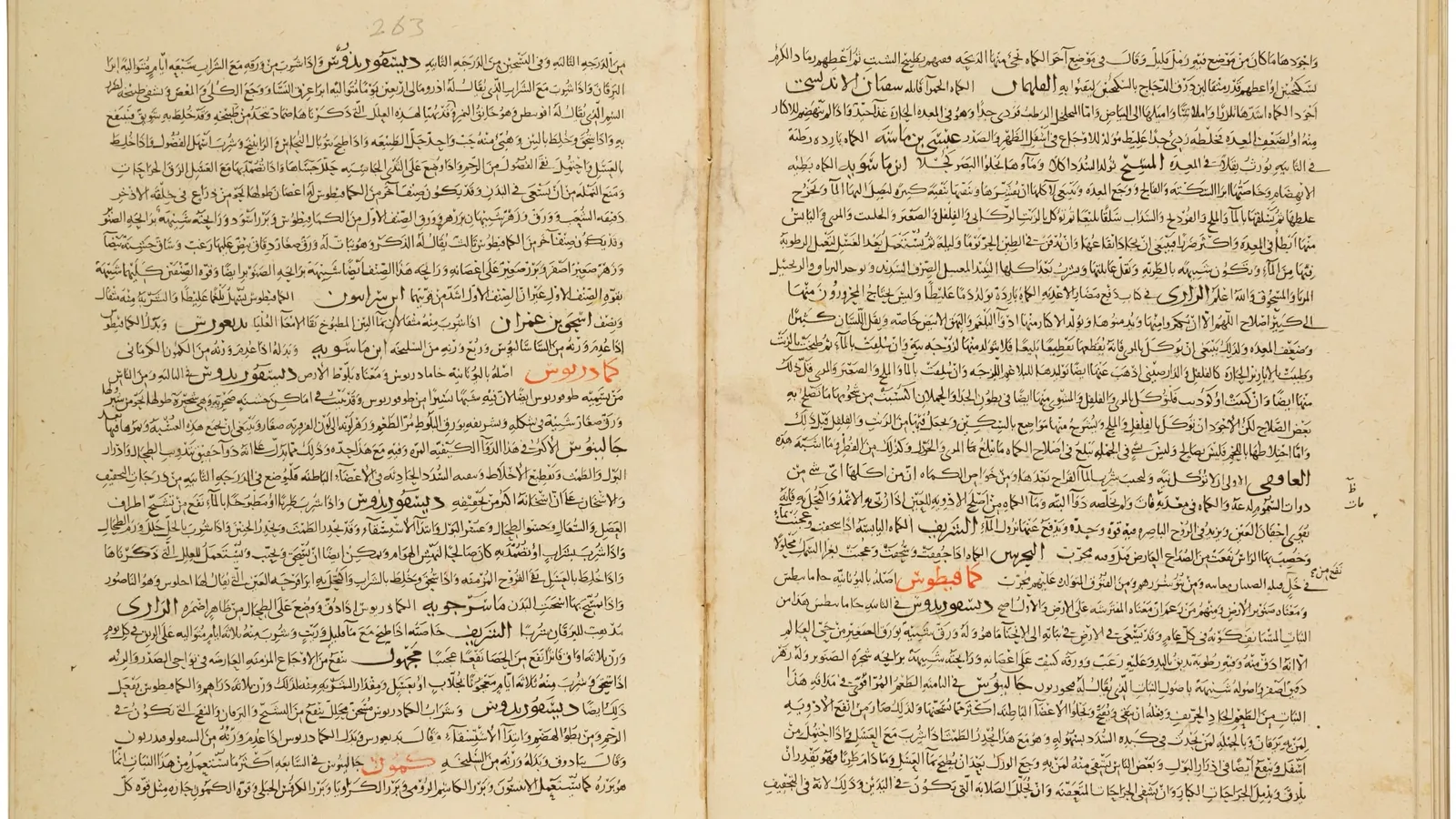
Ibn al-Baitar was a botanist from Malaga in al-Andalus who, in the 1240s, finished one of the largest medieval books on medicines. It gathered more than 1,400 drugs from plants, animals and minerals, arranged alphabetically with notes on how each was prepared and used, according to a 2020 study of its manuscripts in the Archives of Hellenic Medicine. It is also an early lesson in building a reference you can trust.
Who was Ibn al-Baitar?
He was born in Malaga in the last quarter of the 12th century, trained in botany in al-Andalus and collected plant samples there in his twenties, the same 2020 paper reports. Between 1220 and 1223 he travelled across North Africa, then went on to Anatolia, the Greek islands and Alexandria. He became chief botanist of the Ayyubid sultanate in Egypt, worked and taught in Cairo and Damascus, and died in Damascus in 1248.
A 2025 study in the journal Plants puts his life at roughly 1197 to 1248 CE (Applequist, 2025).
What was in the Compendium of Simples?
The book's Arabic title is Kitab al-Jami li-Mufradat al-Adwiya wa al-Aghdhiya, usually translated as the Compendium on Simple Medicaments and Foods. A simple is a medicine made from one substance, such as a single plant, rather than a mixture.
Size: the Jami covers over 1,400 simples of plant, animal and mineral origin, drawn from more than 150 ancient and medieval sources (Bouras-Vallianatos, History of Pharmacy and Pharmaceuticals, 2025).
Entries and substances: Applequist counts over 2,300 alphabetically organised entries covering an estimated 1,400 distinct substances (Plants, 2025).
New medicines: 200 herbal medicines are recorded for the first time in this book, according to İşlek and colleagues, who cite earlier scholarship for the figure.
When: it was written between 1242 and 1248 and presented to the Ayyubid Sultan al-Salih Ayyub.
Afterlife: it was used in Europe until the 19th century, printed in Arabic in 1875 and translated into Latin, German and French; an Ottoman Turkish translation was made between 1334 and 1348 (same paper).
To see the book he built on, read our piece on Dioscorides and De Materia Medica.
How did Ibn al-Baitar build such a big list?
He read widely. He studied Dioscorides, Galen, Hippocrates, Ibn Sina, al-Razi and al-Ghafiqi, and wrote commentaries on some of them (İşlek and colleagues, 2020).
He checked for himself. The same paper says he checked information about plants with observations and experiments, and Bouras-Vallianatos describes the Jami as combining its sources with observations from his own extensive travels.
He named things carefully. He recorded names in Arabic, classical Greek and Latin, and less often regional Persian, Berber or Spanish names (Applequist, 2025).
Was Ibn al-Baitar's list accurate?
One way to test a reference written more than 750 years ago is to ask whether people still use what it describes. Applequist compared 46 plants that Ibn al-Baitar gave Berber names for with modern records from Amazigh (Berber) communities in North Africa (Plants, 2025). About 61% are still used as medicine there, and about 79% of those still carry a matching common name. Of the 46 species shared by three large modern Amazigh studies, 83% were documented by Ibn al-Baitar.
That shows a careful record and long-lived local knowledge. It does not show that every remedy works. Applequist herself points out that a thorough author could simply have recorded most of the plants that were widely used in his time.
How can you study like Ibn al-Baitar?
Turn his method into a revision card for the plant examples you meet in NCERT biology.
Name it twice. Write the scientific name correctly, following the rules for writing binomial names, and add the common name you know.
Say where you read it. Chapter and page, or the paper.
Check it yourself. Look at the real plant, a herbarium sheet or a labelled photo, and write one feature you saw.
Note the claim and who makes it. A use, a habitat, an adaptation.
File it alphabetically. Like the Jami, so you can find any card in seconds.
Here is a worked card, using an entry from the Ottoman Turkish copy that İşlek's team studied. Their Table 1 lists nutmeg among the manuscript's diuretic drugs (Archives of Hellenic Medicine, 2020).
Name: Myristica fragrans (nutmeg)
Source: Archives of Hellenic Medicine 2020, Table 1
Seen: what you notice on a whole nutmeg from your kitchen
Claim: listed as a diuretic in a medieval manuscript; a historical claim, not tested
Filed under: M
The claim line matters most. Ibn al-Baitar kept what he read apart from what he saw, and your card should too.
If a word on your card, such as genus, family or species, is fuzzy, the Fermi Concept Library gives every concept in biology its own lesson and its place in the map, so you can see how one idea leads to the next.
For another collector who wrote down medicinal plants on his travels, read about Garcia de Orta and the medicinal plants of India.


