

On this page
What was Garcia de Orta's 1563 book published in Goa?
On 10 April 1563, printer João de Endem issued *Colóquios dos simples e drogas he cousas medicinais da Índia* in Goa. Written by Portuguese physician Garcia de Orta, it was the first secular scientific treatise printed in Asia. The volume opened with an ode by his friend Luís de Camões, the poet's first published verse.
Orta was a physician of Sephardic Jewish descent educated at Salamanca and Alcalá. Facing religious persecution, he sailed to India in 1534 as physician to Martim Afonso de Sousa. Living in western India for over 30 years, Orta treated viceroys and Indian rulers, including Sultan Burhan Nizam Shah I of Ahmadnagar. As Ivan A. D'Cruz recorded in the British Medical Journal, Orta recorded firsthand observations of tropical diseases—including fatal cholera epidemics—and documented native medicinal plants unknown in Europe.
Which Indian medicinal plants did Garcia de Orta document?
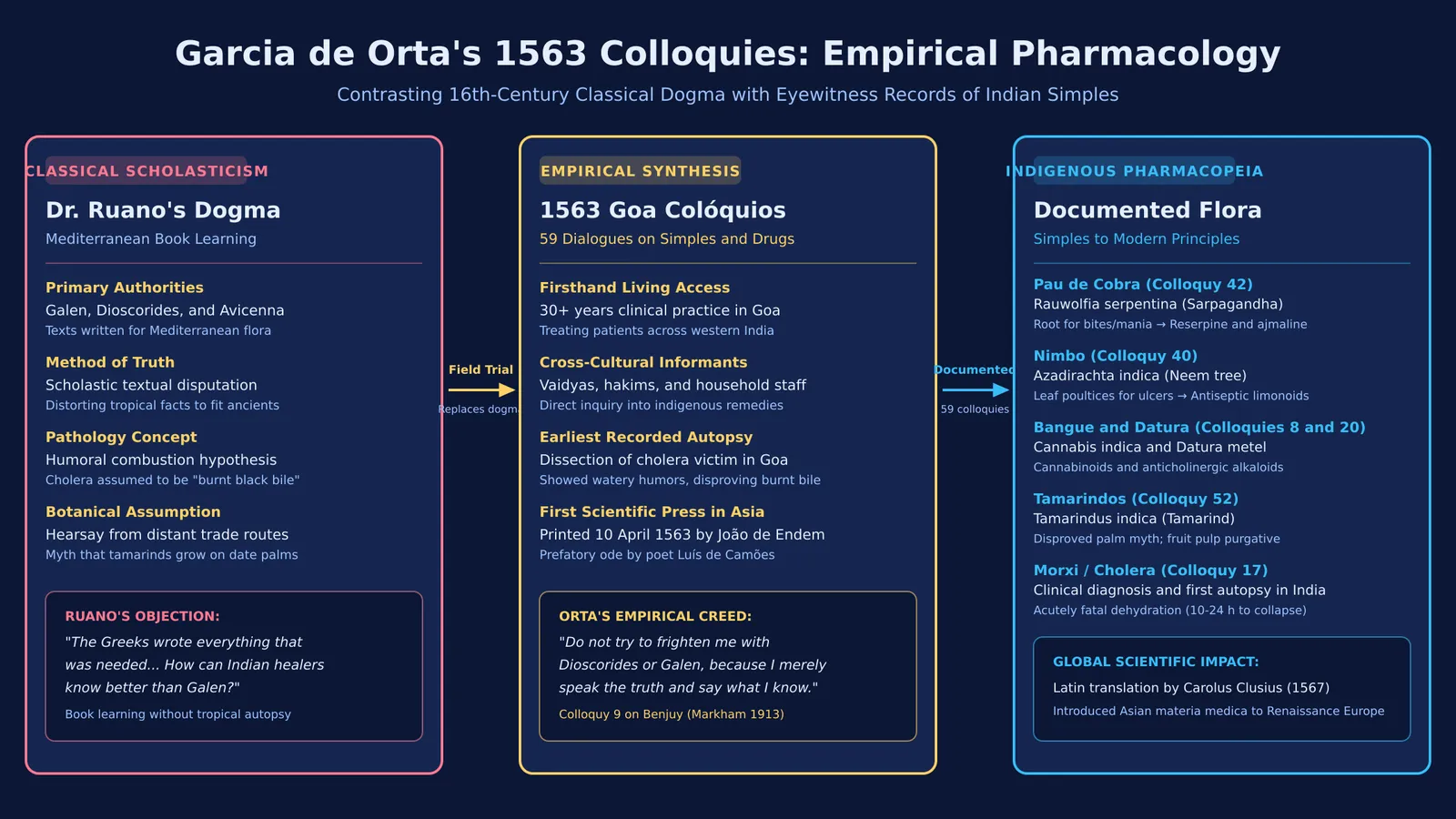
Structured as 59 dialogues between Orta and Dr. Ruano—a fictional classmate clinging to scholasticism—the work contrasts Mediterranean book learning with tropical reality, as analyzed by Palmira Fontes da Costa in Studies in History and Philosophy of Science. Orta documented dozens of indigenous plants:
**Sarpagandha (*Rauwolfia serpentina*):** Described in Colloquy 42 as *pau de cobra*, Orta recorded its use for snakebites, fevers, and mental distress. Modern medicine advanced when Salimuzzaman Siddiqui isolated alkaloids from Rauwolfia, yielding ajmaline and reserpine.
**Neem (*Azadirachta indica*):** Described in Colloquy 40 as *nimbo*, Orta noted that poultices of crushed leaves healed deep ulcers. Centuries later, chemists identified its active limonoids, as explored in T. R. Govindachari's chemical analysis of neem compounds.
Cannabis and Datura: In Colloquy 8, Orta distinguished Indian cannabis (*bangue*) from European hemp, noting its consumption with milk and spices. In Colloquy 20, he recorded the potent anticholinergic delirium induced by *Datura metel*.
**Tamarind (*Tamarindus indica*):** In Colloquy 52, Orta disproved the European myth that tamarinds grew on palms, identifying it as a legume tree used as a gentle laxative and culinary acidifier.
When exploring how plant secondary metabolites evolved and how alkaloids interact with cellular receptors, you can explore the Fermi Concept Library, which organizes every concept in biology into a structured map.
How did Garcia de Orta describe Asiatic cholera?
In Colloquy 17, titled "Do Costo e da Collerica passio", Orta delivered Europe's first clinical account of Asiatic cholera, using the local Konkani and Marathi name *morxi* (from *modshi*).
Orta detailed its unmistakable signs: vomiting, watery evacuations, sunken eyes, muscle cramps, and a vanishing pulse as extremities turned cold. As documented in Robert Pollitzer's study for the World Health Organization, untreated patients frequently died within 10 to 24 hours of onset. Seeking the cause, Orta conducted an autopsy on an Indian patient in Goa—the earliest recorded post-mortem dissection in Indian medical history—finding watery humors in the stomach rather than Galen's supposed "burnt bile".
Pollitzer showed that cholera was endemic to coastal India long before 19th-century pandemics reached Europe. The vascular collapse from acute dehydration remained lethal until British physician Leonard Rogers and hypertonic saline solutions proved that rapid intravenous fluids cut cholera mortality from over 60% down to under 20%, as compiled by the World Health Organization.
Why did Garcia de Orta choose empirical dialogue over ancient dogma?
In 16th-century Europe, questioning Galen or Dioscorides was treated as medical heresy. Orta used dialogue to demonstrate why ancient Mediterranean dogma failed in tropical environments.
When Ruano protested that Indian facts conflicted with classical texts, Orta gave his famous reply, preserved in Clements Markham's 1913 translation: "Do not try to frighten me with Dioscorides or Galen, because I merely speak the truth and say what I know." Orta credited local practitioners, consulting Hindu vaidyas, Muslim hakims, and his Goan household assistant Antonia.
In 1567, botanist Carolus Clusius translated Orta's findings into Latin, spreading Indian pharmacology across Europe. Tragically, Orta's Jewish heritage brought posthumous persecution. Twelve years after his 1568 death, the Goa Inquisition condemned him in 1580, exhuming and burning his remains at an *auto-da-fé*. His empirical observations, however, survived.
How can students evaluate botanical and medical claims today?
Orta's shift from authority to direct observation provides a clear framework for evaluating botanical claims today:
Document local preparation: Note the exact plant organ used (root, bark, seed, or leaf) and whether it is extracted with water, alcohol, or heat.
Confirm taxonomy: Identify specimens through morphological structures rather than regional common names.
Trace the biochemical mechanism: Pinpoint which secondary metabolite class (such as alkaloids, triterpenoids, or flavonoids) drives the physiological response.
Demand clinical evidence: Distinguish traditional claims from controlled trials, verifying therapeutic windows and toxicity thresholds before assuming clinical efficacy.
When you need to connect cellular physiology with pharmacology or work through complex biological systems, Fermi's AI tutor can work out what you already know and build a plan for the session, deciding whether to explain, ask, or show the science step by step.


