

On this page
Cholera kills by draining water and salt from the body. Doctors in the 1800s tried pouring salt water into patients' veins, but the improvement usually lasted only hours. In 1908 a pathologist in Calcutta, Leonard Rogers, asked a sharper question: what if the salt water was too weak? Here is what he changed, his published numbers, the chemistry behind them, and how he tested the idea.
Who was Leonard Rogers?
The Royal College of Physicians' biography of Sir Leonard Rogers gives his dates as 18 January 1868 to 16 September 1962. He joined the Indian Medical Service in 1893, became professor of pathology in Calcutta in 1900, was elected a Fellow of the Royal Society in 1916, and raised the funds for the School of Tropical Medicine in Calcutta.
Why did ordinary saline fail in cholera?
Rogers set out the problem in a 1909 paper to the Royal Society, The variations in the pressure and composition of the blood in cholera. Everyone who had used transfusion, he wrote, saw "the remarkable immediate improvement in the pulse", but it was commonly so brief that many doctors thought it only prolonged the patient's suffering.
A historian's note in Medical History (1983) explains why. When intravenous saline was first tried in 1832, the solution was weaker than blood and its effects did not last. Weak saline stayed in use until Rogers switched to stronger solutions in 1908.
What did Rogers change?
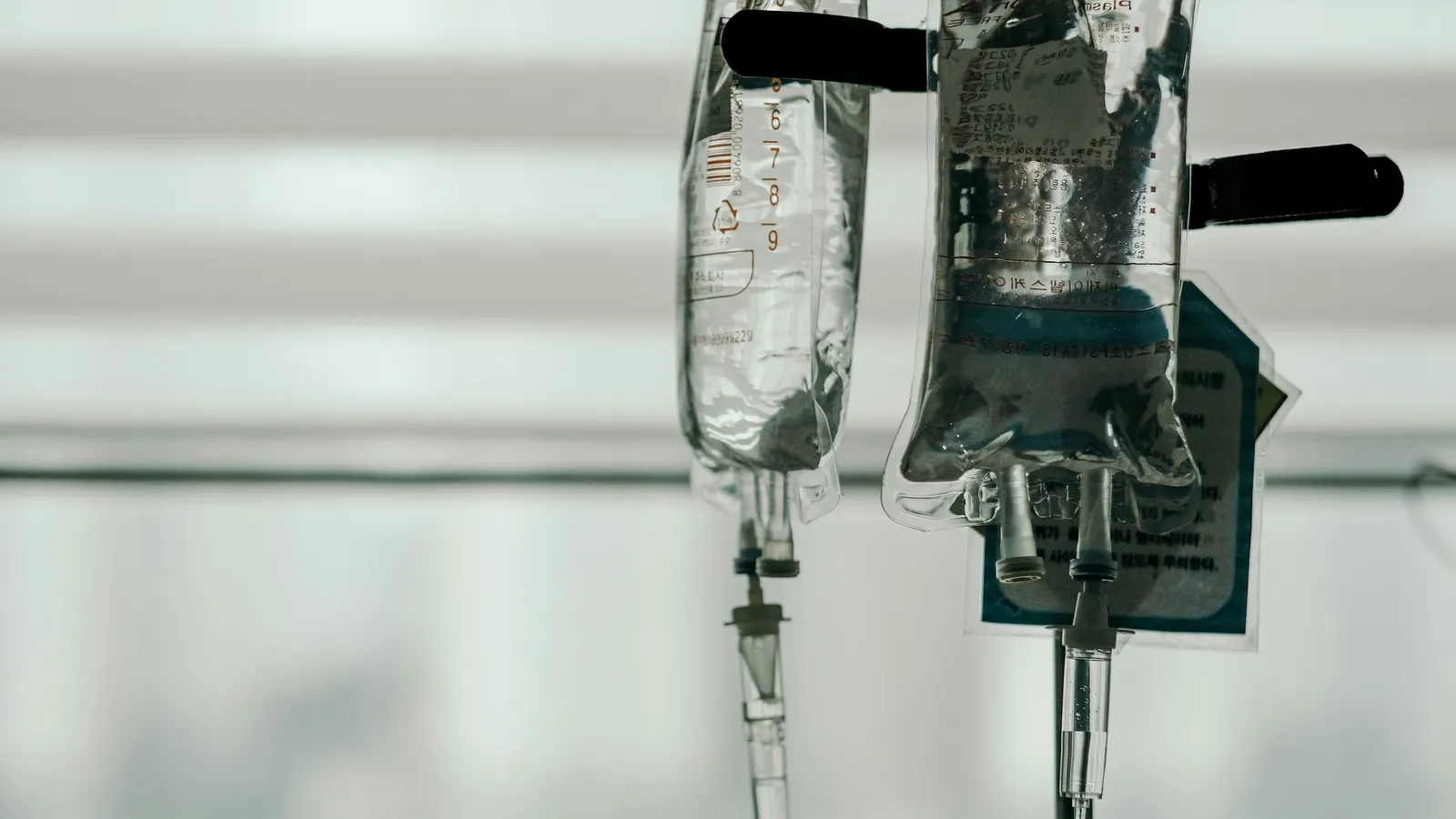
His report with Maxwell Mackelvie, Note on the value of large quantities of hypertonic salt solutions in transfusion for cholera (Indian Medical Gazette, May 1908), gives the reasoning. Cholera blood was so concentrated that its specific gravity could reach 1070 or more. The usual infusion was 0.625 per cent salt, and Rogers suspected that diluting the blood suddenly with this weak solution helped bring the watery stools straight back. After a colleague found that the salt content of Bengali patients' blood was nearer 1 per cent than 0.7, they raised the strength to 0.95 per cent and then to 1.25 per cent, "about two drachms to the pint", double the old strength. They also gave more: "We now generally inject four pints at a time."
Worked example: how much stronger was the new saline?
Osmotic effects depend on the number of dissolved particles, as our post on colligative properties explains.
A 0.625 per cent solution holds 0.625 g of NaCl per 100 mL, or 6.25 g per litre.
Moles per litre: 6.25 / 58.44 = 0.107 mol/L.
Each NaCl gives two ions (Na+ and Cl-), so the ideal particle concentration is about 2 x 0.107 = 0.214 osmol/L, or 214 mOsm/L.
For 1.25 per cent: 12.5 / 58.44 = 0.214 mol/L, so about 428 mOsm/L.
Doubling the percentage doubles the particle count. These are ideal values, but the comparison holds. A common mistake is to forget the factor of 2 for the two ions.
Did the stronger saline work?
The 1908 paper gives cholera deaths at the Medical College Hospital by period. In 1902-05, when transfusion was rare, the death rate was 61.2 per cent. In 1906-07, with normal saline, it fell to 48.7 per cent. Of the 72 patients treated after the 1.25 per cent solution was introduced in 1908, 27.8 per cent died: about 20 deaths and 52 recoveries.
Was the 1908 outbreak simply milder? Rogers checked the nearby Campbell Hospital, which had not changed its treatment. There, 63.2 per cent of 1,399 cases had died over six years, and the rate for early 1908 was 55 per cent, against 27.8 per cent at the Medical College. He concluded that mortality had been halved.
How did he decide how much fluid to give?
In 1912 he described a bedside test in The estimation of the specific gravity of the blood and its value in the treatment of cholera. He kept a row of small bottles of glycerine and water, each mixed to a known specific gravity from 1048 to 1070, with 1056 as normal. A drop of blood from a finger was released into a bottle: if it sank, the blood was denser than the mixture; if it rose, it was lighter. The bottle in which it hung in the middle gave the reading, in about two minutes. It is Archimedes' buoyancy at the bedside.
The reading guided the dose. At 1063, three pints were usually enough; above 1065 in an adult, up to five. Working in Palermo in 1911, he found that patients who collapsed later despite a safe-looking blood pressure on admission had all shown a reading of 1063 or more, so he advised the doctors there to transfuse such patients at once. They sent him notes on 56 severe cases treated this way: 48 recovered, about 86 per cent.
How did he test a new drug fairly?
In 1916 Rogers tested adding atropine injections to his treatment in a paper in the Indian Medical Gazette. He gave the drug to alternate patients, 100 with it and 100 without, and showed that both groups were similarly ill on admission. Deaths were 11 in the atropine group and 22 among the controls.
What came after Rogers?
A history of oral rehydration in Medical History (1994) describes intravenous therapy as something Rogers "advanced" and Robert A. Phillips "virtually perfected" in the late 1950s. Our profile of Dilip Mahalanabis tells the later story of oral rehydration. Today the WHO cholera fact sheet says most people can be treated with prompt oral rehydration salts, while severely dehydrated patients "need rapid intravenous fluids".
What can a student learn from how Rogers worked?
Question the standard dose. Rogers asked whether the usual saline matched the blood it replaced.
Find a fair comparison. He checked a second hospital in the same epidemic, and later used alternate patients as controls.
Turn a measurement into a decision. A two-minute density reading told a doctor how much fluid to give.
If osmosis still feels abstract, the Fermi Concept Library covers every concept in physics, chemistry, biology, mathematics and computing.
Try it now: work out the ideal osmolarity of a 0.95 per cent NaCl solution, the strength Rogers tried on the way to 1.25 per cent.


