On this page
Cervical cancer is one of the most common cancers affecting women, with 88% of cases in 2020 occurring in low- and middle-income countries. The disease is primarily caused by the human papillomavirus (HPV). However, creating a vaccine against HPV posed a massive challenge: the virus could not be cultured in a laboratory without living tissue, making it nearly impossible to study or weaken for a traditional vaccine.
Two researchers, Ian Frazer and Jian Zhou, solved this problem at the University of Queensland. They found a way to mimic the virus using virus-like particles (VLPs), laying the foundation for vaccines that now save thousands of lives every year. By 2025, an estimated 33% of girls aged 9–14 years worldwide had received at least one dose of the vaccine.
Who invented the HPV vaccine?
Ian Frazer, a Scottish-born immunologist, and Jian Zhou, a Chinese virologist, met during a sabbatical at the University of Cambridge in 1989. Bonded by a mutual willingness to push the limits of their research, Frazer convinced Zhou to join him at the University of Queensland in Australia in 1990.
Their goal was to develop a vaccine for HPV without needing the live virus. They turned to molecular biology, aiming to synthesize particles in a test tube that could mimic the virus's outer structure. In March 1991, following Zhou's instructions, his wife and fellow researcher Xiao-Yi Sun successfully assembled viral proteins into a virus-like particle. This breakthrough was the basic technology behind the modern HPV vaccine.
What are virus-like particles (VLPs)?
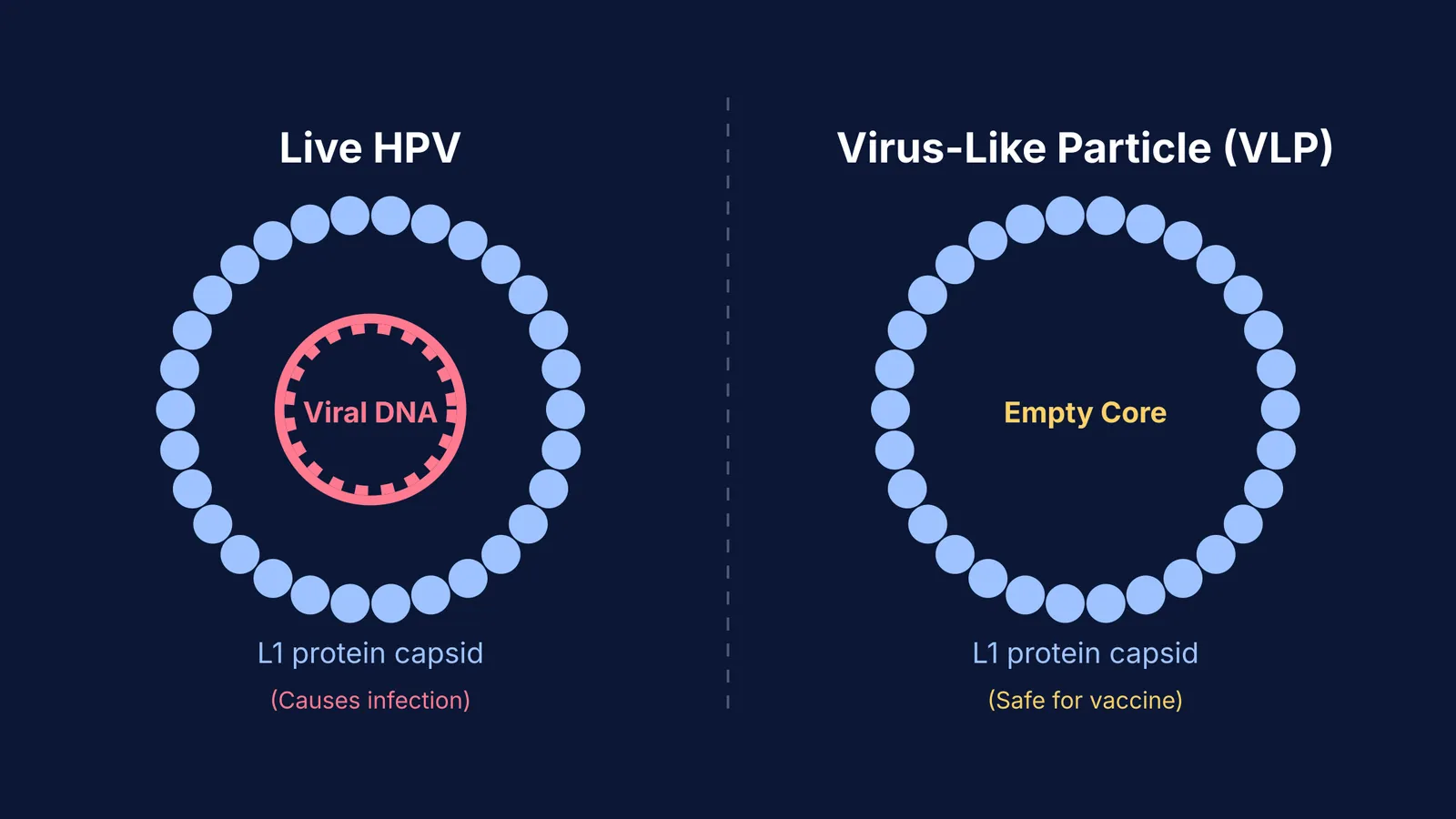
A natural virus consists of genetic material (DNA or RNA) wrapped in a protective protein shell called a capsid.
Virus-like particles (VLPs) are molecules that closely resemble viruses, but they are completely non-infectious because they contain no viral genetic material. They are essentially empty shells.
By expressing the structural proteins of a virus—such as the L1 protein of HPV—scientists can prompt these proteins to self-assemble into a VLP. Because they lack DNA, VLPs cannot replicate or cause disease. This makes them a much safer alternative to vaccines that use weakened live pathogens.
If you find it hard to picture how a protein shell forms without the genetic instructions inside, interactive tools can help. For instance, the Fermi Simulation Lab features interactive simulations for ideas that are easier to see than to read.
How does the HPV vaccine work?
The HPV vaccine uses VLPs to train the immune system. When the vaccine is injected, the body's immune cells encounter the VLPs. Because the exterior of a VLP is structurally identical to a real HPV virus, the immune system responds by producing specific antibodies against it. This targeted approach is part of humoral vs cell-mediated immunity, where antibodies stay in the bloodstream ready to clear the virus before it enters cells.
If the person is later exposed to the actual human papillomavirus, their immune system is already primed. The antibodies bind to the virus, neutralizing it before it can infect cells and cause the changes that lead to cervical cancer.
The original vaccines developed from Frazer and Zhou's work protect against HPV types 16 and 18, which are together responsible for approximately 70% of cervical cancer cases globally. The WHO recommends HPV vaccines as part of routine vaccinations, with a primary target population of girls aged 9–14 years before they become sexually active, aiming to prevent the initial infection from ever taking hold.
How do different types of vaccines compare?
When studying immunity and vaccines, it helps to classify them by how they expose the immune system to the pathogen. Other researchers have explored novel ways of training immunity to prevent pregnancy or disease, but traditional vaccines generally fall into these categories. You can use this checklist to compare them:
Live-attenuated vaccines: Use a weakened form of the germ (e.g., measles, mumps).
Inactivated vaccines: Use a killed version of the germ (e.g., rabies).
Toxoid vaccines: Use a toxin made by the germ (e.g., the diphtheria toxoid vaccine).
Subunit, recombinant, and VLP vaccines: Use specific pieces of the germ, such as a protein or an empty shell (e.g., the HPV vaccine).
By using the VLP method, Frazer and Zhou bypassed the dangers of the live virus entirely, turning an empty protein shell into a powerful shield against cancer.