On this page
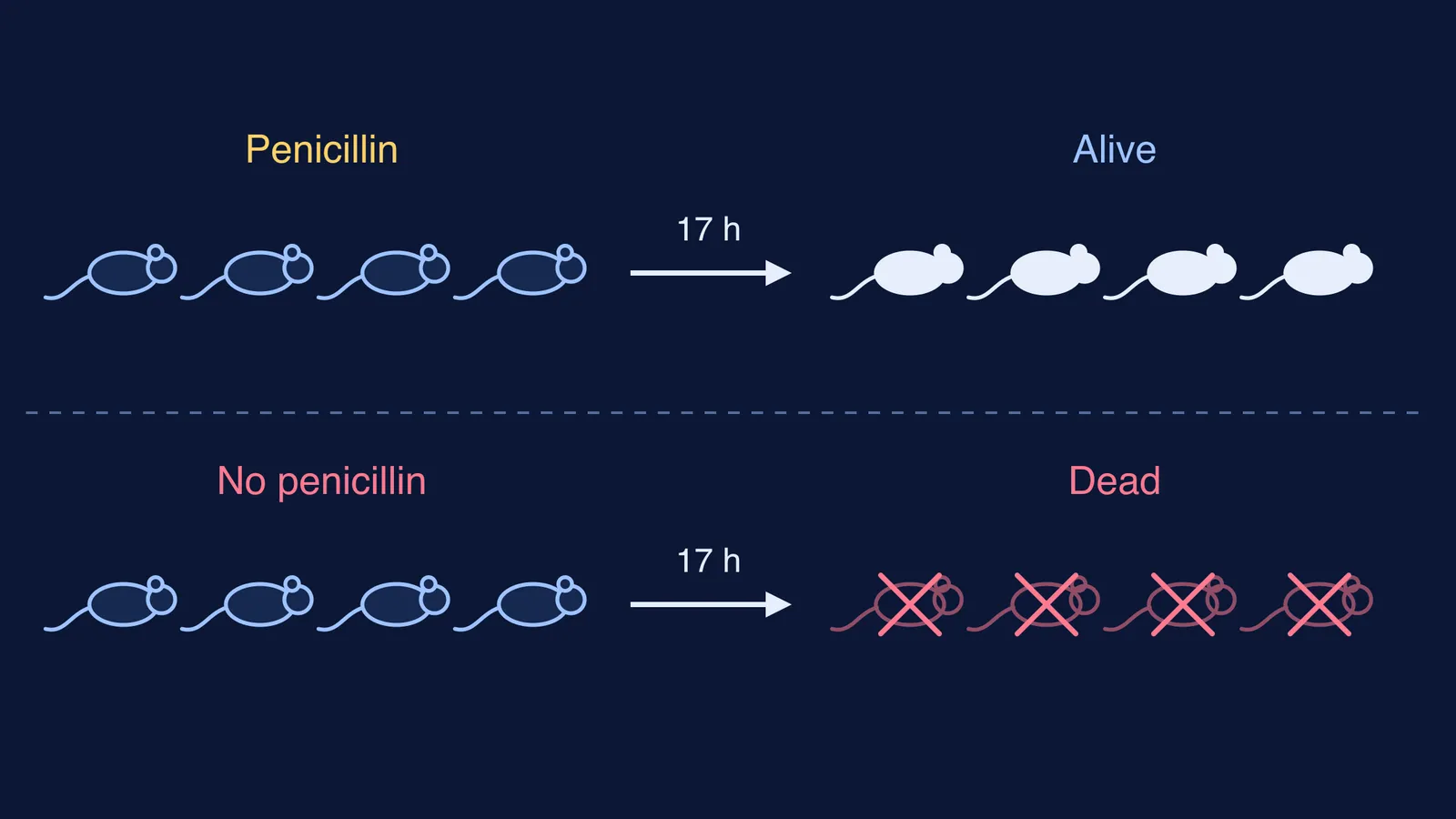
On Saturday 25 May 1940, Howard Florey infected eight mice with a lethal dose of the bacterium Streptococcus pyogenes, then injected four of them with penicillin and left the other four untreated (Hektoen International). By the next day the treated mice were well and the untreated ones were dead.
Norman Heatley, a member of Florey's team, stayed up to watch. His diary records: "I stayed at the lab until 3:45 a.m., by which time all four control animals were dead" (Understanding Animal Research).
Eight mice is a tiny experiment. It mattered because of how it was designed, and that design is the same one you use in a school practical.
What happened in the 1940 mouse experiment?
A 2017 review in the Yale Journal of Biology and Medicine sets out the details (Lobanovska and Pilla, 2017). Eight mice were injected with a fatal dose of Group A streptococcus. One hour later, two mice received a single 10 mg dose of penicillin, and two received 5 mg followed by further 5 mg doses over the next several hours. Four mice received no penicillin.
Seventeen hours after infection, all four untreated mice had died and all four treated mice had survived, according to the same review.
The Oxford team published its results in The Lancet in August 1940 as "Penicillin as a chemotherapeutic agent", with seven authors including Ernst Chain, Florey and Heatley (The Lancet, 1940).
How was the experiment set up, step by step?
Here is the design described in the 2017 Yale review, broken into steps.
Ask one question: can penicillin save an animal from an infection that would otherwise kill it?
Use one set of eight mice and split it into two groups of four.
Give every mouse the same challenge: a fatal dose of the same streptococcus.
Change one thing only: four mice get penicillin, four do not.
Choose an outcome nobody can argue about: alive or dead.
Watch both groups over the same time, through the night.
Compare the counts: four of four treated mice alive, none of four untreated mice alive.
The treated group even held a second, smaller question: whether one large dose or repeated small doses would work. At the 17-hour mark, mice on both schedules were alive.
Why does this count as a controlled trial?
A controlled trial compares a group that gets the treatment with a control group that is handled the same way but does not. The comparison is the whole point. For a fuller explanation with school examples, see our guide on why experiments need a control group in biology.
Imagine Florey had injected only the four treated mice. If they survived, a sceptic could say the dose of bacteria was never deadly, or that these mice were unusually tough. The four untreated mice close that gap: they got the same bacteria and died, so the infection was lethal (Hektoen International).
What could an eight-mouse test not show?
Sample size. With four animals per group in the Yale review's account, one unusual mouse could tilt a result. The split here was all or nothing, which is why it was persuasive.
How mice were assigned. The accounts above do not say how mice were picked for each group. Modern trials assign subjects at random so that no one's choice can bias the groups.
Mice are not people. Human testing came next. The Yale review reports that Florey, Heatley and Chain ran further clinical trials between 1941 and 1942 involving 170 patients (Lobanovska and Pilla, 2017).
Supply. Making enough penicillin was the real bottleneck, a story told in how Norman Heatley extracted penicillin with bedpans.
How can you use Florey's design in your own experiment?
Here is the same template applied to a test you can run at home or for a school project: does soaking moong seeds overnight make them sprout faster?
Question: does overnight soaking change how many seeds sprout in two days?
Subjects: take 20 seeds from one packet and split them into two groups of 10.
Same conditions: same tray, same tap water, same window, same start time.
One change: soak one group overnight; keep the other group dry overnight. The dry group is your control.
Outcome: count seeds with a visible root after 48 hours. Decide this before you start.
Compare: write the result as a count, such as "7 of 10 versus 3 of 10".
Repeat: run it again with fresh seeds before trusting a difference.
If your teacher asks why you needed the dry seeds, you can say: "My control group shows what happens without the change, so any difference comes from the soaking and not from the room, the water or the packet."
If terms like independent variable, dependent variable and control still blur together, the Fermi Concept Library has its own lesson for each concept in biology, chemistry and physics, so you can check the idea before you write up a practical.
To see where the story of penicillin began, read about Alexander Fleming and the discovery of penicillin.