On this page
Boyle's law says that for a fixed amount of gas at a fixed temperature, pressure times volume stays constant: PV = k (Boyle's law, Wikipedia). For about two centuries after Robert Boyle found his gas law, nobody measured gases well enough to see it fail. Then a French experimenter measured them carefully enough to show it is only approximate.
Who was Henri Victor Regnault?
Henri Victor Regnault was born in Aix-la-Chapelle (now Aachen) on 21 July 1810 and died in Paris on 19 January 1878 (Wikipedia). He became professor of physics at the Collège de France in 1841, and in the late 1840s he mentored the young William Thomson, later Lord Kelvin.
The 1911 Encyclopaedia Britannica says he redetermined the specific heats of many substances, put the expansion coefficient of air at 0.003665 per degree, and proved that Boyle's law is only approximately true, with the most easily liquefied gases straying furthest (1911 Britannica entry).
What did Regnault find about Boyle's law?
Nobody saw departures from Boyle's and Gay-Lussac's laws until after 1840, when Regnault began his long series of careful experiments on gases (de Oliveira, Revista Brasileira de Ensino de Física, 2019). A generation later James Clerk Maxwell summed up the result: "The measurements of Regnault and others show that as the pressure increases the volume diminishes faster than that of a gas which obeys the law of Boyle" (Maxwell, Theory of Heat/Chapter_6)). Put simply, squeeze a real gas hard and it shrinks a little more than PV = k predicts.
Regnault didn't throw the laws away. De Oliveira writes that in his 1842 report Regnault argued the laws should stay in science because they hold in the limit of very dilute gas, where the deviations become negligible. That is how you still use the ideal gas law: for thin, low-pressure gas.
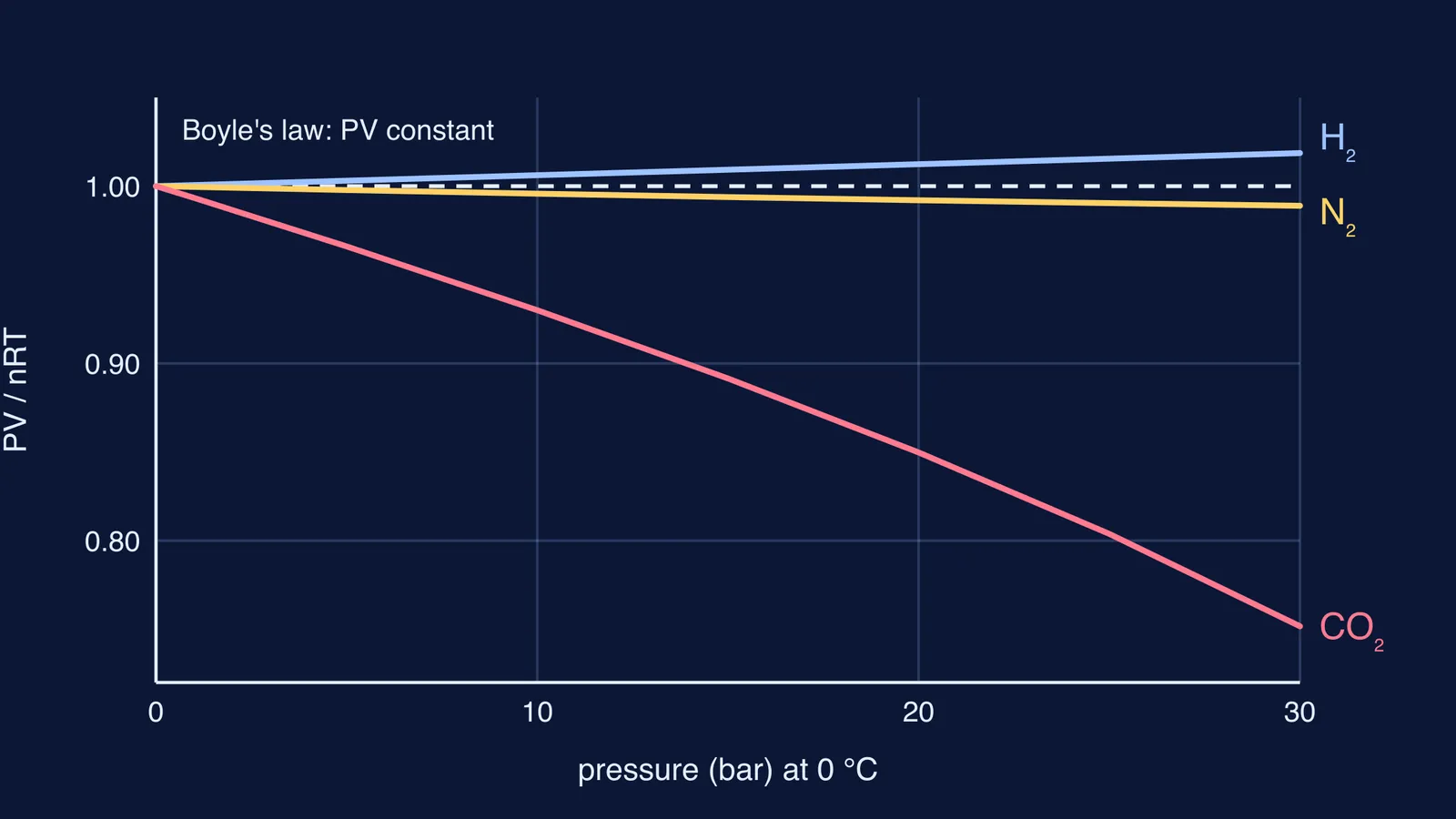
Modern reference data show the same pattern. In the NIST Chemistry WebBook tables at 0 °C, PV/nRT for carbon dioxide drops to about 0.93 at 10 bar. At that pressure nitrogen stays within 0.5% of 1, and hydrogen rises slightly above 1, the opposite way. The chart at the top plots these curves. For why they bend, read our piece on Johannes van der Waals and real gases.
How did Regnault measure the specific heat of gases accurately?
A gas sample is light and carries little heat, so Regnault used a flow method. Gas from a large storage cylinder ran at constant pressure through coiled copper tubes. The first coil sat in a hot bath. The warm gas then passed through another coil inside a small copper calorimeter of cold water (Tatum, Heat and Thermodynamics, LibreTexts/18:_Experimental_Measurements/18.06:_Specific_Heat_Capacities_of_Gases)). From how much the gas cooled and the water warmed, he worked out the specific heat at constant pressure. Tatum notes that the idea was simple, but carrying it out "required an experimental skill of the very highest order."
From his 1853 measurements, Regnault put the specific heat of air at 0.2379 cal/g°C, against 0.2669 from the earlier work of Delaroche and Bérard (de Oliveira, 2019). He also found that the specific heats of air and hydrogen did not change with temperature, testing air from −30 to 200 °C.
Worked example: how wrong was the older value?
Today the specific heat of dry air at 0 °C is listed as 1.006 kJ/kg K (Engineering ToolBox). One thermochemical calorie is exactly 4.184 J (NIST SP 811), so that works out to 1.006 ÷ 4.184 ≈ 0.2404 cal/g°C.
Using the historical values from de Oliveira:
Delaroche and Bérard: (0.2669 − 0.2404) ÷ 0.2404 ≈ +11%.
Regnault: (0.2379 − 0.2404) ÷ 0.2404 ≈ −1.0%.
Comparison: Regnault's error is about one tenth of the older one. Older heat units differ slightly from today's, so treat the last digit loosely.
What is the lesson on experimental error?
Comparing gas thermometers filled with different permanent gases, Regnault found the differences in their scales "so small as to be beyond the limits of accuracy of his observations" (1911 Britannica, Thermometry). He did not claim a difference his apparatus could not resolve. Use this checklist for your next practical:
State your limit. Before claiming two readings differ, check that the gap is bigger than your uncertainty.
Look for bias, not just scatter. An error that repeats in every trial isn't random: something in the method pushes every reading the same way. See our guide to accuracy, precision, random and systematic error.
Make a small effect bigger. A flow method lets a steady stream of gas deliver far more heat than one small sample could. It's the same reason you time 20 swings of a pendulum, not one.
Know a law's range. Boyle's law works well for dilute gases. Say when you are outside that range.
If error calculations keep tripping you up, the Fermi Problem Library has worked problems with a step-by-step solver that explains the reasoning rather than printing an answer. For ideas that are easier to see than to read, the Fermi Simulation Lab has interactive simulations.
Next time you write "human error" in a lab record, do what Regnault did instead: name the error, estimate its size, and say what would shrink it.