On this page
Johannes Diderik van der Waals did not take the usual road into physics. Born in Leiden on 23 November 1837, he became a schoolteacher, and because he knew no Latin or Greek he was not allowed to sit university examinations, says his Nobel Prize biography. He studied at Leiden University in his spare time while teaching, and only took a doctorate after a new law excused science students from the classical-language rule.
Who discovered the van der Waals equation?
Van der Waals did, in his 1873 thesis, *On the continuity of the gas and liquid state*. It set out one equation of state for gases and liquids and showed the two states merge smoothly into each other (Nobel biography). The biography names two sparks: Rudolf Clausius's treatment of heat as molecular motion, and Thomas Andrews's 1869 experiments revealing "critical temperatures" in gases, a story told in our post on how Thomas Andrews found the critical temperature.
His key step was to account for two things the ideal gas law ignores: the volume of the molecules themselves, and the forces between them, now called van der Waals forces.
James Clerk Maxwell wrote in Nature "that there can be no doubt that the name of Van der Waals will soon be among the foremost in molecular science" (quoted in the Nobel biography). In 1876 van der Waals became the first Professor of Physics at the new University of Amsterdam, and in 1910 he received the Nobel Prize in Physics "for his work on the equation of state for gases and liquids" (Nobel Prize facts).
What do a and b mean in the van der Waals equation?
For one mole of gas, the van der Waals equation is (P + a/Vm²)(Vm − b) = RT, where Vm is the molar volume (ChemEnggCalc). For n moles it becomes (P + an²/V²)(V − nb) = nRT.
b is the excluded volume. Molecules are not points, so they have less free space than the container's volume. This correction pushes pressure up.
a is the attraction. A molecule about to hit the wall is tugged back by its neighbours, so it hits more softly. This correction pulls pressure down.
The size of a tracks how sticky a gas is. In the LibreTexts table of van der Waals constants, helium has a = 0.0346 bar L² mol⁻², while water has 5.537.
How wrong is the ideal gas law? A worked example with CO2
Take 1 mol of carbon dioxide in a 0.5 L cylinder at 300 K. The LibreTexts table gives a = 3.658 bar L² mol⁻² and b = 0.04286 L mol⁻¹ for CO2. Use R = 0.08314 L bar K⁻¹ mol⁻¹, so RT = 24.94 L bar mol⁻¹.
Ideal gas law: P = RT/V = 24.94 / 0.5 = 49.9 bar.
Size correction alone: RT/(V − b) = 24.94 / 0.4571 = 54.56 bar. Higher: less free space.
Attraction correction: a/V² = 3.658 / 0.25 = 14.63 bar.
Van der Waals: P = 54.56 − 14.63 = 39.9 bar.
The ideal gas law overestimates by about 10 bar, roughly 25%. Attraction wins because the gas is dense and just below its critical temperature.
The same two constants give the critical point, as our guide to critical temperature from a and b explains. With Tc = 8a/27Rb and Pc = a/27b² (ChemEnggCalc), CO2 comes out at about 304 K and 73.8 bar. The NIST Chemistry WebBook lists measured values of 304.2 K and 73.8 bar.
Why did the van der Waals equation matter so much?
In 1880 van der Waals added the law of corresponding states: express pressure, volume and temperature as fractions of their critical values, and one equation fits every substance. The Nobel biography says this law guided the liquefaction of hydrogen (James Dewar, 1898) and helium (Heike Kamerlingh Onnes, 1908). Kamerlingh Onnes wrote that van der Waals' studies "have always been considered as a magic wand for carrying out experiments".
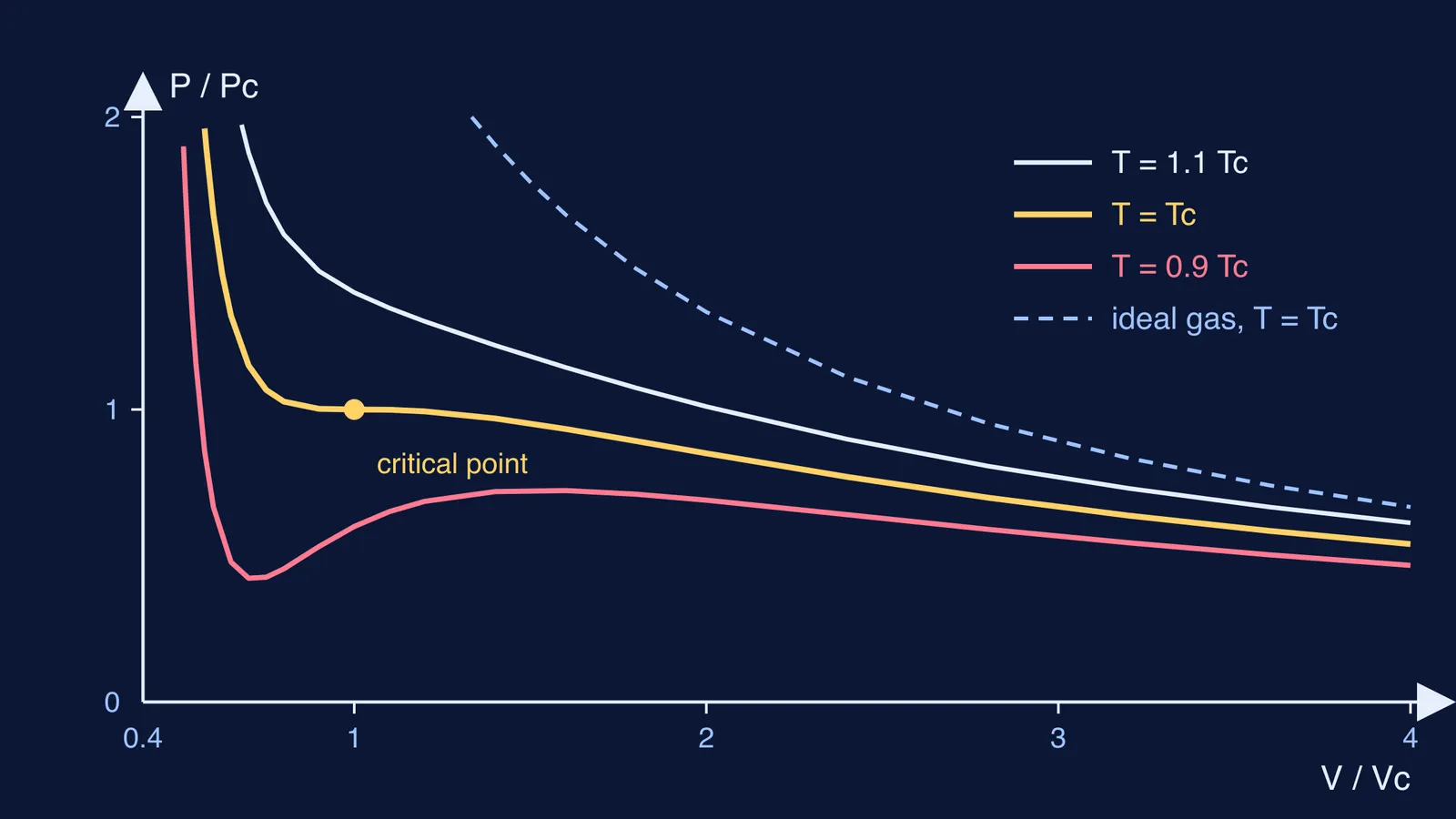
For the syllabus, see our guide to real gases and the van der Waals equation. If the isotherms in the diagram above are hard to picture, the Fermi Simulation Lab has interactive simulations for ideas that are easier to see than to read.
How do you solve van der Waals numericals without mistakes?
Check four things every time:
Match units to R. a in bar L² mol⁻² and b in L mol⁻¹ go with R = 0.08314; SI units go with R = 8.314.
Square n with a, not b. The terms are an²/V² and nb.
Work out the two corrections separately, as in the CO2 example, to see which way each pushes.
Compare with the ideal answer. If a cold, dense gas comes out above the ideal value, look for a slipped decimal.
If you keep picking the wrong method on gas problems, the Fermi Problem Library has worked problems with a step-by-step solver that explains the reasoning rather than printing an answer.
Next time you write a/V² in an exam, remember it began as a schoolteacher's thesis, written in Dutch.