On this page
In August 1931, two botanists at Cornell University published a six-page paper that answered one of genetics' big open questions. Harriet Creighton and Barbara McClintock's paper in the Proceedings of the National Academy of Sciences, "A Correlation of Cytological and Genetical Crossing-Over in Zea Mays", showed that when genes get reshuffled between generations, the chromosomes carrying them have actually swapped pieces. It turned the textbook crossing-over diagram from a good guess into something seen.
Who was Harriet Creighton?
Harriet Baldwin Creighton was born in Illinois on 27 June 1909, according to Encyclopedia.com's profile of her. She graduated from Wellesley College in 1929 and joined Cornell that year as a botany graduate student, so when the paper appeared she was 22 and still a student. In 1940 she returned to Wellesley as an associate professor of botany.
At Cornell she met Barbara McClintock, and the two "worked together to show that chromosomal crossovers occur in corn chromosomes", as the DNA from the Beginning biography of McClintock puts it. McClintock went on to win an unshared Nobel Prize in Physiology or Medicine in 1983, which we cover in our post on Barbara McClintock and jumping genes.
What problem were they trying to solve?
By 1931, geneticists working with fruit flies had built gene maps by counting how often two traits were inherited apart, the method behind Alfred Sturtevant's first gene map. The explanation was that paired chromosomes break and rejoin, swapping segments. But all of that was inferred from counting offspring. What was missing was direct evidence that a new combination of traits came with a visibly new chromosome.
The problem is that two partner chromosomes usually look identical under a microscope. If they swap equal pieces, nothing visible changes. Creighton and McClintock needed partners that looked different at both ends.
How did they mark the chromosome?
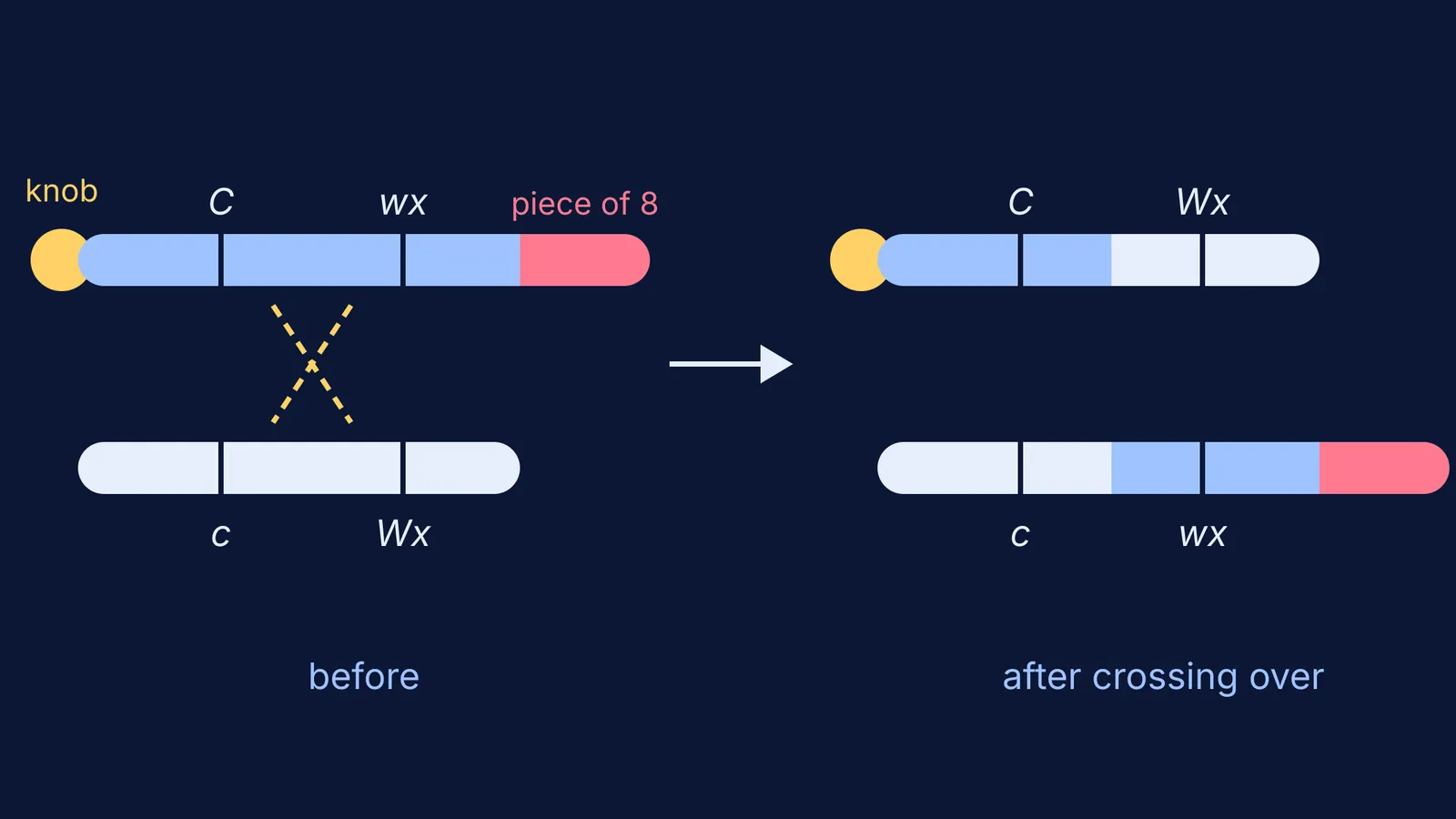
They used a maize strain whose chromosome 9 carried two visible tags, as described in their 1931 paper and explained on Kimball's Biology Pages:
a knob at one end
an extra piece of chromosome 8 attached to the other end, left over from an earlier exchange between chromosomes
The partner chromosome 9 in the same plant looked normal: no knob, no extra piece.
Then they used two genes on chromosome 9 that show up in the corn kernel itself. The marked chromosome carried C (coloured kernel) and wx (waxy starch). The normal one carried c (colourless) and Wx (ordinary starch).
How did Creighton prove crossing over is physical?
The tagged plant was crossed with a plant that had normal-looking chromosomes carrying the recessive c and wx genes. Each kernel's traits then reveal which chromosome 9 it got from the tagged parent.
Parental types were coloured and waxy, or colourless with ordinary starch. The important ones were the recombinants. When Creighton and McClintock looked at the chromosomes of plants grown from these kernels, the Biology Pages summary explains, the tags had been reshuffled too:
Coloured, ordinary-starch offspring had a chromosome with the knob but a normal end, with no chromosome 8 piece.
Colourless, waxy offspring had a chromosome with the chromosome 8 piece but no knob.
The only way to get a knob and a normal end on one chromosome is for the two partners to have broken and rejoined between the genes. The gene swap and the visible swap went together. That is what the title of their paper means by a "correlation of cytological and genetical crossing-over".
How do you explain this experiment in an exam answer?
If a question asks for evidence that crossing over involves physical exchange, use this five-step answer:
State the claim: genetic recombination comes from homologous chromosomes physically exchanging segments.
Name the system: maize chromosome 9, Creighton and McClintock, 1931.
Give both marker types: visible (knob at one end, chromosome 8 piece at the other) and genetic (C/c kernel colour, Wx/wx starch).
Describe the result: recombinant kernels carried recombinant chromosomes, knob with a normal end or chromosome 8 piece with no knob.
Conclude: the gene swap matched a visible swap, so crossing over is physical.
Test yourself: cover the diagram above and draw both "after" chromosomes from memory, labelling the genes. If you can't say why a coloured, waxy kernel tells you nothing new, revise the difference between parental and recombinant types in our guide to linkage and crossing over.
Why does it still matter?
The design is the lesson: give something you cannot see (a gene) a partner you can see (a knob), then check whether they move together.
If breakage and rejoining is hard to picture from a flat textbook figure, Fermi's AI tutor can draw the figure and check your understanding as it goes. If the shaky part is the background, such as homologous chromosomes or meiosis, the Fermi Concept Library gives each concept its own lesson and its place in the map.