On this page
A lighthouse on a lonely reef has one job: shine at night and never fail. More than a century ago, an unattended gas light needed regular inspection, and unless something switched it off, it burned by day as well as by night. The Swedish engineer Gustaf Dalén cut that waste with a valve that needed no clock, no electricity and no person. It read the sunlight directly.
Who was Gustaf Dalén?
Nils Gustaf Dalén was born at Stenstorp, Sweden, on 30 November 1869, the son of a farmer, according to his official Nobel Prize biography. He first studied dairy farming, until the inventor Gustaf de Laval noticed his gift for mechanics and advised him to get a technical education. He graduated as an engineer from the Chalmers Institute in Gothenburg in 1896.
From 1901 he worked on acetylene lighting, and in 1909 he became managing director of AGA (Swedish Gas Accumulator Ltd), the same biography says. He won the 1912 Nobel Prize in Physics "for his invention of automatic regulators for use in conjunction with gas accumulators for illuminating lighthouses and buoys". That year, an explosion while he was testing safety devices on acetylene cylinders cost him his eyesight. He recovered from his other injuries and carried on with his research. He died on 9 December 1937.
How did Dalén's sun valve work?
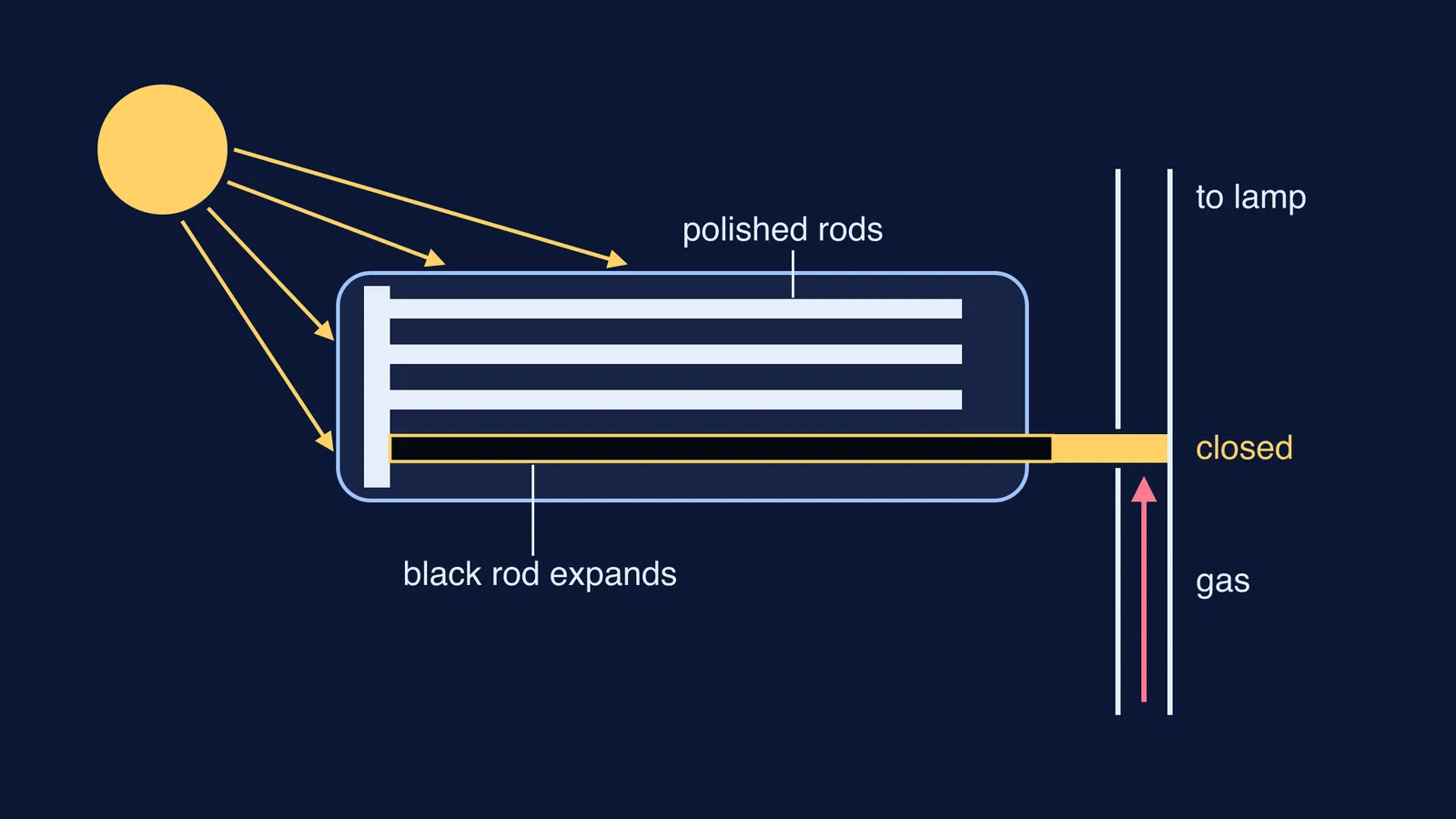
The clearest description comes from the 1912 Nobel award ceremony speech. In 1907 Dalén designed a "solar valve" that put the light out at sunrise and relit it at nightfall. Inside a glass tube sat four metal rods: the lower one blackened, the other three gilded and highly polished.
Here is the sequence, following the speech:
In daylight, the black rod absorbs light and warms up. The shiny rods reflect most of it and stay cooler.
The warmer black rod expands more than the others. That small difference in length pushes the gas valve shut.
As daylight fades, the black rod cools to the temperature of the other three, contracts and lets the valve reopen.
Gas flows to the burner again, where a small permanent flame lights it.
Two pieces of school physics do all the work. Dark surfaces absorb radiation better than shiny ones, the idea behind why good absorbers of heat are also good emitters. And metals get longer when they warm, which you meet in thermal expansion problems. The polished rods matter too. The valve reopens when the black rod reaches the temperature of the other three, so what moves it is the difference between black and shiny, not the temperature of one rod on its own.
How much gas did the sun valve save?
The sun valve worked with Dalén's flashing device. According to the ceremony speech, the usual setting gave a flash lasting 3/10 of a second every three seconds. The same speech says the solar valve combined with an intermittent light saved 93 per cent of the gas.
You can check the size of that number yourself. This is our rough estimate, not Dalén's calculation:
Flashing alone: the main flame burns 0.3 s out of every 3 s, so 0.3 ÷ 3 = 10% of the time.
Sun valve: suppose night is about half of the day. Then the light runs only half the hours, so 10% × 0.5 = 5% of a full day of steady burning.
So the main flame would use roughly 95% less gas. Our sketch ignores the small permanent flame, which burns all the time, and the hours when mist or clouds switch the light on in daytime, so it is no surprise the real figure, 93%, is a little lower.
The speech also gives the practical payoff. With portable gas cylinders, AGA lights could signal for a whole year or more without inspection. One Swedish shoal had needed a lightship costing about 200,000 kronor, plus about 25,000 kronor a year to run. In many cases, an AGA buoy costing 9,000 kronor, with about 60 kronor a year of maintenance, could now do the job.
What can you learn from the sun valve?
Dalén's valve is a good model for studying any invention. When you meet a device in a chapter or a JEE question, ask these four questions:
What is being wasted? Here, gas burned in daylight.
What physical difference can a device sense? Here, how much light a black surface and a shiny surface absorb.
How does that difference become motion? Unequal thermal expansion of the rods.
What happens when it is unsure? It fails towards light.
Try the same four questions on a bimetallic thermostat or a fire sprinkler. If you can't answer question 2 or 3, you've found a concept gap. You can look up each idea, such as absorption or linear expansion, as its own lesson in the Fermi Concept Library. If expansion is hard to picture, the Fermi Simulation Lab has interactive simulations for ideas that are easier to see than to read.
Next, read how Augustin Fresnel designed the lighthouse lens.