

On this page
When oxygen runs short, your body makes more of the hormone erythropoietin (EPO), and EPO drives the production of red blood cells. How that process was itself controlled by oxygen long remained a mystery (Nobel Prize press release). Gregg Semenza, a paediatric geneticist, found the protein complex that flips the switch (Journal of Clinical Investigation), and shared the 2019 Nobel Prize in Physiology or Medicine for it.
Who is Gregg Semenza and what did he discover?
The 2019 prize went jointly to William G. Kaelin Jr, Sir Peter J. Ratcliffe and Gregg L. Semenza "for their discoveries of how cells sense and adapt to oxygen availability" (Nobel Prize press release).
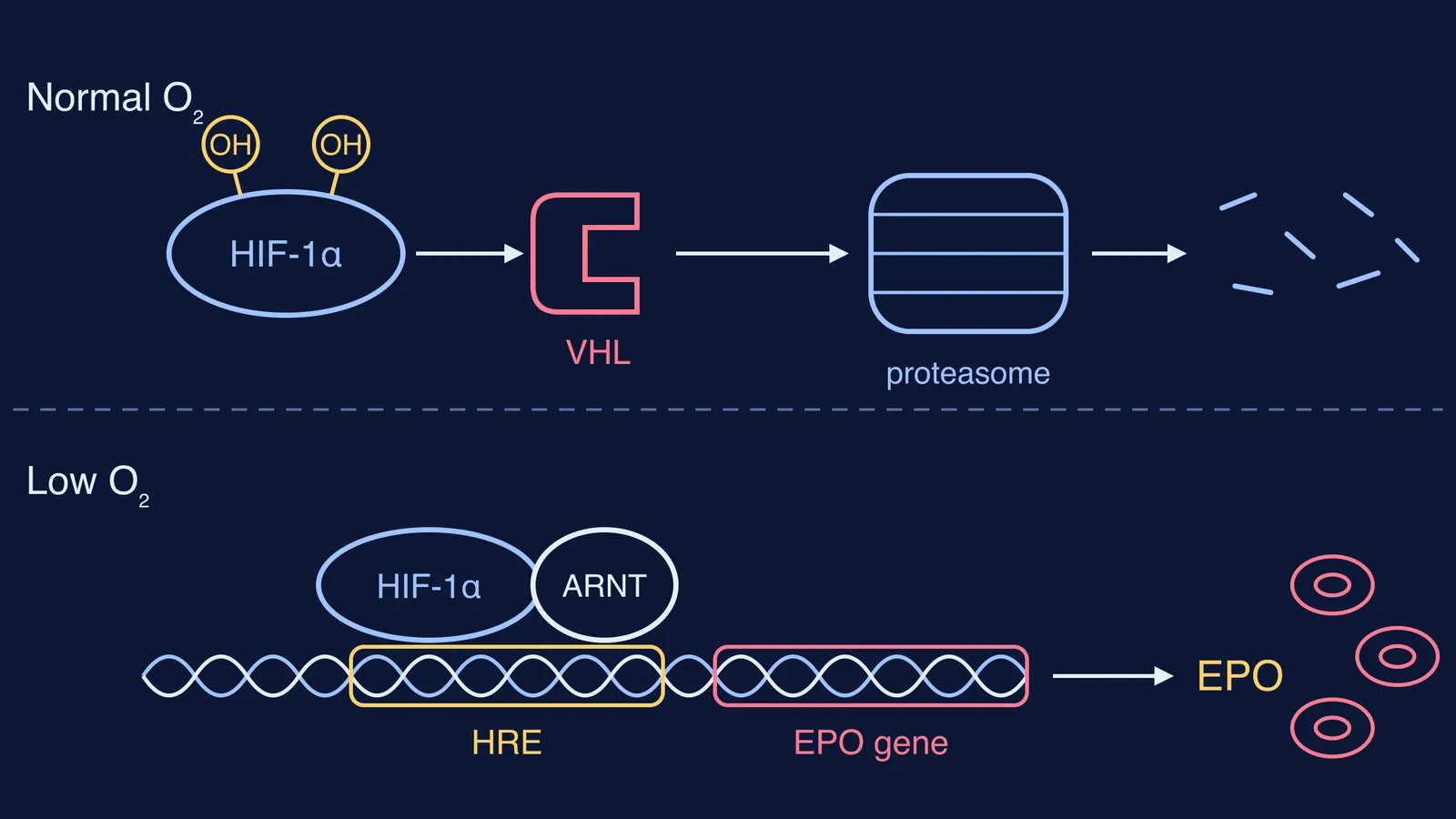
Working with cultured liver cells, Semenza found a protein complex that binds DNA next to the EPO gene in an oxygen-dependent way, and named it hypoxia-inducible factor, or HIF. Hypoxia means too little oxygen. The DNA site it binds is called the hypoxia-response element, or HRE (Journal of Clinical Investigation).
How does HIF switch on genes when oxygen is low?
The discovery came in three papers you can still read.
In 1991, Semenza's group showed that a 256-base-pair stretch of DNA just downstream of the human EPO gene works as a hypoxia-inducible enhancer (PNAS, 1991).
In 1992, Semenza and Guang Wang narrowed it to a 50-nucleotide enhancer that gave a sevenfold rise in a test gene's activity under hypoxia (Molecular and Cellular Biology, 1992).
In 1995, Semenza's group showed HIF-1 is made of two proteins, HIF-1α and HIF-1β (also called ARNT), whose levels rose in cells kept at 1% oxygen and fell quickly when the cells were returned to 20% oxygen (PNAS, 1995).
Semenza's and Ratcliffe's groups found this oxygen-sensing machinery in virtually all tissues, not only the kidney cells that make EPO (Nobel Prize press release). HIF-1 also switches on VEGF, which helps grow blood vessels, and genes for glycolysis (JCI).
Why does HIF-1α vanish when oxygen is normal?
The switch turns on not by making more HIF-1α but by no longer destroying it. At normal oxygen, the cell's proteasome rapidly breaks HIF-1α down (Nobel Prize press release).
In 2001 the labs of Kaelin and Ratcliffe showed how. When oxygen is present, enzymes called prolyl hydroxylases add a hydroxyl (OH) group to a proline in HIF-1α, and only then can the VHL protein grab it and mark it for destruction (Ivan et al., Science, 2001; Jaakkola et al., Science, 2001). The enzyme needs oxygen itself as a raw material, so it acts as the cell's oxygen meter.
What happens to HIF at high altitude?
A study of 22 men from sea level who travelled from Lima (150 m) to Cerro de Pasco (4,340 m) in Peru found their EPO rose significantly by 24 hours and peaked at 48 hours, while young red blood cells kept increasing to the end of the 72-hour stay (High Altitude Medicine and Biology, 2020). Our explainer on why athletes train at high altitude follows that boost further.
People whose ancestors lived high for generations carry traces of this machinery in their genes. Two 2010 studies of Tibetans both pointed to the gene for HIF-2α, a relative of HIF-1α linked to red blood cell production (Yi et al., Science, 2010; Simonson et al., Science, 2010).
This is background science, not travel or medical advice. For how altitude sickness was first traced to thin air, read about Paul Bert and altitude oxygen.
How do you write the HIF pathway in an exam answer?
A strong answer is a chain where each step causes the next. Learn this six-step version.
Oxygen falls (altitude, anaemia, hard exercise).
Prolyl hydroxylases cannot add OH to HIF-1α.
VHL cannot recognise HIF-1α, so it is not destroyed.
HIF-1α builds up in the nucleus and pairs with ARNT.
The pair binds the HRE beside target genes such as EPO.
More EPO from the kidney leads to more red blood cells.
Then test yourself with three "what if" questions, working each one through the chain:
What if VHL is missing? HIF-1α is not destroyed, so oxygen-regulated genes stay on even at normal oxygen. Kaelin saw this in cancer cells lacking VHL (Nobel Prize press release).
What if the hydroxylase is blocked? By step 2, the cell behaves as if oxygen were low.
What if ARNT is missing? Step 4 fails, so HIF-1α has no partner to bind the HRE.
If step 6 feels fuzzy, see how EPO fits with other hormones in our guide to ANF and erythropoietin.
If transcription factors and enhancers are the shaky part, the Fermi Concept Library gives each biology concept its own lesson and its place in the map. If you would rather talk the chain through, Fermi's AI tutor can ask you each "what if" in turn and notice where you get stuck.


