

On this page
When long-distance runners, cyclists, and national squads seek a competitive edge, they head into the mountains. In India, elite athletes train at the Netaji Subhash High Altitude Training Centre at Shilaroo in Himachal Pradesh, located roughly 2,500 metres above sea level. Many people assume mountain air contains a lower percentage of oxygen. In reality, oxygen makes up roughly 20.9% of the atmosphere whether you stand in Mumbai or on a Himalayan ridge.
What changes is total atmospheric pressure. At sea level, barometric pressure is roughly 760 mmHg, giving an ambient oxygen partial pressure of about 159 mmHg. At 2,500 metres, barometric pressure drops, pulling ambient oxygen partial pressure down with it (StatPearls). This lower pressure reduces the gradient driving oxygen across alveolar membranes into pulmonary capillaries.
How does the human body sense and adapt to hypoxia?
The body responds to hypoxia in two phases. The immediate reflex is hyperventilation: breathing faster increases alveolar oxygen intake, though expelling carbon dioxide temporarily causes mild respiratory alkalosis until the kidneys excrete bicarbonate.
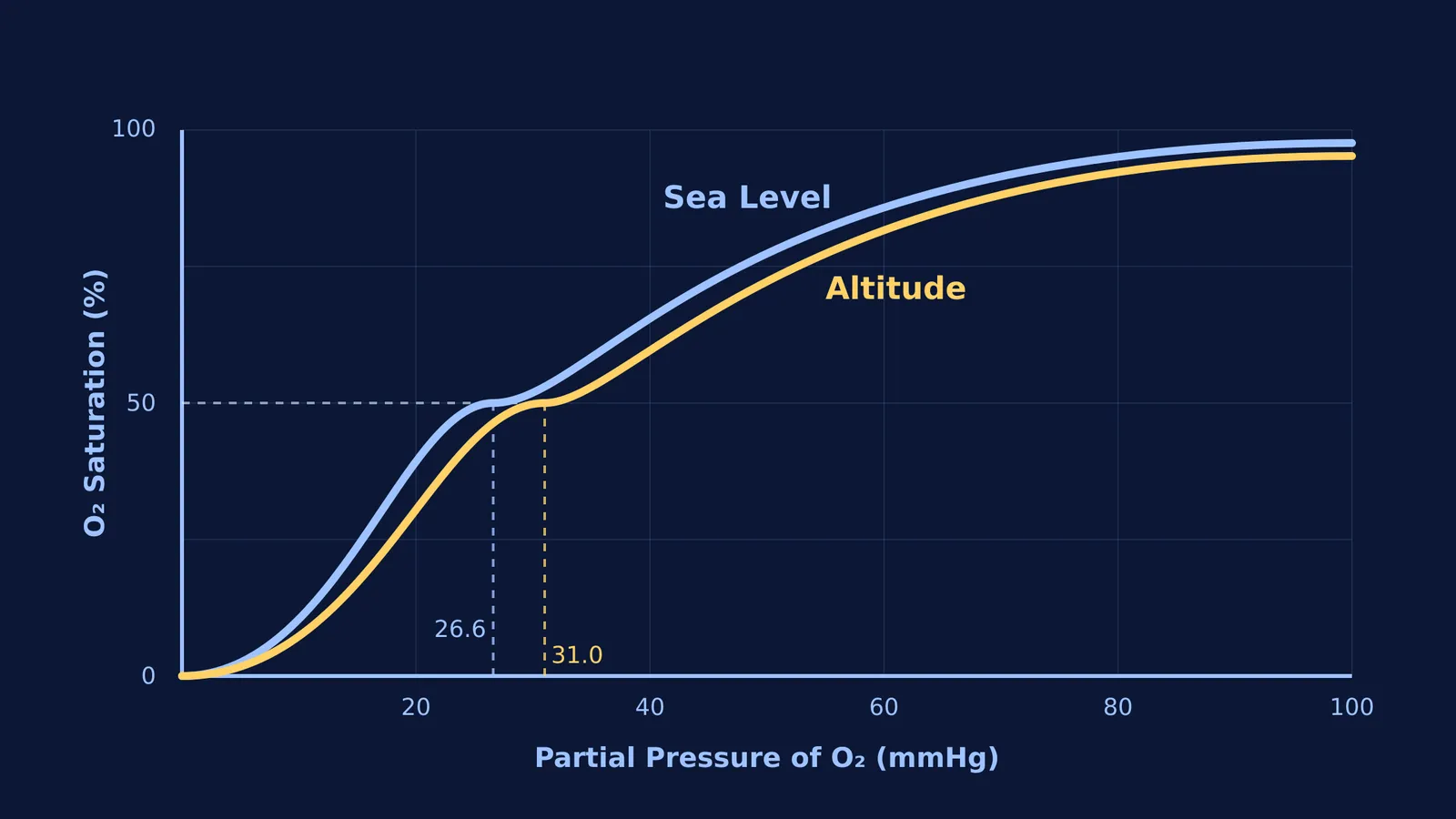
Simultaneously, red blood cells adjust how readily they release oxygen. In a 1968 study in *The Journal of Clinical Investigation*, Dr. Claude Lenfant and colleagues (Lenfant et al., 1968) showed that acute altitude exposure raises 2,3-bisphosphoglycerate (2,3-BPG) levels in erythrocytes within 24 hours. Elevated 2,3-BPG shifts the oxygen-hemoglobin dissociation curve to the right, lifting the P50—the partial pressure required for 50% saturation—from roughly 26.6 mmHg to 31.0 mmHg. This shift enables working muscles to unload oxygen more easily at tissue capillaries, working in tandem with August Krogh's work on capillaries.
If visualising how gas pressures drop across altitude gradients feels abstract on paper, the Fermi Simulation Lab provides interactive simulations for the ideas that are easier to see than to read.
Why does altitude trigger more red blood cells?
Longer acclimatisation relies on manufacturing more erythrocytes. Peritubular cells in the kidneys continually gauge oxygen levels. When oxygen is abundant, prolyl hydroxylase enzymes tag hypoxia-inducible factor 1-alpha (HIF-1α) so the von Hippel-Lindau protein marks it for destruction—a sensory mechanism detailed in the 2019 Nobel Prize in Physiology or Medicine.
In hypoxic air, prolyl hydroxylase slows down. HIF-1α accumulates, translocates to the cell nucleus, and triggers the transcription of erythropoietin (EPO). Erythropoietin circulates to bone marrow, stimulating erythropoiesis to generate mature red blood cells. This process links the study of formed elements of blood directly to systemic transport in body fluids and circulation.
What is the live-high, train-low strategy?
Training exclusively at altitude presents an obstacle: thin air prevents athletes from hitting their maximum race velocity, risking neuromuscular detraining over time.
To resolve this conflict, Dr. Benjamin D. Levine and Dr. James Stray-Gundersen tested 39 collegiate runners in a four-week study in the *Journal of Applied Physiology* (Levine & Stray-Gundersen, 1997). Runners living at 2,500 metres and training low at 1,250 metres were compared with sea-level and altitude-only training groups. Both altitude groups increased red cell volume by 9% and raised maximal oxygen uptake (VO2 max) by 5%. However, only the live-high, train-low athletes improved sea-level 5,000-metre race times, clipping an average of 13.4 seconds. Resting at altitude triggered red cell growth, while training lower preserved muscle speed.
How can NEET students solve altitude adaptation questions?
Altitude physiology is a staple of competitive examinations like NEET-UG. Use this four-point framework:
Check the gas physics: Atmospheric oxygen remains 20.9%; the physiological trigger is the decline in barometric pressure and partial pressure, not a lower oxygen fraction.
Trace the endocrine axis: Low renal oxygenation stabilizes HIF-1α, causing peritubular cells to release erythropoietin, which stimulates bone marrow erythropoiesis.
Separate acute from chronic responses: Acute changes include hyperventilation and a 2,3-BPG right-shift; chronic adaptations produce higher hematocrit and total red cell mass.
Watch the affinity trap: Exam options frequently claim hemoglobin affinity increases at altitude. In fact, affinity decreases acutely (P50 rises) to facilitate tissue unloading.
To connect these physiological steps with the broader syllabus—from gas laws to endocrine control—the Fermi Concept Library maps every concept in physics, chemistry, biology, mathematics and computing, each with its own lesson and its place in the map.


