

On this page
If you have ever swapped one game for another in the same console, you are using an idea that reached homes in 1976. Gerald "Jerry" Lawson, an electronics engineer at Fairchild, led the work that turned it into a product.
Who was Jerry Lawson?
According to the Lawson papers finding aid at The Strong National Museum of Play, Lawson was born in Brooklyn, New York, in 1940 and grew up in Queens. As a teenager he repaired televisions and radios and ran an amateur radio station from his home. He studied at Queens College and the City College of New York, and joined Fairchild in 1970.
In his spare time he built a coin-operated video game called *Demolition Derby* in his garage. The Strong says he finished it in early 1975 using Fairchild's new F8 microprocessors. The finding aid says that when Fairchild's managers found out, they asked him to build a video game console prototype for the company.
The Henry Ford museum notes that Lawson was one of the first Black engineers to work in Silicon Valley, and an early member of the Homebrew Computer Club.
Did Jerry Lawson invent the video game cartridge?
He shares the credit. The Henry Ford says Lawson, as Fairchild's head of engineering and hardware, "co-invented the cartridge". In a 2009 interview with Vintage Computing and Gaming, he was asked whose idea the cartridge was. He said: "I always had that idea. We had a lot of people that did." An editor's note added to the interview in 2015 says the initial idea came from Wallace Kirschner and Lawrence Haskel of Alpex Computer Corporation, who licensed the technology to Fairchild.
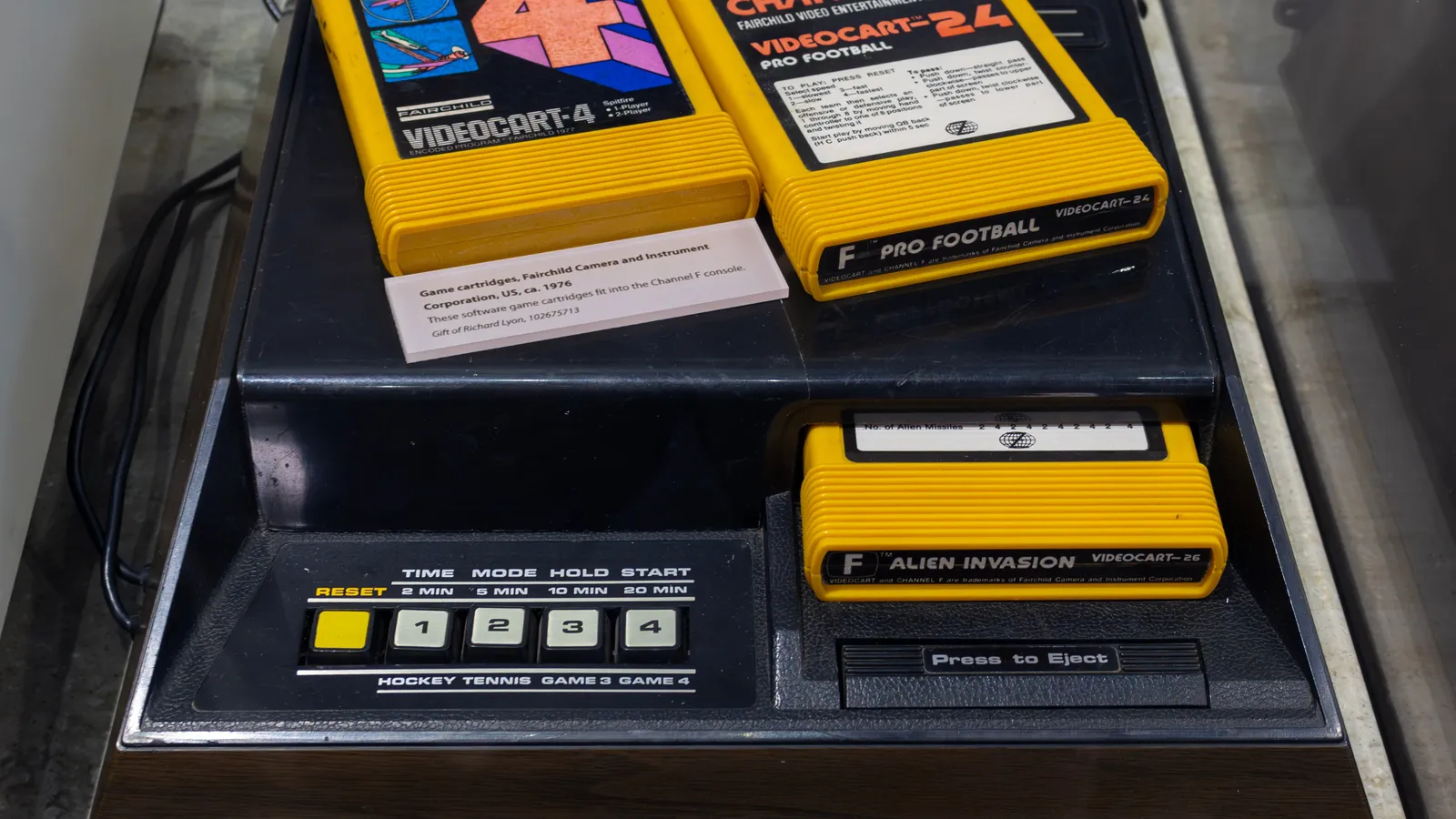
The Strong's finding aid says he used the Fairchild F8 processor in the console and developed a mechanism that let people insert separate memory devices without destroying the console's semiconductors. The result went on sale in 1976 as the Fairchild Channel F, the first home video game system to use separate programmable cartridges for each game.
What problems did the cartridge have to solve?
In the same interview, Lawson described three hurdles.
Wear from plugging in. "We didn't have statistics on multiple insertion and what it would do," he said. No consumer product had done that before.
Static. Lawson said the team worried that plugging in could "cause an explosion on the semiconductor device" through static charge. The finding aid likewise highlights the mechanism that let cartridges go in without destroying the console's semiconductors.
Radio interference. A console sends signals to a TV, so it can leak noise into nearby radios and TVs. Lawson said the US Federal Communications Commission (FCC) "was really hard on us", that the team "had to put the whole motherboard in aluminum", and that each time they made a cartridge, "the FCC wanted to see it".
Inside, the cartridge was simple. Lawson described putting the chip on a small board, bonding it down and covering it with a "glob top".
What happened after the Channel F?
Atari's VCS followed in 1977. The Computer History Museum calls it "one of the first successful consoles that used interchangeable cartridges with factory programmed ROM chips", and says it sold more than twenty million units throughout the 1980s.
The finding aid records that Lawson co-founded Video Soft, Inc. in 1980, which made cartridges for the Atari 2600 and other systems. He later mentored students at Stanford University. The International Game Developers Association honoured him in March 2011, and he died in April 2011 in Mountain View, California.
What can a student learn from Lawson's cartridge?
The cartridge split a game machine into two parts: the part that stays the same (processor, controllers, the link to the TV) and the part that changes (the game). Then it made the joint between them tough.
Worked example: a quiz buzzer for your school science fair.
What stays? The board, the buttons, the buzzer and the score display.
What changes? The question sets for each class and subject.
Where is the joint? Put the questions on a removable memory card, so a teacher can swap Class 8 science for Class 10 maths without touching the wiring.
What can go wrong at the joint? Loose contacts after many swaps, static from hands, and a wrong file format. Test the joint many times before the fair, not once.
If you like taking things apart, our guide on opening old electronics safely is a good first step. For another story of a connector that changed computing, read how Ajay Bhatt's team built USB. And computer engineering vs CSE explains how to check what a course really teaches.
If electric charge or electromagnetic waves still feel shaky, the Fermi Concept Library has a lesson for each concept in physics, chemistry, biology, mathematics and computing. Fermi's AI tutor can work out what you already know and build a plan for the session, so you start from where you are.
Asked in that 2009 interview what advice he would give young Black men and women considering science or engineering, Lawson said: "You've gotta step away from the crowd and go do your own thing."


