On this page
If you are filling in choices after JEE Main or a state CET, you will see the same subject under two names: Computer Engineering at some colleges and Computer Science and Engineering (CSE) at others. The name often reflects history and university custom. What you study is set by the syllabus, and you can read that yourself in about 15 minutes.
What is the difference between computer engineering and computer science engineering?
Internationally, the two names started out as different disciplines. The ACM and IEEE Computer Society report Computing Curricula 2020 describes the computer engineering programmes that emerged in the 1960s as an offshoot of electrical engineering that applied engineering practice to the design and construction of computing hardware.
The same report says computer science is "the foundational discipline with an emphasis on discovery related to programming, algorithms, and data structures", and that "computing hardware is primarily the domain of computer engineering" (CC2020).
CSE, the usual Indian label, joins both words. Think of a spectrum with hardware at one end and algorithms at the other; an Indian BTech or BE can sit anywhere on it.
Why do some colleges call it computer engineering and others CSE?
The CC2020 task force says it plainly: terms such as "computer engineering", "computer science" and "information technology" "mean radically different things to computing educators and practitioners in different parts of the world and indeed, within national localities" (CC2020, section 1.5).
In India, the name often follows the university. Colleges affiliated to Savitribai Phule Pune University (SPPU) in Maharashtra offer a degree its syllabus calls Bachelor of Computer Engineering. The same university also runs Computer Science and Engineering (Data Science), and that syllabus was issued on behalf of the same Board of Studies (Computer Engineering). So the two labels can come from one committee.
How do you compare the actual syllabus?
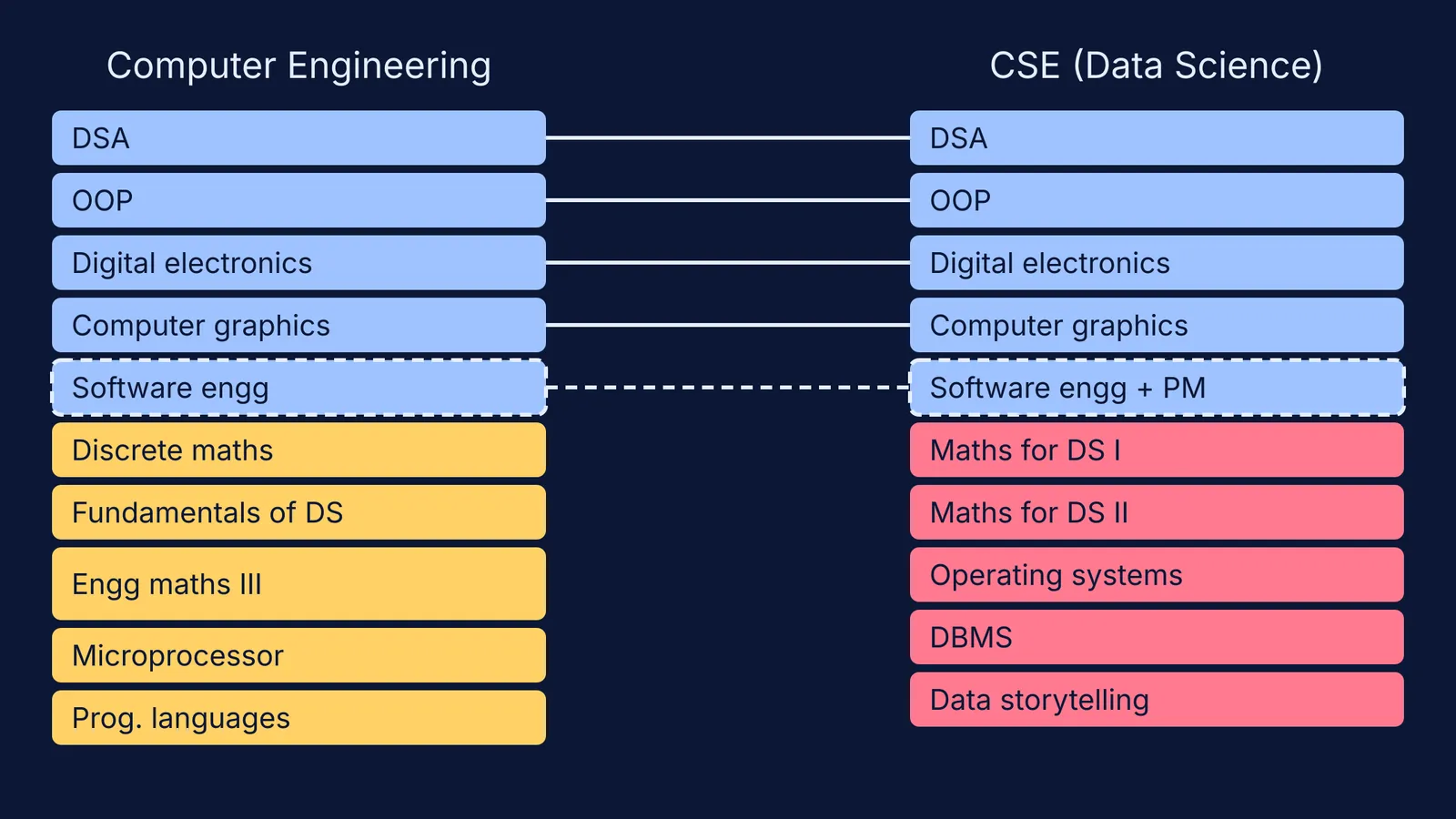
Here is a worked example using two official SPPU second-year syllabi: Computer Engineering (2019 course) and Computer Science and Engineering (Data Science), 2019 pattern, from 2024-25%20Syllabus_19062024.pdf).
Both carry 22 credits in each of semesters III and IV, according to the course tables in those two documents. The first took effect in 2020-21 and the second in 2024-25, so check for newer versions before relying on either.
Shared: Data Structures and Algorithms, Object Oriented Programming, Digital Electronics and Logic Design, Computer Graphics, plus a software engineering course in each.
Only in Computer Engineering: Discrete Mathematics, Fundamentals of Data Structures, Engineering Mathematics III, Microprocessor, Principles of Programming Languages.
Only in CSE (Data Science): Mathematical Foundation for Data Science I and II, Operating Systems, Database Management System, Data Storytelling and Visualization.
What this tells you: the Computer Engineering year keeps a hardware course (Microprocessor) and classic theory, while the Data Science variant brings operating systems, databases and data courses forward. Neither is "more computer". They put different things in second year. Before you decide, check the third and fourth year too, because a course missing in year two can turn up later.
A 15-minute syllabus check for any two colleges
Download the official curriculum PDF from the university or college website, not a coaching summary.
Check the effective year on the cover. A syllabus from several years ago may have been revised.
List the core theory courses for semesters III to VI. Ignore labs, audit courses and electives for now.
Mark each course as shared, only in A, or only in B.
Count the hardware courses (digital electronics, microprocessors, computer organisation or architecture, embedded systems) and the theory courses (discrete maths, algorithms, theory of computation).
Look at the electives in the final two years. Programmes often differ most here.
Write down one question for the department, such as "How many students take the embedded systems electives?"
If a course name means nothing to you yet, look it up before you judge it. The Fermi Concept Library has a lesson for every concept in physics, chemistry, biology, mathematics and computing, so you can see what "logic design" or "discrete mathematics" involves before ranking a college on it.
Which should you choose?
If your shortlist has both names, choose on the college, the faculty and the syllabus, not the label. If you enjoy circuits and how processors work, lean towards the programme with more hardware courses; if you prefer algorithms and data, lean the other way.
For neighbouring choices, read our guides to CSE vs IT syllabus differences and how to read an information science engineering syllabus. Then take your marked-up list to the department, using these questions to ask professors before choosing a branch.