On this page
In short Computer Science and Engineering (CSE) and Information Science and Engineering (ISE) are nearly identical B.Tech branches. Both follow a 160-credit structure, but ISE replaces hardware-focused subjects with data management and software application courses. In tech industry placements, the two degrees are treated interchangeably.
When students fill out their engineering counselling choices, they often see a branch named Information Science and Engineering (ISE) listed alongside Computer Science and Engineering (CSE). Because the cut-off ranks for ISE are sometimes slightly lower, students wonder if it is a compromise or a completely different field.
In reality, ISE is essentially the same as Information Technology (IT)—different state universities just use different names. Visvesvaraya Technological University (VTU) in Karnataka, for example, officially calls it ISE, whereas universities in Maharashtra or Tamil Nadu might call it IT.
What is information science engineering?
Information Science and Engineering is an undergraduate engineering branch focused on how data is managed, stored, and secured. While CSE historically leans towards the "science" of how computers operate at a hardware and theoretical level, ISE leans toward the "application" of computing in the real world.
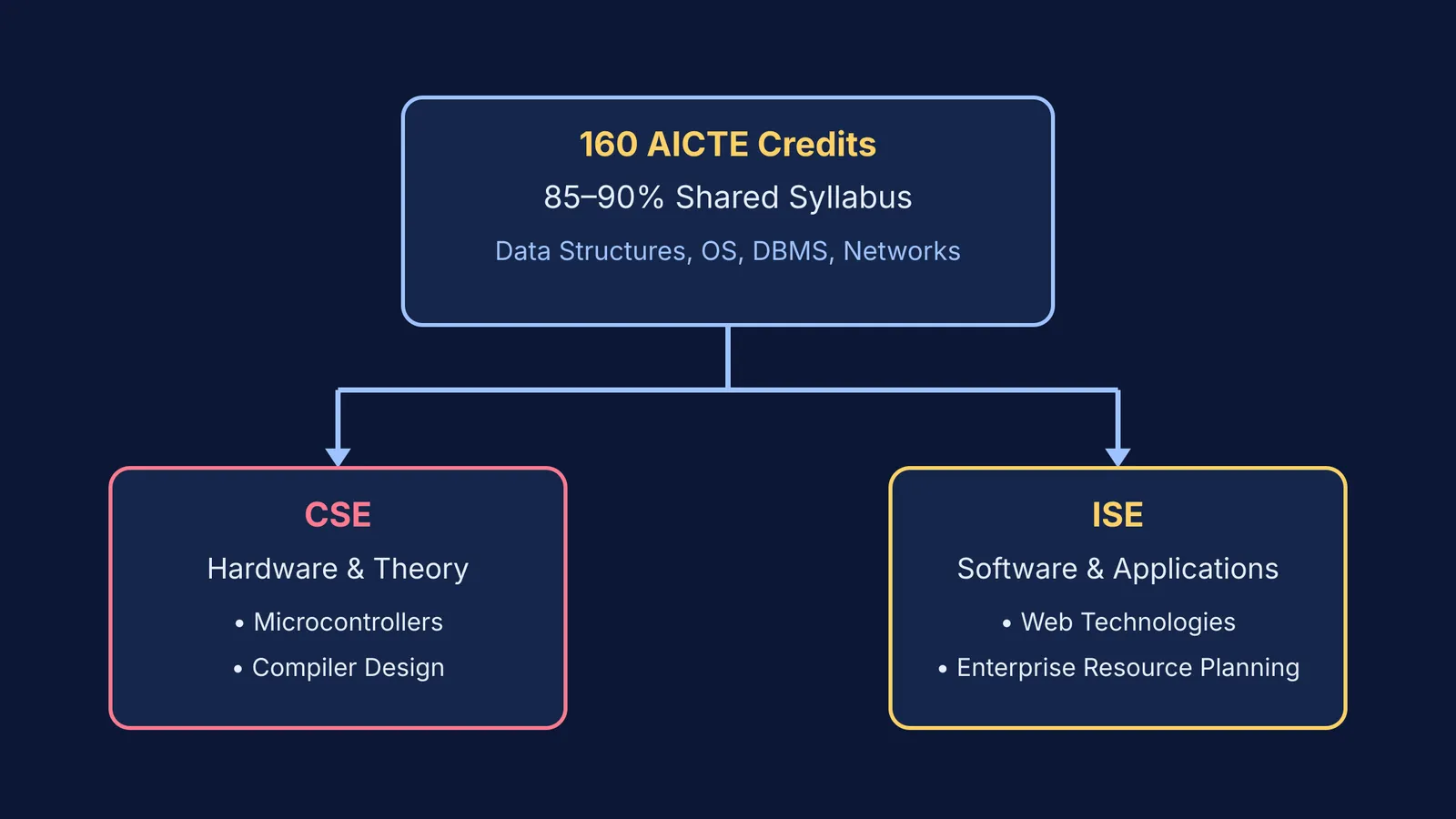
The All India Council for Technical Education (AICTE) defines a model curriculum that standardises engineering degrees across India to 160 credits. Both CSE and ISE adhere to this 160-credit structure. In the first and second years, the subjects are identical. Students in both branches will study C programming, data structures, discrete mathematics, database management systems (DBMS), and operating systems.
If you are struggling with the logic of these foundational topics in your early semesters, a tool like the Fermi Concept Library maps out every computing concept with its own lesson, making it easier to grasp before you start writing code.
What is the difference between information science engineering and CSE?
The differences between the two branches only appear in the final three or four semesters. Based on the 2022 syllabus scheme from VTU, the two branches overlap by 85% to 90%.
The divergence becomes clear when you look at the advanced subjects:
Computer Science and Engineering (CSE): Retains subjects that bridge hardware and software. You will take courses like Microcontrollers, Compiler Design, Theory of Computation, and Advanced Computer Architecture.
Information Science and Engineering (ISE): Replaces hardware and deep theory with application and management subjects. You will take courses like Advanced Java, Web Technologies, Enterprise Resource Planning (ERP), and Information Security.
How can you check the syllabus difference?
When exploring and understanding engineering branches, universities often publish their syllabi online. You can run a quick "ten percent test" on the course list to see exactly what you will be studying.
Skip the first four semesters: The foundation subjects will be the same.
Look for the hardware: Check semesters five, six, and seven. If you do not see "Microprocessors" or "Automata Theory," you are looking at an ISE or IT syllabus.
Check the electives: ISE programs usually offer a richer set of electives around data warehousing, cloud computing, and software project management.
You can use the Fermi Problem Library to work through coding logic step by step, rather than just copying a printed answer.
Do placements and higher studies differ?
For the vast majority of software companies in India—including large services firms like TCS and Infosys, as well as product companies like Amazon and Google—CSE and ISE graduates sit for the exact same placement tests. The interviewers do not distinguish between the two degrees because the core programming knowledge required is identical. The only exception is a small fraction of core hardware companies, such as Intel or Qualcomm, which may restrict their hiring to CSE or Electronics students.
For higher studies, the path is equally open. You are eligible to write the GATE exam in the Computer Science paper regardless of whether your degree says CSE or ISE. When applying for a Master's degree abroad, international universities treat ISE as an equivalent to a Computer Science or Information Systems degree. If you are interested in branching out, you can always explore a minor degree in BTech to add specialised skills like AI or robotics to your portfolio.