

On this page
A chatbot can quickly explain what mechanical or chemical engineering involves, which helps when many of the branch names on a counselling list are new to you. But it sounds just as sure when it is wrong. So let AI help you ask better questions, then get the answers from the college's own course structure and from students already in the branch.
What can AI tell you about engineering branches?
Used well, AI is a patient explainer: what a branch is about in plain words, and which school topics it builds on. It is weak on anything that must be current, local or counted: this year's syllabus at one college, fees, cut-offs and placement numbers. In a 2023 study in Scientific Reports, William Walters and Esther Wilder found that 55% of the citations GPT-3.5 produced for short literature reviews were fabricated, against 18% for GPT-4. The study is about references, but the lesson carries: confident is not the same as sourced. Our guide to checking references when AI makes up sources shows how to test a claim quickly.
How do you check what a branch actually studies?
Open the department's official course structure, usually a PDF on the institute's website, and read the course names semester by semester. Take IIT (BHU) Varanasi's 2025-26 structures. In the mechanical engineering course structure, the first semester includes classical, relativistic and quantum mechanics, engineering mathematics and chemistry; by the third and fourth semesters it is fluid mechanics and fluid machinery, kinematics of machines, mechanics of deformable solids, and heat and mass transfer. The chemical engineering course structure runs through fluid mechanics, heat transfer operations, chemical reaction engineering, mass transfer operations, and process dynamics and control.
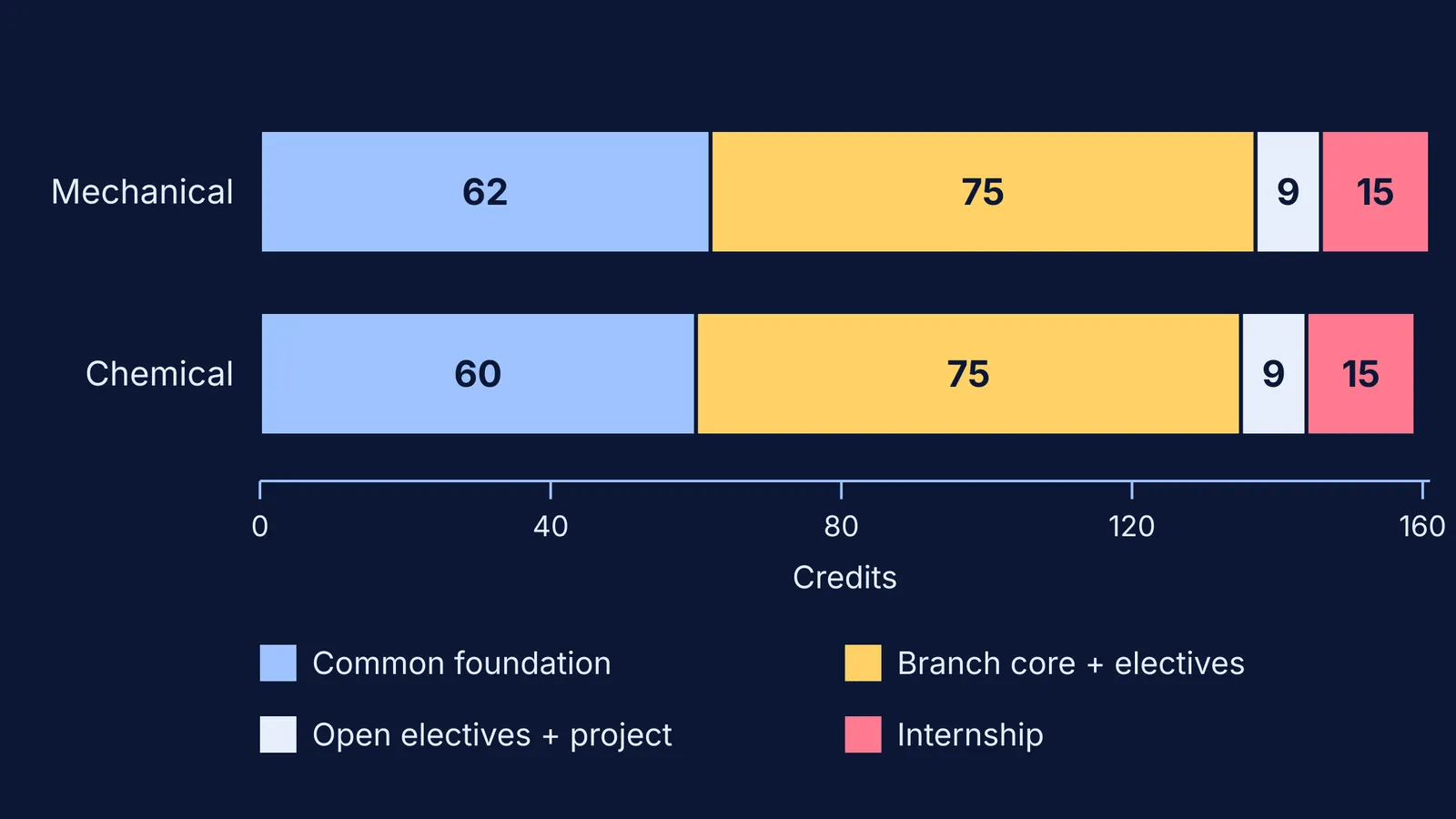
Both lists lean hard on physics and maths; chemical engineering is not simply more Class 12 chemistry. And branch courses are only part of the degree. In both IIT (BHU) structures, department core plus electives come to 75 credits, out of 161 proposed credits for mechanical and 159 for chemical, and a sixth-semester internship carries 15 credits. IIT Delhi's Courses of Study 2025-26 says it in words: departmental courses "constitute about half of the total curriculum".
Here is a worked example: prompt, then check.
Ask: "Explain chemical engineering to a Class 12 student. List the five subjects I would study most in years two and three, and the Class 11-12 chapters each builds on."
Open a college's official course structure and mark which of the five actually appear.
Paste in the real course names: "Explain each in two lines, with one everyday example."
Take anything you could not find in the document to a senior.
If a course name like heat and mass transfer means nothing to you yet, the Fermi Concept Library has a lesson for each concept in physics, chemistry, biology, mathematics and computing, so you can see the ideas a course builds on before you commit.
Why should you ignore placement figures from a chatbot?
Because there is usually nothing behind them. Checkable placement data comes from the institute itself, such as the figures it submits to the Ministry of Education's National Institutional Ranking Framework (NIRF).
IIT Delhi publishes its NIRF 2025 submission on its own website. For its four-year UG programmes as a whole, it reports that 946 students graduated in the minimum time in 2023-24, 711 were placed, 49 were selected for higher studies, and the median salary of placed graduates was Rs 19,08,000. The table has no split by branch. So if a chatbot quotes a branch-wise figure for that institute, ask for its source; if there is none, drop it.
What should you ask seniors in the branch?
Documents tell you what is taught; seniors tell you what it is like. Reach two or three through college clubs or alumni groups:
"Which second-year course surprised you most, and why?"
"How many hours a week go to labs and assignments?"
"Did anyone in your batch switch branch or take a minor?"
"What do you wish you had known before choosing?"
One senior's view is one data point; if two agree, weigh it. For how choices are filled, see our JoSAA counselling guide for parents; for life after admission, read your first semester at engineering college.
A one-week plan before you fill choices
Day 1: List your branches and ask AI for a plain overview of each.
Days 2-3: Download course structures from two colleges; mark what the AI got right and missed.
Day 4: Ask AI to explain unfamiliar course names; check two in a textbook.
Day 5: Message seniors.
Day 6: Note real placement figures from published NIRF data or placement reports, with links.
Day 7: With a parent, rank branches by what you would enjoy studying for four years, then by the checked data.
If you are not sure where to begin, Fermi's AI tutor works out what you already know and builds a plan for the session, so you can start with the physics or maths a branch leans on.


