On this page
Before USB, adding a printer or scanner to a computer could mean opening the case, choosing the right port, installing drivers and rebooting, sometimes more than once. Ajay Bhatt thought plugging in a device should be as easy as plugging a lamp into a wall socket. This post covers how he and his team designed the Universal Serial Bus, how it works inside, and some binary and data-rate arithmetic you can check yourself.
Who is Ajay Bhatt?
The European Patent Office, which named him and his team finalists for its 2013 European Inventor Award, says Bhatt was the person friends went to for fixing radios, televisions and circuit breakers. His interest in electronics took him from India to study at City University in New York, where he helped develop video technology used aboard the Space Shuttle Columbia. He went on to work on computer development at Intel.
The government's Padma Awards 2025 announcement lists Shri Ajay V Bhatt, Science and Engineering, among the Padma Shri recipients.
What problem was he trying to solve?
The EPO tells the story. In 1990, while installing a new printer on his wife's computer, Bhatt hit an all-too-common frustration. Each device talked to the computer through its own driver and plug, and those drivers often sent conflicting commands. If an Intel engineer found this hard, he reasoned, ordinary users must find it far harder.
His model was the electrical wall outlet: plug something in and it works. The EPO's summary of the invention credits Bhatt with Bala Sudarshan Cadambi, Jeff Morriss, Shaun Knoll and Shelagh Callahan, under European patent EP 0789867 B1, developed by Intel with a consortium of six other companies.
How does USB work?
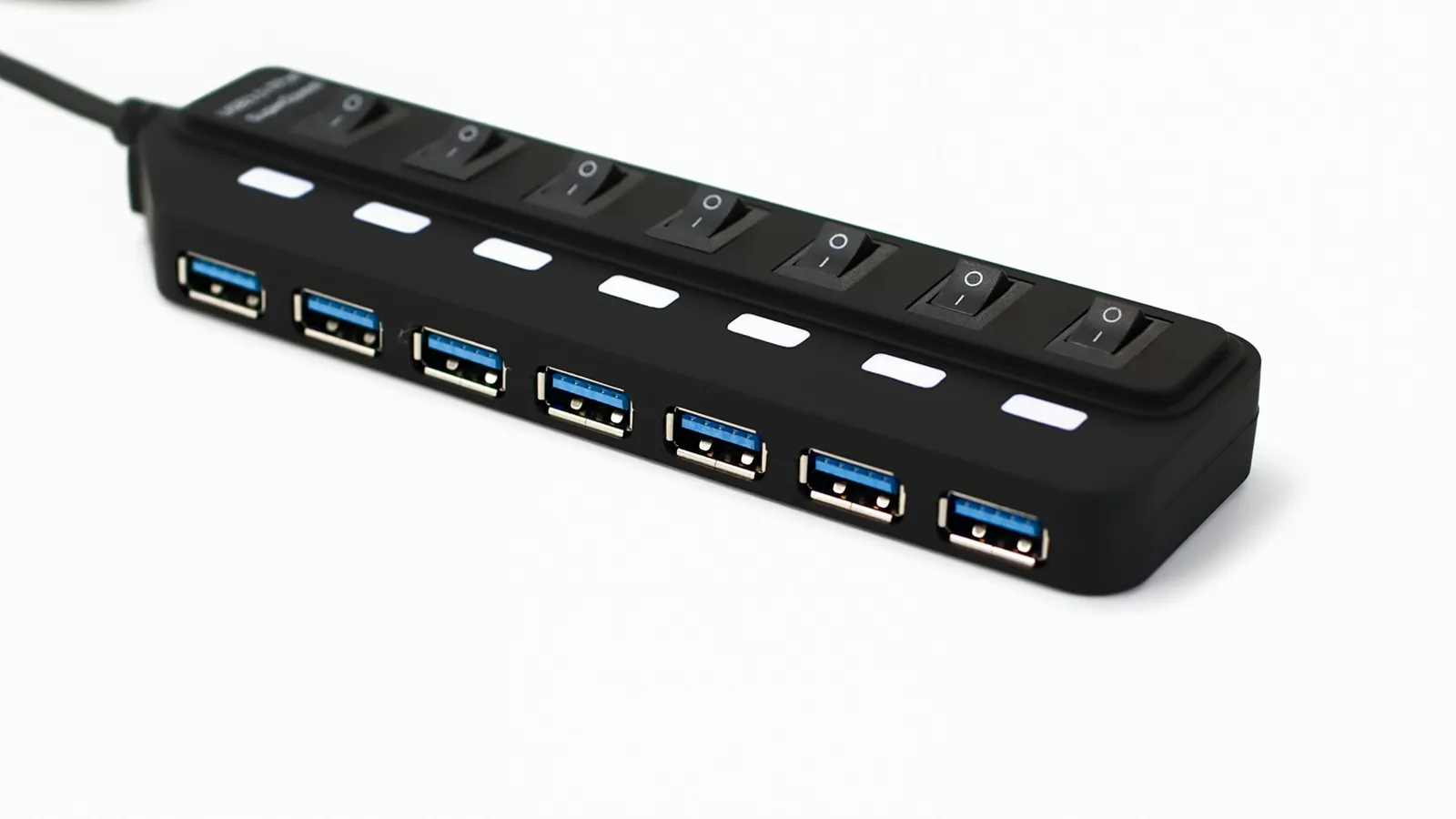
Instead of every device talking whenever it liked, Bhatt's design put all of them on one shared line to the computer, managed by a hub. The EPO describes what happens when you plug something in: the hub gives the device a number called an address, works out what kind of device it is, and then cycles through all the devices many times a second, passing packets of data back and forth.
The official USB 2.0 specification fills in the details. Its revision history dates USB 1.0 to 15 January 1996 and USB 2.0 to 27 April 2000. It defines the device address as "a seven-bit value," says a device starts at the default address 0 when first powered or reset, and says USB "supports up to 127 physical devices." It lists three signalling rates: low-speed at 1.5 Mb/s, full-speed at 12 Mb/s, and the high-speed rate of 480 Mb/s added in USB 2.0.
Worked example: why 127 devices?
Count the addresses. Seven bits give 2^7 = 128 different patterns, from 0000000 to 1111111, that is 0 to 127.
Remove the default. Address 0 is reserved for a device that has just been plugged in and not yet assigned a number.
What remains. 128 - 1 = 127 addresses for working devices, matching the specification.
Our post on binary number systems has practice converting between binary and decimal, and Pingala's binary patterns show how old the idea is.
Worked example: how long does a file take?
Take a 1 GB file, using the decimal definition, 1 GB = 10^9 bytes. With 8 bits in a byte, that is 8 x 10^9 bits.
Full-speed, 12 Mb/s. 8 x 10^9 / 12 x 10^6 = 667 s, about 11 minutes.
High-speed, 480 Mb/s. 8 x 10^9 / 480 x 10^6 = 16.7 s.
High-speed is 480 / 12 = 40 times faster. These are upper limits: the signalling rate is a ceiling, and real transfers are slower because part of the traffic is control information.
Common mistakes:
Mixing bits and bytes. Speeds are in megabits per second (Mb/s), file sizes in bytes. Multiply bytes by 8 first.
Forgetting the prefixes. Mega is 10^6 and giga is 10^9, so 8 x 10^9 / (480 x 10^6) is 16.7, not 0.0167.
When unit conversions like these keep going wrong, the Fermi Problem Library has worked problems with a step-by-step solver that explains the reasoning rather than printing an answer.
Why did USB spread so widely?
The EPO notes that adoption was slow at first, because USB needed a version of Microsoft Windows that was not ready until 1998, and that Apple's iMac was the first mass-produced USB computer. Intel did not sell USB as a product: the companies holding essential patents pooled them through the USB Implementers Forum and licensed them without royalties, which let anyone build USB devices. By 2011, the EPO says, about 7 billion USB-equipped devices had shipped.
What can a student take from Bhatt's way of working?
Your own frustration is data. A printer that would not install led to a global standard.
Borrow a model that already works. The wall socket gave the design its goal.
Make it easy for others to adopt. Royalty-free licensing mattered as much as the engineering.
Try it now: how many devices could a bus support if its addresses used 8 bits, with address 0 still reserved?