

On this page
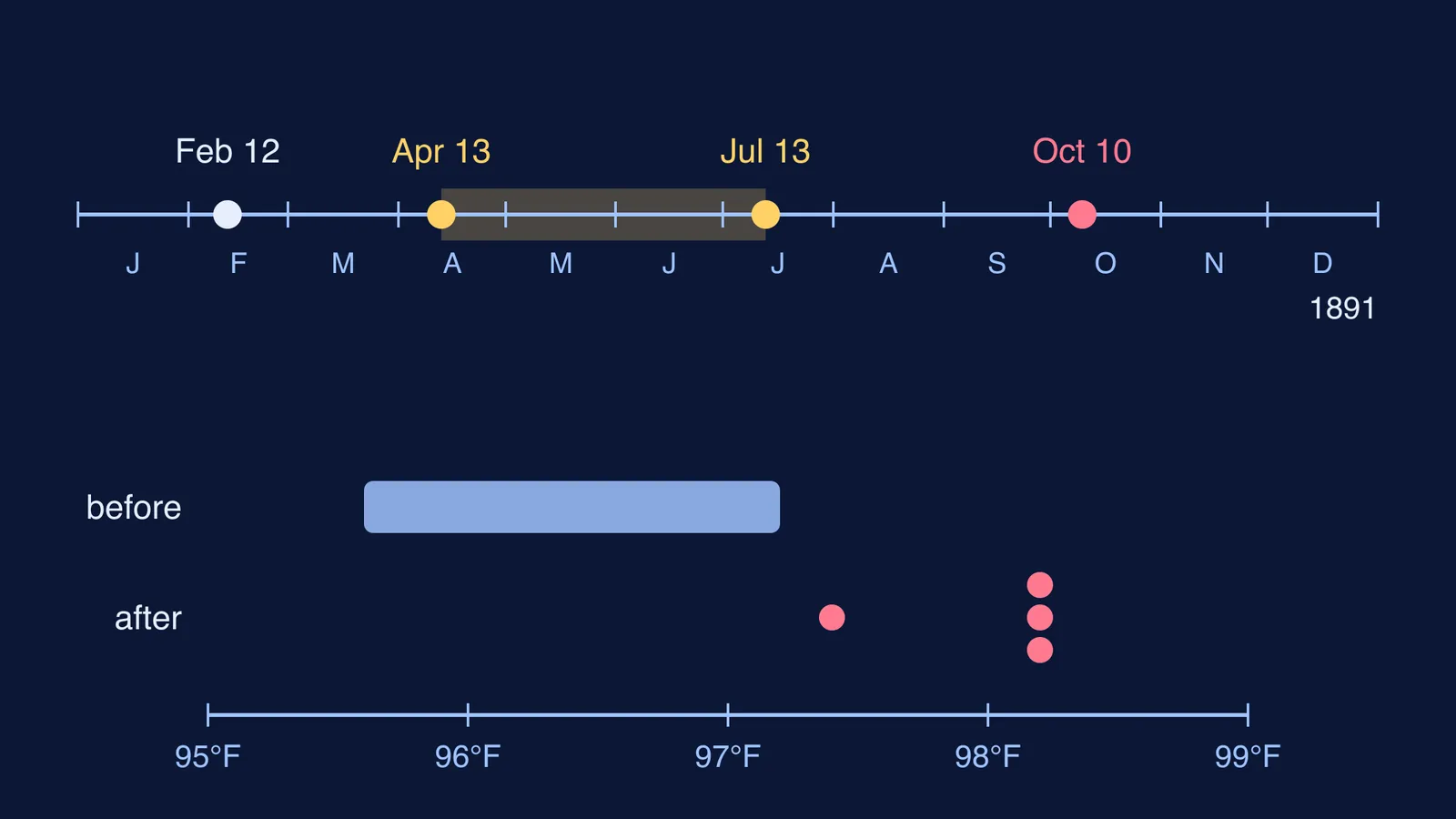
In April 1891 a young Newcastle doctor, George Redmayne Murray, began injecting a 46-year-old woman with juice squeezed from a sheep's thyroid gland. Her illness, myxoedema, is what doctors now call a severe underactive thyroid, and it had long been considered incurable. Murray's report in the British Medical Journal of 10 October 1891 is one of the first records of a missing hormone being replaced from outside the body.
Who was George Murray, and why did he try sheep thyroid?
Murray, born in 1865, qualified in medicine at University College London in 1888, according to a profile in Hektoen International. The same profile dates his first talk on the idea, to the Northumberland and Durham Medical Society, to 12 February 1891.
His own 1891 note sets out the reasoning. Theodor Kocher's observations of patients whose thyroid had been removed, and Victor Horsley's experiments on monkeys, showed that myxoedema came from losing the thyroid gland's function. In Lisbon, Bettencourt and Serrano had grafted a sheep's thyroid, in two halves, under the skin of a 36-year-old woman with myxoedema, and she improved from the next day. Murray argued the change came too quickly for the graft to have gained a blood supply, so the juice of the gland was probably doing the work. If the body lacked a substance, it was rational to supply it with extract from a healthy gland.
The surgical side of this story is in our post on how Theodor Kocher made thyroid surgery safe.
How did Murray make the thyroid extract?
The recipe in his 1891 note can be followed line by line:
Remove one lobe of a sheep's thyroid soon after the animal is killed, and trim off fat and connective tissue.
Sterilise every instrument and glass vessel with a 1 in 20 solution of carbolic acid.
Cut the lobe into small pieces on a glass dish and put them in a test tube with 1 cubic centimetre of pure glycerine and 1 cubic centimetre of 0.5% carbolic acid.
Leave it in a cool place for 24 hours.
Squeeze it through a handkerchief dipped in boiling water, giving about 3 cubic centimetres of turbid pink liquid.
Inject 1.5 cubic centimetres under the loose skin of the back twice a week, so the patient receives one lobe a week.
What happened to Murray's first patient?
Murray called her Mrs S. His report describes a woman whose speech and actions had slowed over four or five years. Her face, hands and feet were swollen, her skin was dry, she had not sweated for four years, she felt the cold badly, and her mouth temperature ran between 95.6°F and 97.2°F.
By 13 July, three months after the first injection, she had received extract from five lobes, equal to two and a half glands. The swelling had largely gone, her speech was quicker, her memory better, and she walked in the streets alone. Of four recent temperature readings, three were 98.2°F and one was 97.4°F.
Murray wrote that "it is not wise to draw many conclusions from a single case", but argued that sweating and periods returning after four years showed the treatment had a real effect.
A history in the Journal of the Royal Society of Medicine reports that she died at 74, after about 28 years of treatment using extract from some 870 sheep. Murray told her whole story in a 1920 BMJ paper.
How is an underactive thyroid treated today?
The missing substance was later pinned down: read how Edward Kendall isolated thyroxine. The JRSM history notes that Harington and Barger synthesised thyroxine in 1927. According to the NHS, an underactive thyroid is usually treated with levothyroxine tablets that replace the hormone the body cannot make, and diagnosed with a blood test for TSH and T4.
This is history, not medical advice. Symptoms such as constant tiredness, feeling cold or unexplained weight gain are a reason to talk to a doctor.
Worked example: read Murray's case like a data table
Try these steps with the numbers from Murray's 1891 note and the JRSM history.
Convert the temperatures with °C = (°F − 32) × 5/9. Before treatment, 95.6°F is about 35.3°C and 97.2°F about 36.2°C. After, 98.2°F is about 36.8°C.
Check the dose. Two injections of 1.5 cubic centimetres make 3 cubic centimetres a week, one lobe. Five lobes in the 13 weeks from 13 April to 13 July is fewer than one a week, which fits Murray's remark that treatment was not continuous.
Scale up. 870 sheep over 28 years is about 31 sheep a year for one patient.
Link it to the syllabus. Ask what normally tells the thyroid to make more hormone. Our walk-through of the thyroid hormone negative feedback loop shows TSH and thyroxine working together.
If terms like TSH, T4 or feedback are still fuzzy, the Fermi Concept Library gives each biology concept its own lesson and its place in the map, so you can close the gap before revising the endocrine chapter.


