On this page
Can two sounds add up to silence? In 1866 the German physicist Georg Hermann Quincke showed that they can. He published a paper titled "Ueber Interferenzapparate für Schallwellen" ("On interference apparatus for sound waves") in Annalen der Physik, volume 204. The tube he described is still one of the clearest ways to show that sound is a wave.
Quincke was born on 19 November 1834 in Frankfurt (Oder) and died on 13 January 1924 in Heidelberg, according to his Wikipedia biography. He taught at Berlin and Würzburg, then held the physics chair at Heidelberg from 1875 to 1907, succeeding Gustav Kirchhoff. He also studied the reflection of light from metals and the effect of electric forces on matter, but the sound tube is the work students meet.
What is the Quincke tube experiment?
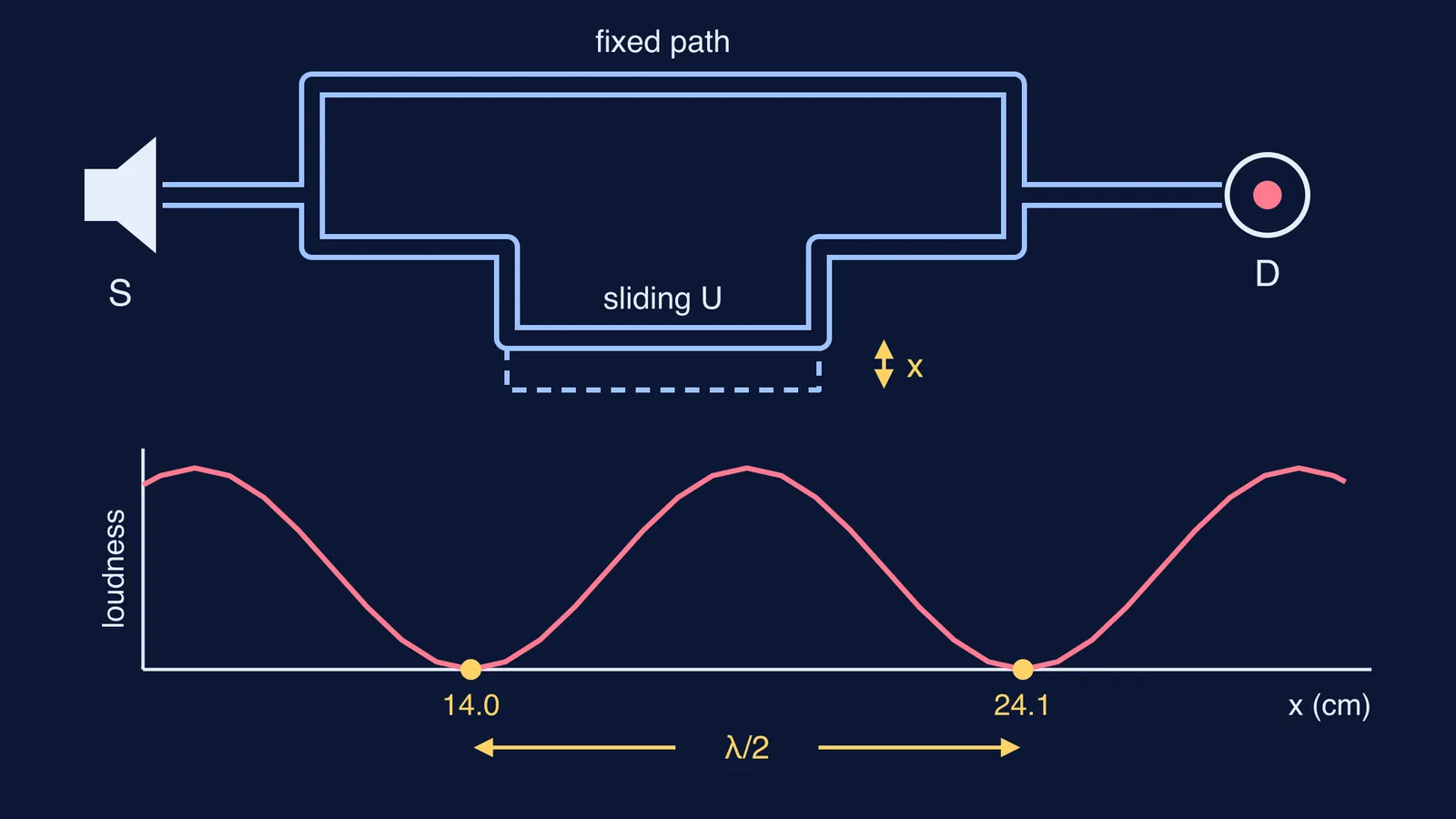
The Quincke tube is two parallel tubes fed by one sound source, with one tube adjustable in length, as described on the Arizona State University physics demonstration page. Sound goes in at one end, splits into the two branches, and joins up again at the far end, where you listen with your ear or a microphone.
As you pull the sliding branch out, the sound at the detector gets louder and softer, again and again. The same biography notes that it is also called the Herschel–Quincke tube, because John Herschel had proposed a similar apparatus but did not build it.
How does the sliding U-tube cancel sound?
Both branches carry the same wave from the same source, so the two waves are coherent. What matters is the path difference: how much farther the sound travels in the sliding branch than in the fixed one.
If the path difference is 0, λ, 2λ and so on, crests meet crests and the sound is loud (constructive interference).
If the path difference is λ/2, 3λ/2, 5λ/2 and so on, crests meet troughs and the sound almost disappears (destructive interference).
If you need a refresher on turning a path difference into a phase difference, our guide to phase difference and path difference walks through it.
Now the key step. The sliding part is a U, so when you pull it out by a distance x, both legs of the U get longer by x. The sound travels 2x farther, not x.
The minimum is rarely perfect silence. If the two waves arrive with slightly different strengths, they cannot cancel completely, so you hear a deep dip rather than nothing.
How do you find wavelength from two silent points?
Here is a worked example. The numbers are sample readings chosen for practice, not data from Quincke's paper.
A speaker plays a steady 1700 Hz tone into a Quincke tube. You pull the slide out slowly. The sound fades to a minimum when the scale reads 14.0 cm. You keep pulling, it gets loud, then fades again to the next minimum at 24.1 cm.
Slide distance between the two silent points: d = 24.1 − 14.0 = 10.1 cm.
The path difference changes by 2d = 20.2 cm.
From one minimum to the next, the path difference goes from λ/2 to 3λ/2, a change of exactly one wavelength. So λ = 2d = 20.2 cm = 0.202 m.
Speed of sound: v = fλ = 1700 × 0.202 = 343.4 m/s.
Check it against a reference: HyperPhysics gives 344 m/s for air at 20°C, so the answer is sensible.
Common slips in this kind of question:
Writing λ = d instead of λ = 2d, because the factor of two was forgotten.
Treating the loud-to-silent slide distance as λ/2 when it is λ/4.
Mixing centimetres and metres when multiplying by frequency.
If that factor of two keeps slipping, the Fermi Problem Library has worked problems with a step-by-step solver that explains the reasoning rather than printing an answer. If you would rather watch two waves add up and cancel out, the Fermi Simulation Lab has interactive simulations for ideas that are easier to see than to read.
Where is Quincke's idea used today?
The same biography notes that the tube's principle is now used in mufflers and other noise-control devices. Engineers still study it. A 2022 paper in Philosophical Transactions of the Royal Society A explains that the classic Herschel–Quincke tube cuts noise in narrow frequency bands related to the length, wavenumber and cross-section area of the parallel branch. The authors then gave the branches modulated properties, which widened those bands and added more of them.
The idea is the same one you meet with two speakers producing loud and quiet spots in a room. The tube just keeps both sound paths inside pipes, so you can measure them with a ruler. For another 19th-century tube that turns sound into a length you can measure, read about August Kundt's tube and the speed of sound.
Next time you see a Quincke tube question, find the two silent points, double the slide distance, and you have the wavelength.