On this page
In 1891 Gabriel Lippmann presented to the Paris Academy of Sciences a way to photograph colour without any dyes or pigments. According to his Nobel Prize biography, he had worked out the theory in 1886, presented plates made by the Lumière brothers with much better colour in 1893, and published the complete theory in 1894. In 1908 he won the Nobel Prize in Physics "for his method of reproducing colours photographically based on the phenomenon of interference".
The idea behind it is one you already meet in the Class 11 chapter on waves: two waves meeting head-on make a standing wave.
How did Lippmann make colour photographs using interference?
In his Nobel lecture of 14 December 1908, Lippmann described the method as "very simple". A glass plate was coated with a transparent light-sensitive layer that was even and grainless. The plate went into a holder filled with mercury, so the liquid metal touched the layer and acted as a mirror. After exposure the plate was developed in the ordinary way, and once it dried the colours appeared when you looked at the light it reflected.
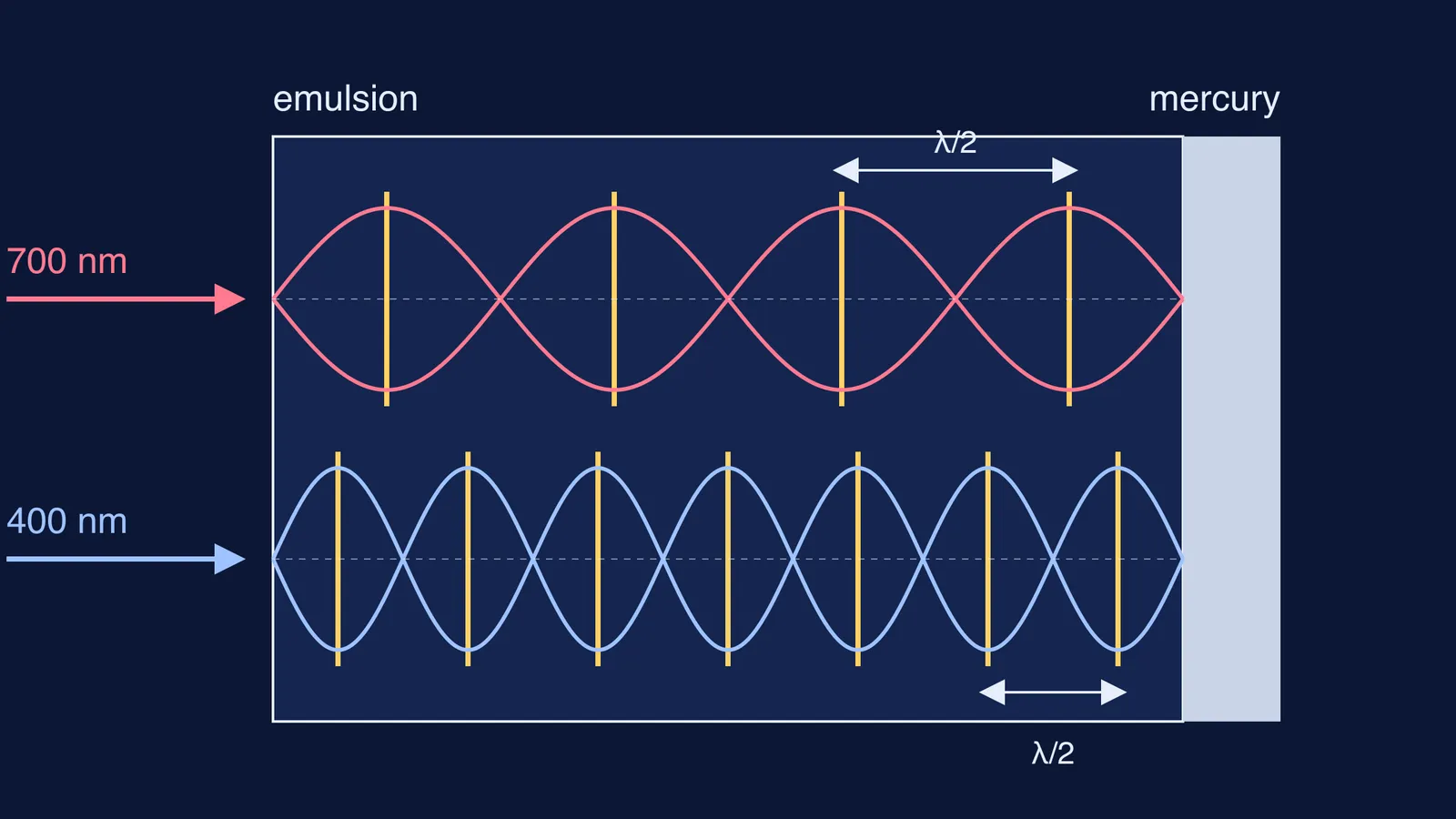
The colour comes from interference inside the layer. Light coming in and light bouncing back off the mercury overlap, forming fringes "half a wavelength distant from each other", in Lippmann's words. These fringes are recorded through the whole thickness of the film. Lippmann stressed that the finished picture is "formed of colourless matter like that of mother-of-pearl or soap film". No pigment is red or green; the spacing of the layers is the colour.
Why are the recorded layers half a wavelength apart?
When a wave meets its own reflection travelling the other way, the sum has fixed nodes and antinodes, and neighbouring antinodes are λ/2 apart (a refresher: stationary versus progressive waves).
The mirror also fixes where the pattern sits. Reflection from the metal flips the wave's phase, so the electric field is zero at the mercury surface and the first bright plane lies λ/4 in front of it. The same phase flip makes the edge fringe dark in Lloyd's mirror experiment.
How far apart are the layers for red and violet light?
Visible light runs from about 380 nm (violet) to about 700 nm (red), according to NASA.
Red light of 700 nm records bright planes 350 nm apart (λ/2).
Violet-blue light of 400 nm records planes only 200 nm apart.
Now shine white light on the red part. Reflections from neighbouring planes differ in path by twice the spacing, 2 × 350 = 700 nm, which is exactly one red wavelength, so every reflection adds up.
For green light of 500 nm, the same 700 nm path difference is 1.4 wavelengths. Reflections from successive planes are out of step, and over many planes they cancel.
Inside the gelatine every wavelength is shorter by the refractive index, but the light is recorded and replayed in the same layer, so that factor cancels. Each spot sends back only the colour that made it.
How is this like the colours of a soap bubble?
A soap film has just two reflecting surfaces, so it reflects a broad mix of wavelengths and its colours look washed out (see why soap bubbles show colours). A Lippmann plate is a stack of many partly reflecting layers, so it picks out one colour much more sharply.
In his Nobel lecture, Lippmann wet a plate of the spectrum and its colours vanished, because the swollen gelatine had made the spacings "two or three times too large". As it dried, the colours came back in order: red first, then orange, green, blue and violet.
What held Lippmann photographs back?
Lippmann himself named one limit: speed. In the same lecture, he said exposures needed about one minute of sunlight, down from fifteen minutes when he began: still too long for portraits. He closed with: "Life is short and progress is slow."
The physics still attracts researchers. In a 2021 PNAS study, Gilles Baechler and colleagues at EPFL showed that the spectrum a Lippmann plate reflects is not the same as the spectrum that exposed it. They also showed that the original spectrum can be recovered with an algorithm, if you know the plate's colour absorption.
A five-minute self-check on standing waves
Cover the answers and try these:
Two identical waves travel in opposite directions. How far apart are the antinodes? (λ/2)
Why is there a node, not an antinode, at the mercury surface? (Reflection from the metal flips the phase.)
Orange light of 600 nm exposes a plate. What is the plane spacing, ignoring the refractive index? (300 nm)
The gelatine swells. Does the reflected colour move towards red or violet? (Towards red, and then beyond what you can see.)
If the standing wave in question 1 is hard to picture, the Fermi Simulation Lab has interactive simulations for ideas that are easier to see than to read. For a gap in the basics, the Fermi Concept Library gives every physics concept its own lesson.
Next time a soap bubble catches the light, try to work out its thickness the way Lippmann would.