On this page
If you have studied haloalkanes, you have met the Swarts reaction as one line in a list of preparations. Behind that line is a careful Belgian chemist who worked out how to put fluorine onto carbon at a time when fluorine itself had only just been caught, and whose recipe was later used to make the first samples of a CFC refrigerant.
Who was Frédéric Swarts?
Frédéric Swarts was born in 1866 and died in Ghent on 6 September 1940, according to a biographical note from the Royal Flemish Chemical Society (KVCV). His father, Théodore Swarts, had been a student of August Kekulé and succeeded him at the University of Ghent. Frédéric studied both science and medicine, earning his doctorate in 1889, but preferred chemistry, and in 1903 he succeeded his father in the Faculty of Science.
The timing matters. Henri Moissan had only isolated elemental fluorine in 1886, and the gas was dangerous to handle; read how he did it in our story on Henri Moissan and the isolation of fluorine. Swarts took a gentler route: instead of using fluorine gas, he carried fluorine in on a metal.
What is the Swarts reaction?
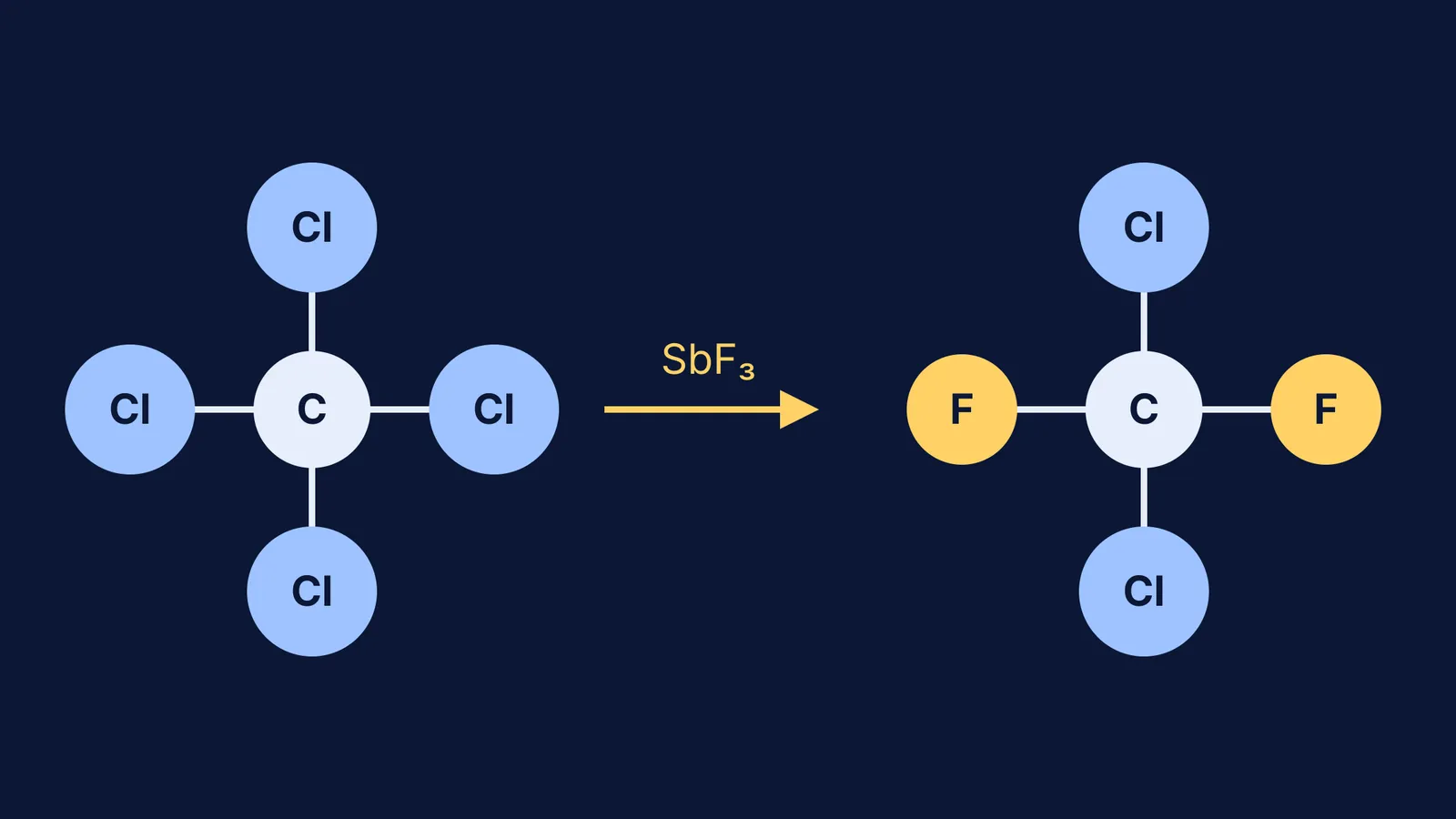
The Swarts reaction replaces chlorine (or another halogen) on carbon with fluorine by treating the organic halide with a metal fluoride such as antimony trifluoride, as described in this summary of Swarts fluorination. Other metal fluorides used include silver(I) fluoride, mercurous fluoride and cobalt(II) fluoride. With SbF3, the reaction is run in the presence of chlorine or antimony pentachloride, and the same source notes that Swarts first described the reaction in 1892.
The simplest classroom example is:
CH3Br + AgF → CH3F + AgBr
The carbon keeps its skeleton and gains fluorine; the metal picks up the halogen that left. Swarts pushed the method much further. A 2009 review of organofluorine history by Takashi Okazoe records that in 1898 Swarts made the first aromatic compounds with fluorinated side chains, finding that benzotrichloride (PhCCl3) reacted rapidly with SbF3 to give, step by step, PhCCl2F, PhCClF2 and PhCF3. The KVCV note adds that he also made trifluoroacetic acid.
The Finkelstein reaction, by contrast, uses sodium iodide in acetone to turn alkyl chlorides or bromides into alkyl iodides, according to this overview of the Finkelstein reaction. Our exam-focused guide to the Finkelstein and Swarts reactions sets the two side by side.
How did Swarts's work lead to CFCs?
Okazoe's review tells the story. In 1928 General Motors gave McNary, Midgley and Henne the task of finding an inert refrigerant, because the ones in use were flammable, corrosive or toxic. Midgley's team concluded that a boiling range of 0 °C to −40 °C might be reached with fluorinated aliphatic compounds, chose CCl2F2 and prepared their first sample from carbon tetrachloride and SbF3, "a synthesis originally reported by Swarts", as the review puts it. Midgley and Henne published the work in 1930 as Organic Fluorides as Refrigerants.
By early 1931, the review adds, Freon-12 was being made in commercial quantities, by a process using hydrogen fluoride with an antimony catalyst. Our profile of Thomas Midgley, leaded petrol and CFCs follows what came next.
The twist came after Swarts's death. In 1974 Mario Molina and F. S. Rowland published a Nature paper titled Stratospheric sink for chlorofluoromethanes: chlorine atom-catalysed destruction of ozone. The Montreal Protocol, signed in 1987 and in force from 1989, phases out the production and consumption of ozone-depleting substances, CFCs included. Swarts made the chemistry possible; he did not choose how it was used.
How do you write a Swarts reaction in an exam?
Use this four-step check whenever a question asks you to prepare an alkyl fluoride:
Find the halogen to replace: usually Cl or Br on an alkyl carbon.
Pick a metal fluoride: AgF, Hg2F2, CoF2 or SbF3.
Swap: fluorine goes onto carbon, the old halogen goes onto the metal.
Balance by counting halogens, remembering that one Sb carries three F.
Worked example: write a balanced equation for making CCl2F2 from CCl4 with SbF3.
Each CCl4 must lose 2 Cl and gain 2 F.
Each SbF3 gives 3 F and becomes SbCl3.
The smallest whole numbers that match are 3 CCl4 (needing 6 F) and 2 SbF3 (giving 6 F).
3 CCl4 + 2 SbF3 → 3 CCl2F2 + 2 SbCl3
Check: 12 Cl, 6 F, 2 Sb and 3 C on each side.
If balancing exchange equations like this one trips you up, the Fermi Problem Library has worked problems with a step-by-step solver that explains the reasoning rather than printing an answer. To see where halogen exchange sits among other haloalkane preparations, the Fermi Concept Library gives every chemistry concept its own lesson and its place in the map.
Next time you write CH3Br + AgF in an answer, remember Swarts's laboratory in Ghent, more than a century ago.