On this page
In 1879 Franz von Soxhlet published a five-page paper with a practical goal: weighing the fat in a sample of milk quickly and accurately (Soxhlet, Dingler's Polytechnisches Journal, 1879). The glass apparatus in that paper still carries his name.
Who invented the Soxhlet apparatus?
Franz Ritter von Soxhlet (1848–1926) was a German agricultural chemist, born in Brno in the Austrian Empire, who became professor of agricultural chemistry at the Technical University of Munich in 1879, the same year he described the extractor (Franz von Soxhlet, Wikipedia). His 1872 doctoral thesis was on the physiological chemistry of milk, and in 1886 he proposed pasteurising milk.
The paper came from an agricultural chemistry station in Vienna, and in it Soxhlet credits the siphon to a Mr Szombathy in that laboratory. He says his own trial runs then worked out the best sizes for each part (Soxhlet, 1879).
The problem was time. Soxhlet reports that with the widely used Zulkowsky apparatus, extracting all the fat usually took 10 hours. In those older extractors, ether dripped through the sample nonstop, so each new drop only diluted the fatty solution already there.
How does a Soxhlet extractor work?
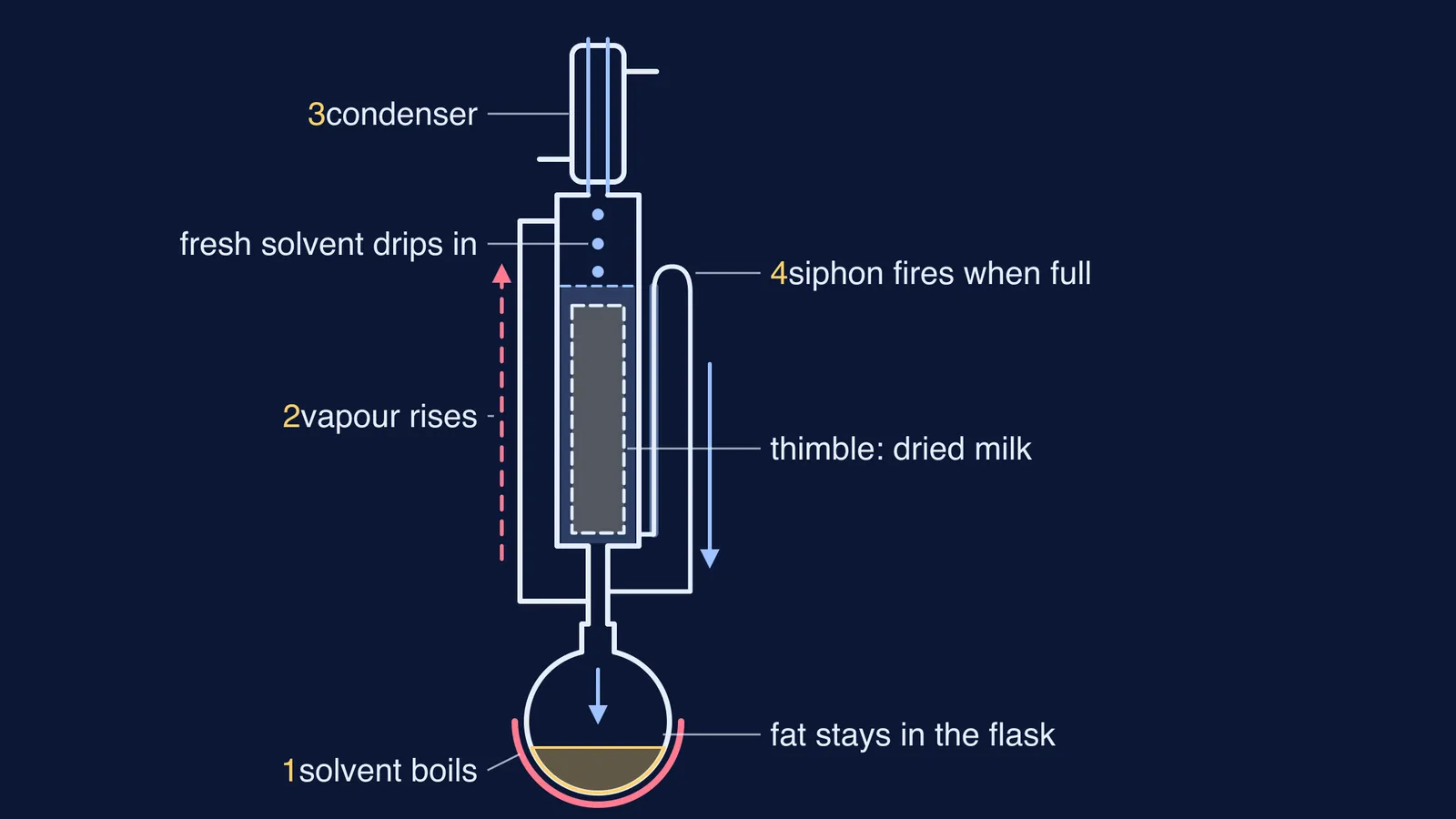
The numbered steps match the diagram above (Soxhlet, 1879).
Solvent boils. About 25 cc of dry ether sits in a small flask, standing in a water bath held at 70 to 72 °C.
Vapour rises. The vapour goes up a side tube and into the chamber above, without passing through the sample.
The condenser drips fresh solvent. A cooled tube turns the vapour back into liquid, which drips into a paper thimble holding the sample. For milk, Soxhlet first mixed 10 cc of milk with 20 g of burnt gypsum and dried it to a crumbly powder.
The siphon fires. The chamber slowly fills. When the level passes the top bend of the narrow siphon tube, the siphon drains the whole chamber, now carrying dissolved fat, back into the flask. Then the filling starts again.
Only the ether boils off again, so the fat stays in the flask while clean solvent goes back up. At the end, Soxhlet dried the flask and weighed it. The gain in mass is the fat. The condenser works as in reflux versus distillation.
With the bath at 70 °C, the fill-and-siphon cycle repeated ten times in 20 to 25 minutes, and ten washes were enough to take all the fat out of the dried milk (Soxhlet, 1879). Twelve extra washes added only 0.3 to 1.1 mg to samples holding 128 to 532 mg of fat. The full test took under two hours.
Why is fresh solvent better than one long soak?
A soaked powder always keeps some liquid back after draining, and that trapped liquid holds fat too. Soxhlet compared good extraction to washing a precipitate on a filter paper: cover it with wash liquid, let all of it drain, and only then pour in fresh liquid (Soxhlet, 1879). A standard lab text makes the same point: "using multiple portions of a solvent maximizes the extractive power of the solvent". In its example, three 50 mL portions recover 92% of a compound, against 80% for one 150 mL portion (LibreTexts, Extraction Theory/04%3A_Extraction/4.05%3A_Extraction_Theory)).
A worked example
A simple model with made-up numbers: the wet powder starts with 5 mL of liquid holding all the fat, keeps 5 mL back after every draining, and fat spreads evenly through all the liquid.
One soak in 50 mL: the trapped 5 mL keeps 5/55 of the fat, so about 9% stays in the sample.
Five washes of 10 mL (also 50 mL): each wash leaves 5/15 = 1/3 of what was there, so after five washes (1/3)^5 = 1/243, or about 0.4%, stays behind.
Ten washes (100 mL): (1/3)^10 is about 0.002%.
The catch is that many washes need a lot of solvent. Because every wash is distilled again from the same flask, Soxhlet's apparatus can wash a sample 300 times in 11 hours. That sends 7.5 to 9 litres of boiling ether through the sample while using only about 80 cc (Soxhlet, 1879).
How do you draw and explain the Soxhlet extractor in an exam?
Flask at the bottom, with heat.
A vapour side arm that skips the thimble.
A condenser on top, dripping into the thimble.
Thimble top below the siphon bend.
Siphon from the chamber floor back to the flask.
Fat ending up in the flask.
Then say it in three sentences: "Solvent boils, rises as vapour, condenses and drips through the sample. When the chamber fills, the siphon empties it into the flask, leaving the extracted substance there. The solvent is distilled again, so every wash is fresh."
A common slip is drawing the vapour passing through the sample. If the cycle is still hard to picture, Fermi's AI tutor can draw the figure with you and check your understanding as it goes, and the Fermi Concept Library has a lesson on every concept in chemistry.
Next, read why cream rises to the top of milk or how Johan Kjeldahl measured nitrogen.