On this page
In February 1888, an electric street railway designed by Frank Julian Sprague began carrying passengers in Richmond, Virginia. The IEEE Milestone record for the Richmond Union Passenger Railway says the way Sprague arranged its parts became the model for the great majority of street railways that followed.
Sprague, born in 1857, was a US Naval Academy graduate who went to work as Thomas Edison's technical assistant in 1883 (ETHW biography).
What did Frank Sprague build in Richmond in 1888?
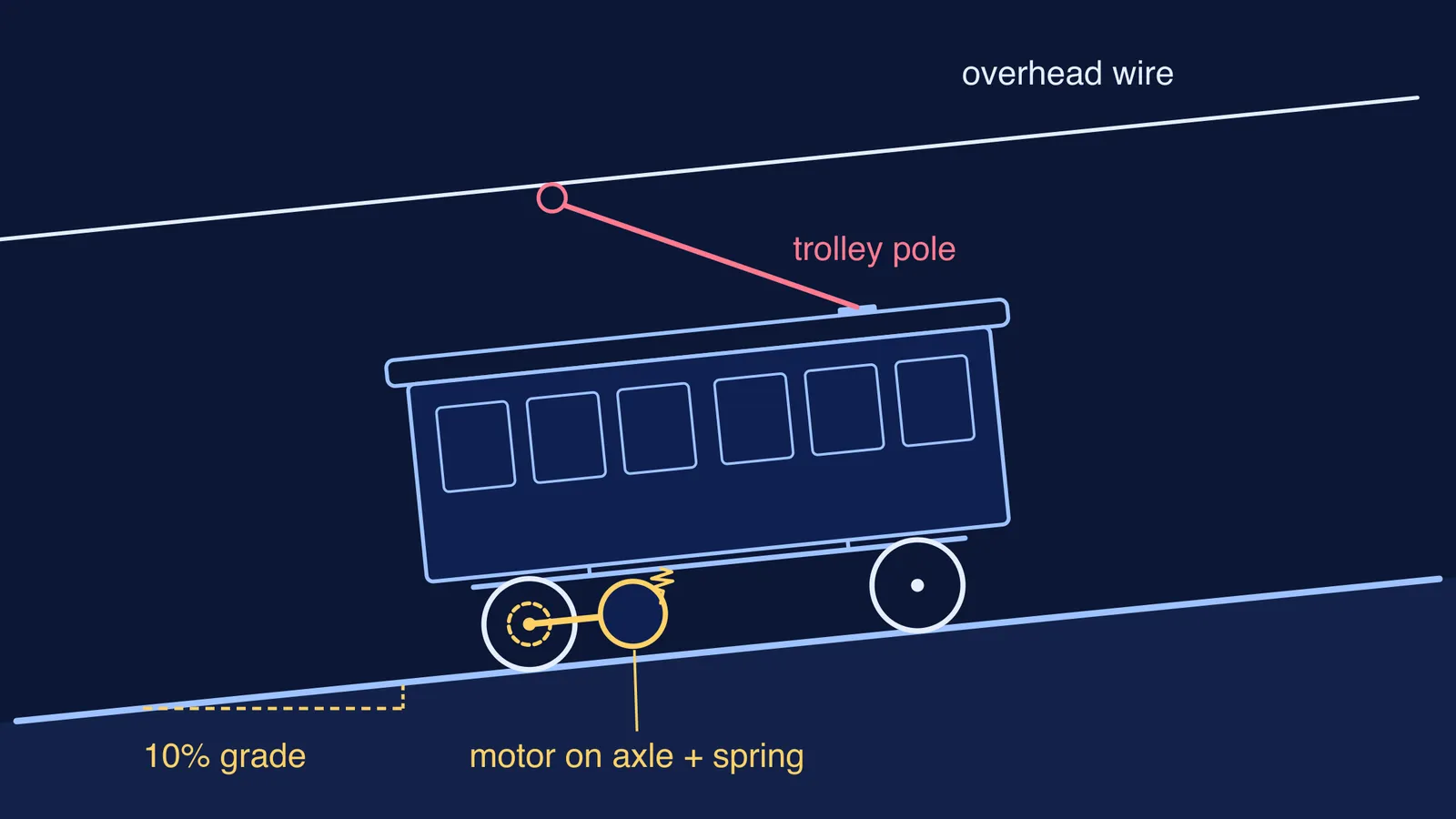
American Heritage magazine's account says the contract asked Sprague to equip a 375-horsepower power plant, put up overhead wire along twelve miles of track and supply forty cars with two motors each, for $110,000 if the work was satisfactory. Each motor was rated at seven and a half horsepower. He had bargained for grades of at most 8 per cent, but the track climbed hills as steep as 10 per cent.
The system had four main parts:
Overhead wire and trolley pole. Current came from a wire above the street through a pole on the roof, and Sprague improved the trolley wheel and pole designs.
Motors under the floor. The motors sat beneath the car, centred on the axles, with one switch controlling both (ETHW biography).
The wheelbarrow mounting. One side of each motor hung from the truck frame on a spring; the other rested on the axle (American Heritage). The axle side keeps the gears in mesh; the spring takes the jolts.
Double gear reduction. For the hills, he added an intermediate gear, so speed was reduced twice between motor and axle.
By the first week of May, thirty cars were in service, and soon afterward Sprague ran forty at one time, ten more than the contract called for (same source).
Why did Richmond work when earlier electric trams had not?
The IEEE Milestone page counts 74 earlier attempts in more than 60 communities in North America, the UK and Europe. It also says Richmond was more than three times larger than the average electric railway built up to then, with more than eight times as many self-propelled cars.
An IEEE history of pre-subway transport names three problems Sprague solved: getting current from a fixed power source into a moving car, building a motor that could survive constant stopping and starting, and mounting that motor so it could take the jolts of the street. The milestone page puts Richmond's lasting influence down to its large-scale practicality and operating superiority.
How fast did other cities copy the Richmond pattern?
To convince Henry M. Whitney of Boston's West End Railway, Sprague lined up 22 cars platform to platform, and Whitney then decided that Sprague motors would be used on all his cars. Within two years of Richmond opening, the US had more than 200 electric railway systems, well over half equipped by Sprague's firm and most of the rest based on his patents (American Heritage).
By 1895, the US had almost 900 electric street railways and nearly 11,000 miles of track, according to the IEEE Milestone page.
Worked example: could a Richmond car climb a 10% hill at full speed?
From American Heritage: two 7.5 hp motors, 10 per cent grades, and speeds as high as fifteen miles per hour. Our assumption: a loaded car of about 5,000 kg, with friction and motor losses ignored.
A 10% grade rises 10 m per 100 m across, so tan θ = 0.1 and sin θ ≈ 0.0995.
Force along the slope: F = mg sin θ = 5,000 × 9.8 × 0.0995 ≈ 4,880 N.
Power available: 15 hp × 746 W ≈ 11,200 W.
Since P = Fv, the top climbing speed is v = 11,200 / 4,880 ≈ 2.3 m/s, about 8 km/h.
At fifteen miles per hour (6.7 m/s), the climb would need about 33 kW, roughly three times the motors' rating.
So, on these assumptions, a loaded car could not hold full speed up the steepest hills. That is why the extra gear mattered: more reduction gives more torque at the wheels, at the cost of speed. Starting from rest on a slope was hardest of all; our post on back emf in a DC motor and why starting current is so large explains why.
This is the P = Fv of Class 11 work, energy and power numericals. If your answers keep going wrong at the force step, the Fermi Problem Library has worked problems with a step-by-step solver that explains the reasoning rather than printing an answer.
Where does the physics of a tram motor come from?
Richmond's cars ran on effects found decades earlier: read how Michael Faraday discovered electromagnetic induction in 1831, then try our DC motor simulation, where you predict the torque at every coil angle. The Fermi Simulation Lab has more interactive simulations for ideas that are easier to see than to read.
Next time you see a tram with a pole reaching up to a wire, look for the motor beside the axle: that is the Richmond layout.