

On this page
Florentino Ameghino started as a boy picking up bones on the plains around Luján in Argentina and ended as director of a national museum, with a list of named extinct mammals that still turns up in research papers more than a century later. His story is also a warning: the drive that made him collect so much led him to one big claim that did not survive testing.
Who was Florentino Ameghino?
Ameghino was born on 19 September 1853 in Moneglia, Italy, moved to Argentina with his parents at 18 months old and died in La Plata, Argentina, on 6 August 1911, according to his Wikipedia biography. He "received only a scanty formal education", writes Justo Gárate in the Dictionary of Scientific Biography entry.
The same entry says that in 1869, as a teenager, he explored the area around Luján collecting fossil bones of extinct animals. He taught school in the town of Mercedes in the early 1870s, and later spent three years in Paris studying fossils and visiting scientific institutions. In 1902 he became director of the Museum of Natural Sciences in Buenos Aires and served there for nine years.
What fossils did Ameghino find on the pampas and in Patagonia?
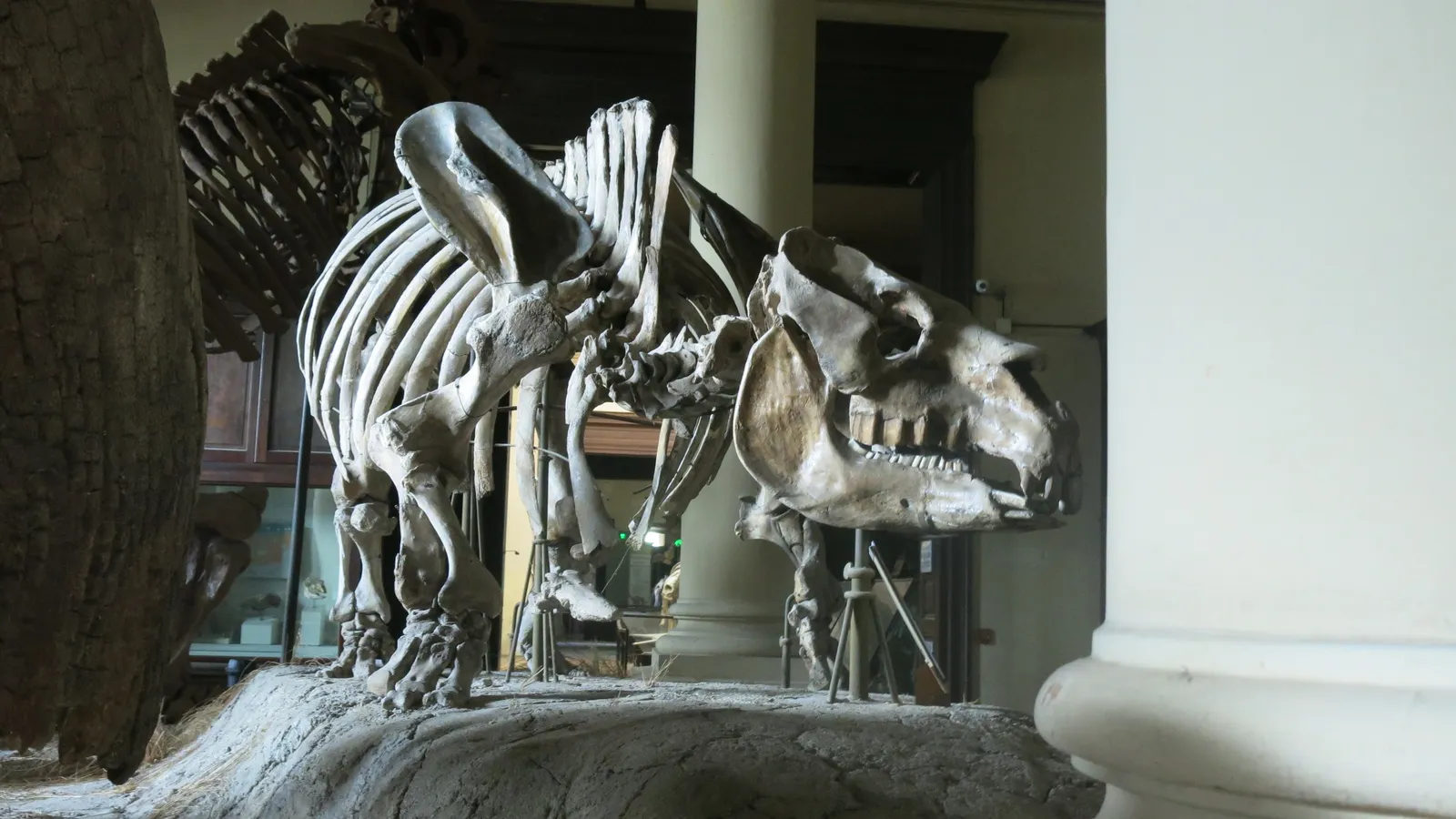
His early finds came from the pampas around Luján and Mercedes, grasslands known for big extinct mammals such as *Toxodon* (photo above). His larger legacy came from Patagonia, and much of it was dug up by his younger brother.
In September 1887, Carlos Ameghino, then assistant preparator of palaeontology at the Museo de La Plata, returned from a successful expedition to the banks of the Santa Cruz River, as Juan Carlos Fernicola describes in the Revista del Museo Argentino de Ciencias Naturales. By the end of that year Florentino, then assistant director of the museum, had briefly described 122 taxa from the trip, 110 of them new species. A few months later, amid a conflict with the museum's director, Francisco Moreno, he was dismissed and denied access to the collections. Fernicola's evidence supports the earlier conclusion that Ameghino kept some 1887 specimens, which are now in his own collection in Buenos Aires.
Carlos kept going. Florentino's Wikipedia biography counts 14 trips to Patagonia between 1887 and 1902. The rocks he worked are now called the Santa Cruz Formation, dated to the Early Miocene; in 2014 a team of palaeontologists revisited the Santa Cruz Formation fossil sites Carlos prospected in 1887.
In 1889 Florentino published his major book, *Contribución al conocimiento de los mamíferos fósiles de la República Argentina* ("Contribution to the knowledge of the fossil mammals of the Argentine Republic"), prepared for the Paris Universal Exposition that year. A scan is free to read on the Internet Archive.
How many species did Ameghino describe?
The exact count depends on who is counting. The Dictionary of Scientific Biography says that "in all, he discovered over 6,000 species." His Wikipedia biography speaks of descriptions of more than 9,000 extinct animals across his writings.
Not every one of those names has lasted, because later study can show that two names belong to the same animal. But some have: a study of Santa Cruz Formation mammals along the Río Santa Cruz still lists species such as *Hegetotherium mirabile* Ameghino (Fernández and Muñoz, PEAPA).
What did Ameghino get wrong?
Ameghino became convinced that humans originated on the Argentine pampas during the Tertiary period, and he named supposed early human ancestors, such as *Tetraprothomo* and *Diprothomo*, from fossil fragments. The Dictionary of Scientific Biography says this theory "has been rejected." The Smithsonian anthropologist Aleš Hrdlička reviewed these claims in his 1912 report Early Man in South America.A history of the controversy on the Fossil Bias blog argues that Ameghino was first misled by his brother's incorrect reading of the rock layers at the fossil mammal sites. A second post on the same blog reports that his supposed early human specimens, once dated, range from 200 to 10,000 years old.
The lesson: a strong hunch needs the same testing as everything else, especially when you want it to be true.
How do you read a species name like Ameghino's?
Palaeontology papers use the same binomial nomenclature you learn in biology class. A worked example with *Hegetotherium mirabile* Ameghino:
*Hegetotherium* is the genus. It always starts with a capital letter.
*mirabile* is the species epithet. It is lower case, and genus plus epithet make the species name.
Ameghino is the author, the person who first described it. The author's name is not italicised.
If the name is printed as (Ameghino) in brackets, the species has since been moved to a different genus from the one he first put it in.
Try it yourself: take three species from any fossil paper or museum label and write down the genus, epithet and author of each.
If words such as genus, family and order still blur together, the Fermi Concept Library has a lesson for each concept in biology and shows where it sits in the map.
Next, read how fossils are dated using rock layers and radioactivity, see how Georges Cuvier used fossil bones to prove that species go extinct, or meet another collector with little schooling, Mary Anning and her Jurassic Coast fossils.


