On this page
When a burn destroys a large area of skin, surgeons usually cover it with a skin graft: a thin sheet shaved from an unburnt part of the same patient. The trouble is that a badly burnt person may not have much unburnt skin left, and every donor site is a fresh wound. Fiona Wood, a plastic surgeon in Perth, Australia, and medical scientist Marie Stoner set out to make a little skin go much further.
Who invented spray-on skin?
According to Wikipedia's biography of Fiona Wood, she was born in Yorkshire, England, in 1958, and in 1993 began working with Marie Stoner on tissue engineering for burns. The same page says older methods needed 21 days to grow enough cells in the lab to cover major burns, and Wood's work cut that to five days.
IP Australia, Australia's patent office, tells the rest. Wood and Stoner applied for a provisional patent in 1993 but lost it; Wood says they did not yet understand the commercialisation process. Their company, Clinical Cell Culture, was set up in 1993 and is now Avita Medical. Their product, RECELL, received Australian (TGA) approval and the European CE mark in 2002, and US FDA approval followed in 2018.
How does spray-on skin work?
Take a small, thin piece of the patient's healthy skin, separate it into individual cells, suspend those cells in liquid, and spray them over the cleaned burn so they can spread and regrow the outer layer.
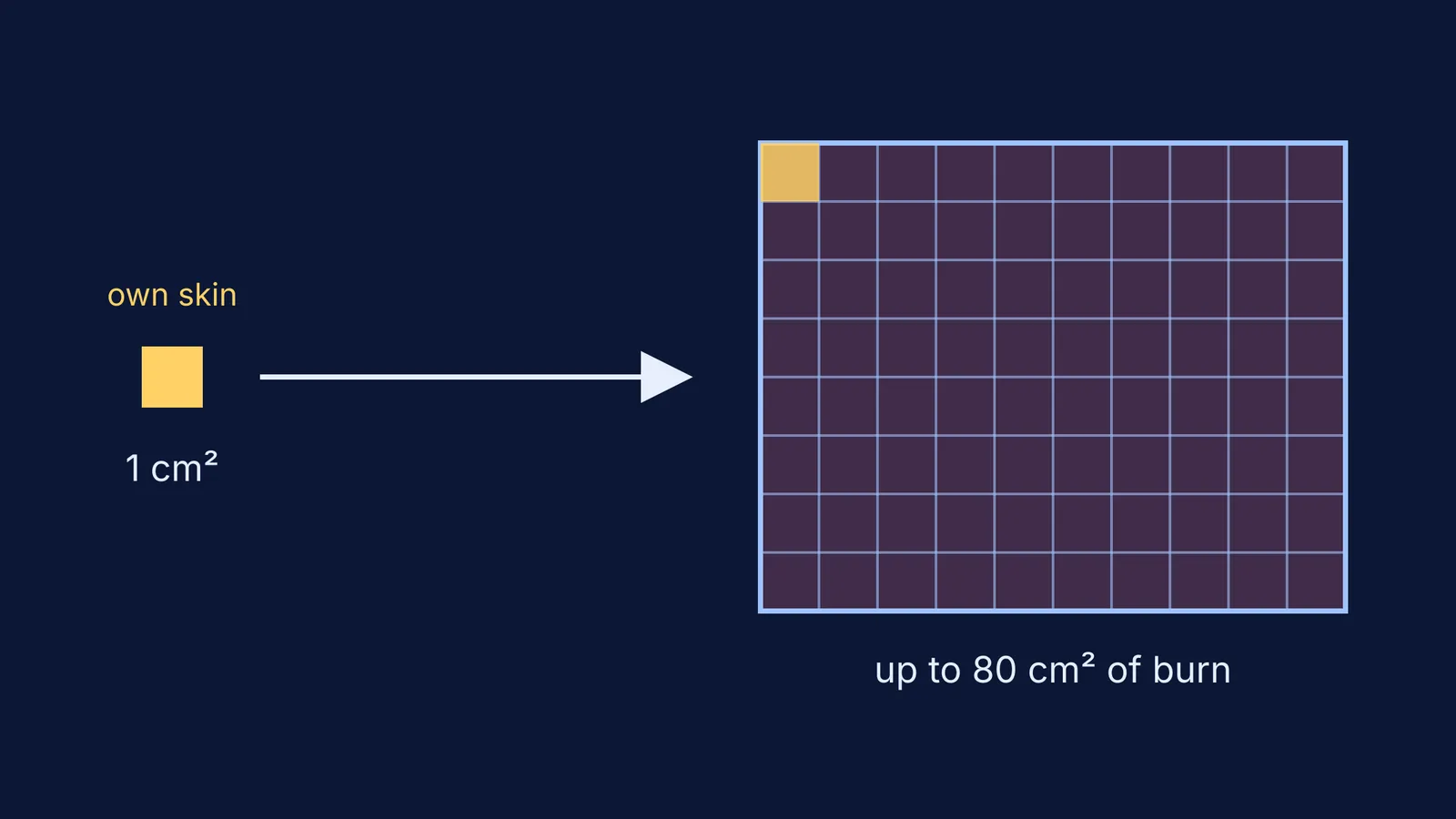
The 2019 RECELL trial paper in Burns describes the device as preparing a suspension of non-cultured, disaggregated, autologous skin cells, using 1 cm² of the patient's skin to treat up to 80 cm² of excised burn.
Unlike the lab-grown (cultured) cells of Wood's earlier work, the spray uses cells that have not been grown at all (non-cultured), prepared at the point of care.
What happened after the 2002 Bali bombings?
In October 2002, bombs exploded in Bali, Indonesia. The Australian of the Year awards page records that 28 victims were flown to Perth for burns treatment. Wikipedia says those patients had burns covering between 2 and 92 per cent of their bodies, along with deadly infections and delayed shock. Wood led the team, and IP Australia reports that 25 of the 28 survived and that Wood and her spray-on skin gained international attention after the bombings.
Wood was named the 2005 Australian of the Year, as a plastic surgeon and spray-on skin pioneer, according to the official awards page.
Does spray-on skin actually work?
Two clinical trials tested the device against standard skin grafts.
Deep partial-thickness burns. In a 2018 study in the Journal of Burn Care and Research, 101 patients were enrolled. The spray needed a donor site of 4.7 cm² on average, against 194.1 cm² for a normal graft, a 97.5% reduction. Patients reported less donor-site pain.
Mixed-depth burns. In the 2019 Burns trial of 30 patients, surgeons combined the spray with a more widely meshed graft. That cut the donor skin needed by 32%, and at 8 weeks 92% of treated wounds had healed compared with 85% of control wounds.
For deeper burns, then, the spray did not replace grafting; it helped a smaller graft go further.
Worked example: how far does 1 cm² go?
Use the ratio from the Burns paper: 1 cm² of donor skin treats up to 80 cm² of burn.
Suppose a burn on a forearm measures 20 cm by 12 cm. Its area is 240 cm².
Divide by the ratio: 240 ÷ 80 = 3 cm² of donor skin, at the very least.
Compare with real numbers. In the deep partial-thickness trial, standard grafts used about 194 cm² of donor skin on average and the spray about 4.7 cm².
The word "up to" matters. Real burns vary, so surgeons decide the amount, not a formula. But the arithmetic shows why a ratio of 1 to 80 changed what was possible for patients with little healthy skin left.
What can a student learn from Fiona Wood?
If medicine or biology appeals to you, try this habit with any invention:
Name the bottleneck. Here it was the shortage of healthy donor skin and the weeks needed to grow more.
Find the key number. Here it is 1 cm² to 80 cm².
Check the limits. The trials show the method works alongside grafts for deep burns, not as a magic replacement.
To follow the biology behind it, start with how skin repairs itself in how a cut forms a scab, step by step, then see why steam causes worse burns than boiling water. If the layers of skin or the idea of a tissue feel shaky, the Fermi Concept Library has a lesson for every concept in biology, each with its place in the map.
For that last step, read why students should learn basic first aid and where to train.