

On this page
In the NCERT Class 9 Science textbook (Chapter 1, "Matter in Our Surroundings"), students encounter a classic conceptual question: why does steam at 373 K (100 °C) cause far more severe burns than boiling water at the same temperature? While both register 100 °C on a thermometer, their capacity to transfer destructive thermal energy to living tissue is starkly different.
What is latent heat of vaporisation in Class 9 physics?
Latent heat of vaporisation is the thermal energy needed to convert 1 kg of liquid into gas at its boiling point without changing temperature, as defined in the NCERT Science curriculum. The term "latent" means hidden, describing heat that overcomes intermolecular attractions rather than increasing kinetic energy.
At 100 °C, liquid water molecules remain bound by hydrogen bonds. Overcoming these bonds to form vapour requires substantial energy. According to the NIST Chemistry WebBook, water has a standard enthalpy of vaporisation of 40.657 kJ/mol at 373.15 K, or approximately 2,257 kJ/kg (often rounded to 2.26 × 10⁶ J/kg in textbook exercises).
Steam at 100 °C therefore carries far more internal energy than liquid water at the same temperature. When steam strikes skin, it condenses back to liquid, dumping that stored latent heat directly into tissue. Our Class 9 guide on matter in our surroundings and latent heat explains how temperature plateaus form during state transitions.
Visualising molecular interactions during state changes can be challenging from static diagrams. The Fermi Simulation Lab provides interactive simulations for the ideas that are easier to see than to read, helping students see how intermolecular bonds break during boiling.
How much more energy does steam transfer than boiling water?
The difference in burn severity comes down to the total energy delivered. Normal skin surface temperature is roughly 33 °C, while core tissue sits near 37 °C, according to the skin models in Scientific Reports.
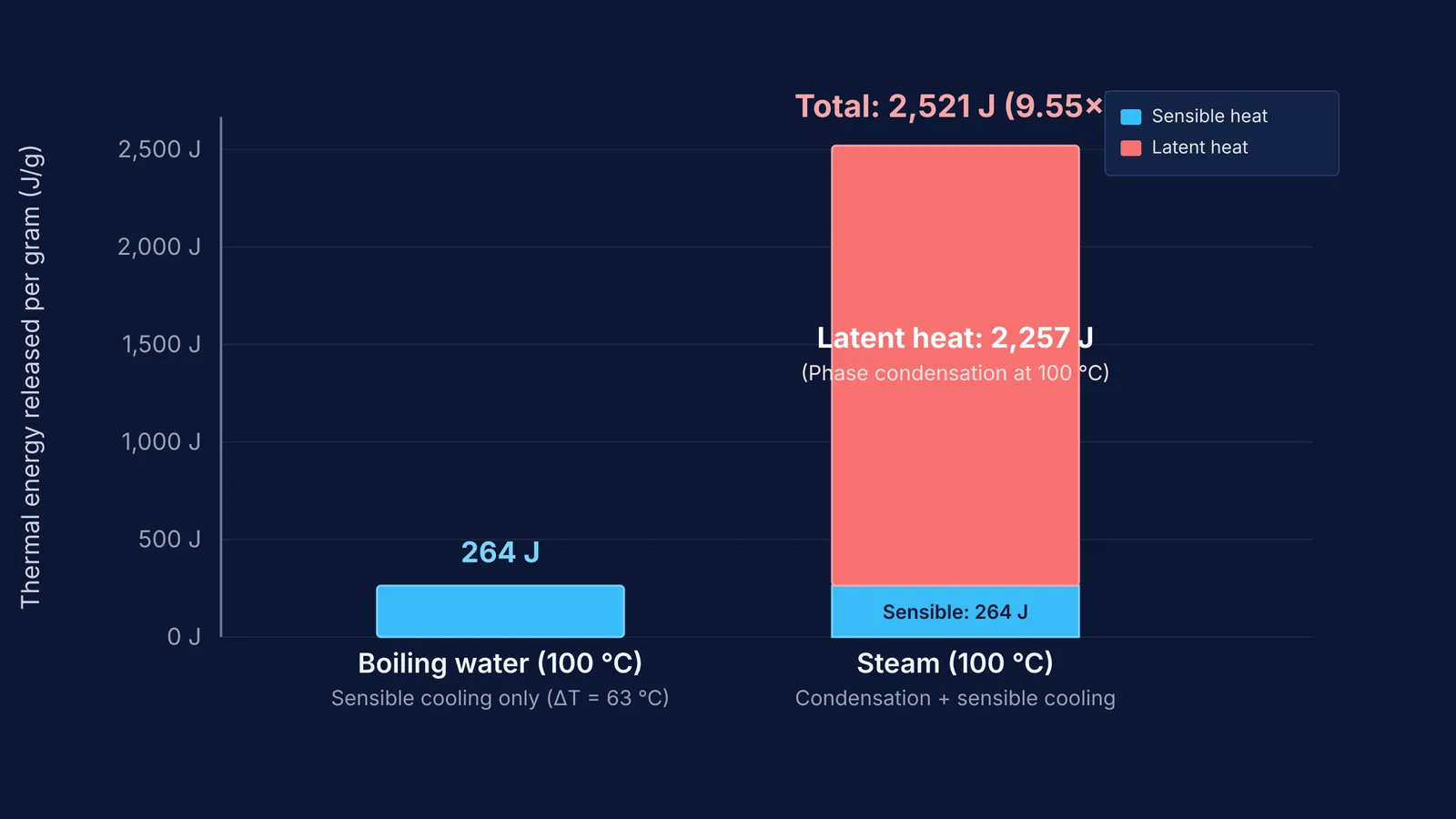
Consider 1 g of boiling water at 100 °C cooling to skin temperature at 37 °C. Liquid water has a specific heat capacity of 4.184 J/(g·°C), as recorded in the NIST Chemistry WebBook. As the liquid cools across 63 °C, it releases sensible heat:
Q_liquid = 1 g × 4.184 J/(g·°C) × 63 °C ≈ 264 J.
Now consider 1 g of steam at 100 °C striking skin and cooling to 37 °C:
Condensation phase change: The steam first condenses into liquid at 100 °C, releasing latent heat: Q_latent = 1 g × 2,257 J/g = 2,257 J, per the NIST Chemistry WebBook.
Sensible cooling: The resulting liquid cools from 100 °C to 37 °C, releasing sensible heat: Q_sensible = 264 J.
Total heat transferred: Combining both steps yields Q_total = 2,257 J + 264 J = 2,521 J.
Dividing 2,521 J by 264 J shows that 1 g of condensing steam delivers roughly 9.55 times more thermal energy than 1 g of boiling water, based on thermochemical values from the NIST Chemistry WebBook. The latent heat released during condensation alone (2,257 J) is more than 8.5 times the total heat transferred by the boiling water.
Our guide on calorimetry and heat transfer covers multi-phase energy balances. For practice with heat equations, the Fermi Problem Library offers worked problems with a step-by-step solver that explains the reasoning rather than printing an answer.
Why does steam penetrate deeper into living tissue?
Severity is also dictated by where heat is deposited. A study by Lina Zhai, René M. Rossi, and colleagues at Empa, published in Scientific Reports, analysed steam burns on porcine skin using confocal Raman microspectroscopy. They demonstrated why steam scalds produce deep damage:
Gaseous diffusion: Hot water vapour diffuses through microscopic epidermal pores much faster than liquid water can penetrate.
Deep condensation: Steam penetrates the epidermis and condenses directly inside the dermis, dumping latent heat onto collagen fibres and capillary beds.
Thermal barrier breakdown: Steam hyper-hydrates the stratum corneum, weakening the skin's protective thermal barrier.
Heat trapping: Because the outer epidermis conducts heat poorly, it traps heat in the dermis, prolonging tissue damage after exposure stops.
Clinical observations by Joseph Still and co-authors in Burns00144-3) confirm that steam scalds frequently cause deep partial-thickness burns requiring surgical excision. In physics coursework, our guide on reading latent heat on temperature-time transformation graphs shows how phase transitions absorb and release large energy quantities at a constant temperature.
Why does thermal dissipation require prolonged cooling for steam burns?
Because condensing steam deposits latent heat deep within dermal layers, sustained heat dissipation is necessary to stop ongoing thermal necrosis. The World Health Organization burn guidance outlines emergency thermal protocols that directly reflect these physical principles:
Sustained heat extraction: Effective cooling requires irrigating the scald under cool running tap water for roughly 20 minutes to conduct trapped heat away from deep tissue. Ice is contraindicated because extreme cold triggers vasoconstriction, compromising blood flow and worsening tissue death.
Edema management: Rapid fluid shifts cause swelling as capillary permeability rises, making early removal of rings and constricting items essential before tissue pressure spikes.
Avoiding thermal insulators: Home remedies such as butter, oils, or toothpaste act as thermal insulators that trap heat inside the wound while increasing infection risk, warns the World Health Organization.
Clean coverage: Covering the area loosely with a clean, non-stick dressing shields vulnerable tissue from pathogens while epidermal barriers recover.


