

On this page
In 1418 Florence Cathedral still had a huge octagonal gap where its dome should be. On 19 August the wool merchants' guild, the Arte della Lana, announced a competition to fill it, according to the history of Florence Cathedral. Filippo Brunelleschi, born in Florence in 1377 and trained as a goldsmith (biography), beat Lorenzo Ghiberti for the job. The dome went up between 1420 and 1436, with nothing holding it from below.
What is centring, and why couldn't Florence use it?
Centring is the temporary structure on which the stones of an arch or vault are laid during construction (definition). An unfinished arch has no strength, so it rests on a wooden frame until the last stone is in.
Florence's dome made that impractical. It starts 52 metres above the floor and spans 44 metres, and there was not enough timber in Tuscany to build the scaffolding and forms (Florence Cathedral). Brunelleschi needed a dome that held itself up at every stage of building, not just at the end.
How did Brunelleschi build the dome without centring?
Two shells, rising together. The dome is really two brick domes, one inside the other. Both were built of brick, chosen because it is lighter than stone, and raised with nothing supporting them from below (Florence Cathedral). In the engineer Mario Salvadori's account in *Why Buildings Stand Up*, the inner dome is seven feet thick at the bottom and five at the top, and the outer one is two and a half feet at the bottom and one and a quarter at the top (excerpt). That is roughly 2.1 m tapering to 1.5 m inside, and 0.76 m to 0.38 m outside. Salvadori notes that the ribs and both domes rose to the same height together. More than four million bricks went in (biography).
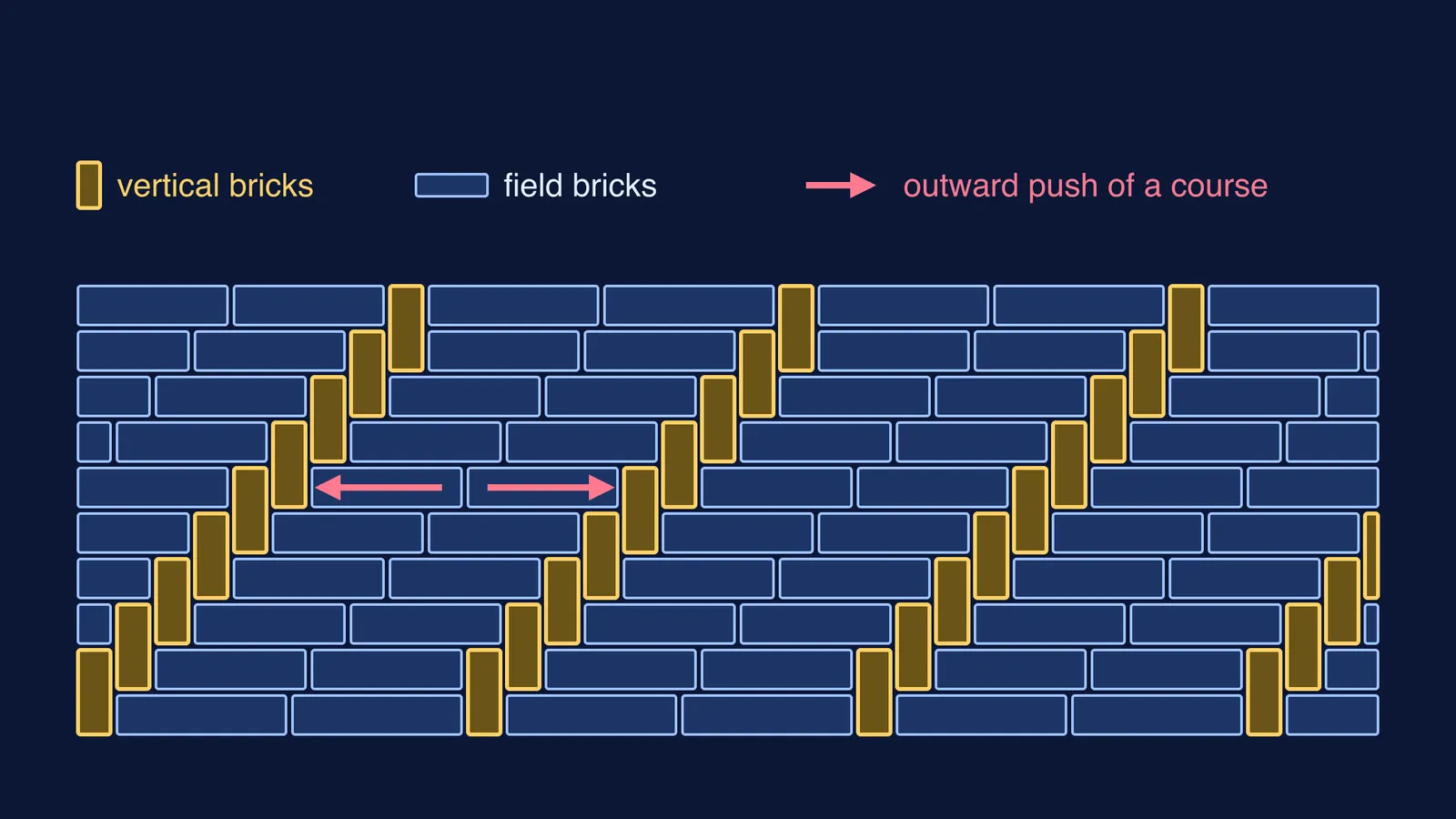
Herringbone brickwork. Most bricks in each course lie flat. Every so often one is set on end, standing up into the course above. These vertical bricks form staggered lines running diagonally across the curve of the dome, making a V-shaped herringbone pattern with the flat field bricks (Princeton Engineering). Each course of flat bricks pushes outwards on the vertical bricks at its ends, forming a plate-bande, a straight or flat arch.
In a 2020 study in *Engineering Structures*, Vittorio Paris, Attilio Pizzigoni and Sigrid Adriaenssens of the University of Bergamo and Princeton University modelled this kind of brickwork (paper). The dome they analysed was Santa Maria in Ciel d'Oro in Montefiascone, not Florence's. As Princeton reported, for domes with radial geometry, the herringbone pattern lets the bricks be wedged as plate-bandes and not slide inwards, which would make the dome collapse. In Florence, Brunelleschi used a single helix, so the lines of vertical bricks run parallel and never cross.
Why would a fresh brick slide, and how steep is too steep?
Picture a hemisphere whose bed joints all point at its centre. At the base a course lies flat. Climb an angle φ around the curve and the bed of that course tilts towards the middle by the same angle φ. A brick on a bed tilted at θ is held by friction alone only while tan θ ≤ μ, where μ is the coefficient of friction between brick and wet mortar.
Take an illustrative value, μ = 0.6 (an assumption, not a measured figure for Florence).
The critical tilt is θ = tan⁻¹(0.6) ≈ 31°.
Beyond about 31° up the curve, a loose brick on wet mortar starts to slide inwards.
At 60°, friction alone would need μ = tan 60° ≈ 1.73, nearly three times our value.
This is where the vertical bricks matter: a brick that cannot slide past the stop at the end of its course is held by the course, not by a frame. The real dome is pointed and octagonal, not a hemisphere, so treat this as a model of the idea rather than of the building.
You can test step 2 at home. Put an eraser on a hardcover book and slowly raise one end until it slides. Measure the raised height h and the horizontal length L: μ ≈ h/L. Then tape a pencil across the book as an end stop and tilt it again.
What can a student learn from Brunelleschi's dome?
Check every stage, not just the finished thing. The 2020 team analysed the dome they studied at several layers and stages of construction (Tech Xplore), because a structure that stands when complete can still fall while half built.
Turn one big support problem into many small ones. Each course of bricks only had to hold itself between two stops.
Spot it in your syllabus. Class 11 friction-on-an-incline problems use the same tan θ = μ condition.
If a tilting bed is hard to picture, the Fermi Simulation Lab has interactive simulations for ideas that are easier to see than to read. For practice, the Fermi Problem Library has worked problems with a step-by-step solver that explains the reasoning rather than printing an answer.
Read next: how Emily Warren Roebling saw the Brooklyn Bridge through, how Joseph Monier's garden pots gave us reinforced concrete, and why Galileo's square-cube law limits how big things can grow.


