On this page
Michael Faraday's ice-pail experiment takes a minute to describe, and the conducting-shell problems you meet in Class 12 still rest on it. In 1843 he published it as a short letter, “On static electrical inductive action”, in the Philosophical Magazine, volume 22, pages 200–204. The kit was ordinary: an insulated metal ice pail, a gold-leaf electrometer wired to it, and a charged brass ball on a silk thread.
What was Faraday's ice-pail experiment?
Here is Faraday's own set-up, as quoted by Kenyon College's collection of early physics apparatus: “Let A in the diagram represent an insulated pewter ice-pail, ...connected by a wire to a delicate gold-leaf electrometer E, and let C be a round brass ball insulated by a dry thread of white silk, three or four feet in length, so as to remove the influence of the hand holding it from the ice-pail below.”
The silk insulates the ball, and the long thread keeps his hand from disturbing the reading. The electrometer's gold leaves spread apart when the pail's outside is charged. If that instrument is new to you, start with how a gold-leaf electroscope detects charge.
What did the electroscope show at each step?
Markus Zahn's textbook Electromagnetic Field Theory, free on MIT OpenCourseWare (chapter 2, section 2-1-3), walks through the sequence. Put together with Faraday's letter, it runs like this:
Ball far away. The leaves hang limp; the pail has no charge.
Ball lowered inside without touching. The leaves diverge. Faraday noted that the divergence grows until the ball is below the rim, then holds steady.
Ball moved around inside. In the words of Zahn's figure caption, “the charge on the outside of the pail is independent of the position of the charged ball.”
Ball taken out without touching. Faraday wrote, as quoted on Wikipedia's page on the experiment, “if C be taken away, E will collapse perfectly.” Nothing was transferred; the pail's own charge was only pushed around.
Ball touches the inside, then comes out. The leaves stay just as they were in step 2, and the ball comes out uncharged. Faraday: “If C is made to touch the bottom of A, all of its charge is communicated to A.”
Step 5 is the key. Touching changed nothing outside, so the inner-wall charge must already have cancelled the ball's charge exactly.
Why is the induced charge equal to the charge inside?
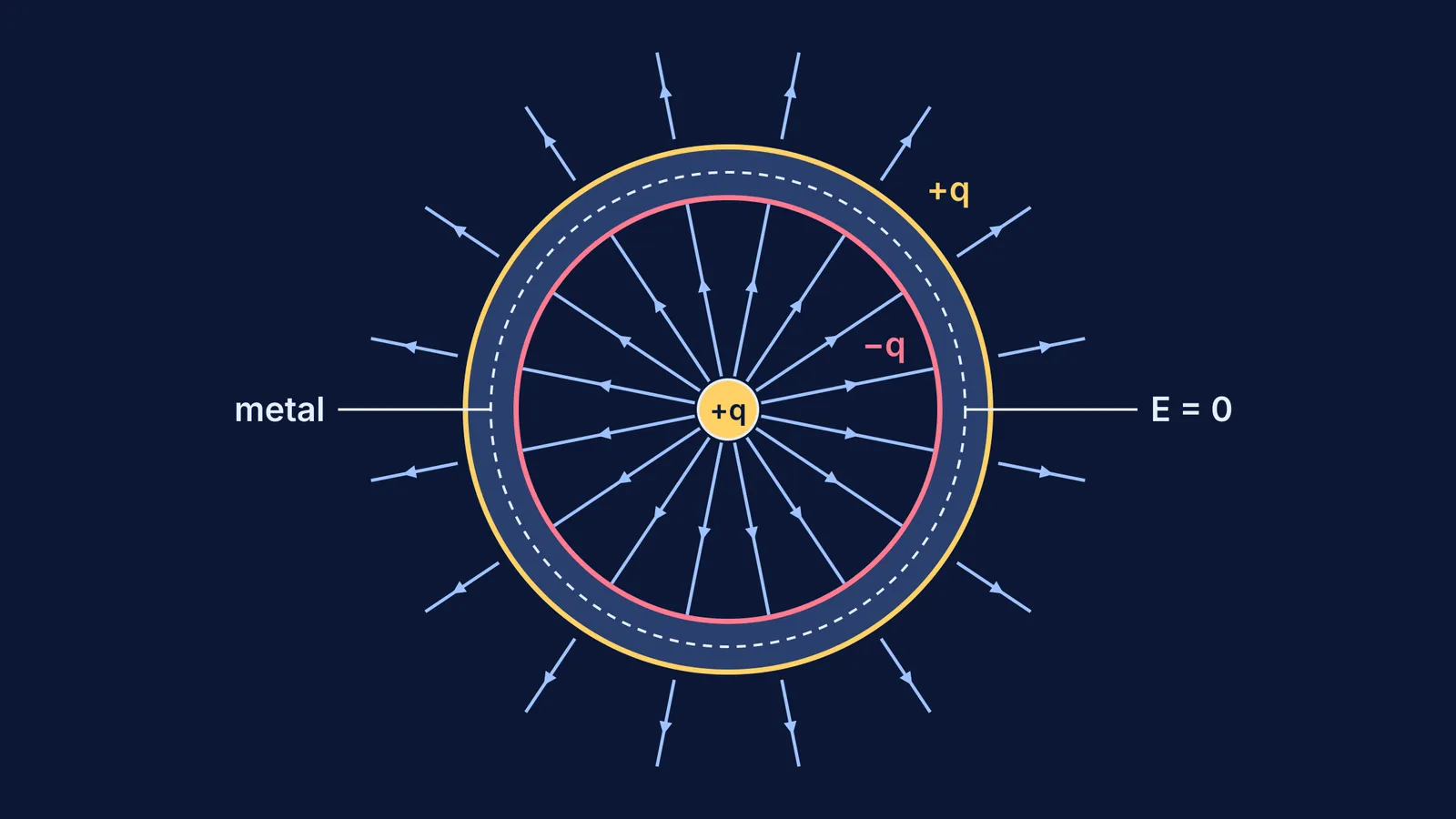
Faraday showed it by experiment; Gauss's law explains why. In electrostatic equilibrium the electric field inside the metal is zero. Draw a closed surface that runs through the metal of the pail, around the cavity (the dashed circle in the diagram at the top of this post). The flux through it is zero, so the total charge it encloses is zero. It encloses the ball's charge q and the inner-wall charge, so the inner wall must hold exactly −q, wherever the ball sits and whatever the cavity's shape. The pail started neutral, so +q must appear on the outside. The same Wikipedia article sets out this argument for a fully closed container, and our explainer on Gauss's law in Class 12 electrostatics covers flux from the start. A real pail is open at the top, so the match is close rather than exact once the ball is well inside.
Zahn adds a practical consequence: repeat step 5 again and again and the charge on the pail keeps building up, which is the principle behind electrostatic generators. The same physics lies behind Faraday's 1836 cage experiment.
How do you use the ice-pail rule in a shell problem?
Try this Class 12 and JEE-style example.
A metal spherical shell of outer radius 0.2 m carries +5 μC. A small ball with +2 μC hangs inside it, off-centre, not touching.
Inner surface: −2 μC, so a Gaussian surface in the metal encloses zero.
Outer surface: total minus inner, +5 − (−2) = +7 μC.
Field 0.5 m from the centre, outside the shell: E = kQ/r² = (9 × 10⁹)(7 × 10⁻⁶)/(0.5)² = 2.52 × 10⁵ N/C, pointing outward. Moving the ball does not change this.
Now the ball touches the inner wall: ball 0, inner surface 0, outer surface still +7 μC. The field outside is unchanged, just as in Faraday's step 5.
Start again, but earth the shell instead (ball not touching): the outer charge drains to 0, the inner surface keeps −2 μC, and the field outside becomes zero.
Before any shell question, run through these:
Draw the Gaussian surface inside the metal first.
Inner charge = minus the charge enclosed in the cavity.
Outer charge = the conductor's total charge minus the inner charge.
Check whether the shell is isolated or earthed.
If you keep getting the outer charge wrong in timed practice, the Fermi Problem Library has worked problems with a step-by-step solver that explains the reasoning rather than printing an answer. If the gap is Gauss's law itself, the Fermi Concept Library gives each concept its own lesson and its place in the map.