

On this page
The gold-leaf electroscope is one of the oldest and most sensitive instruments for detecting static electricity. Though modern digital meters have replaced it in most research labs, it remains a staple in physics classrooms—from Class 12 demonstrations to JEE preparation.
What makes up a gold leaf electroscope?
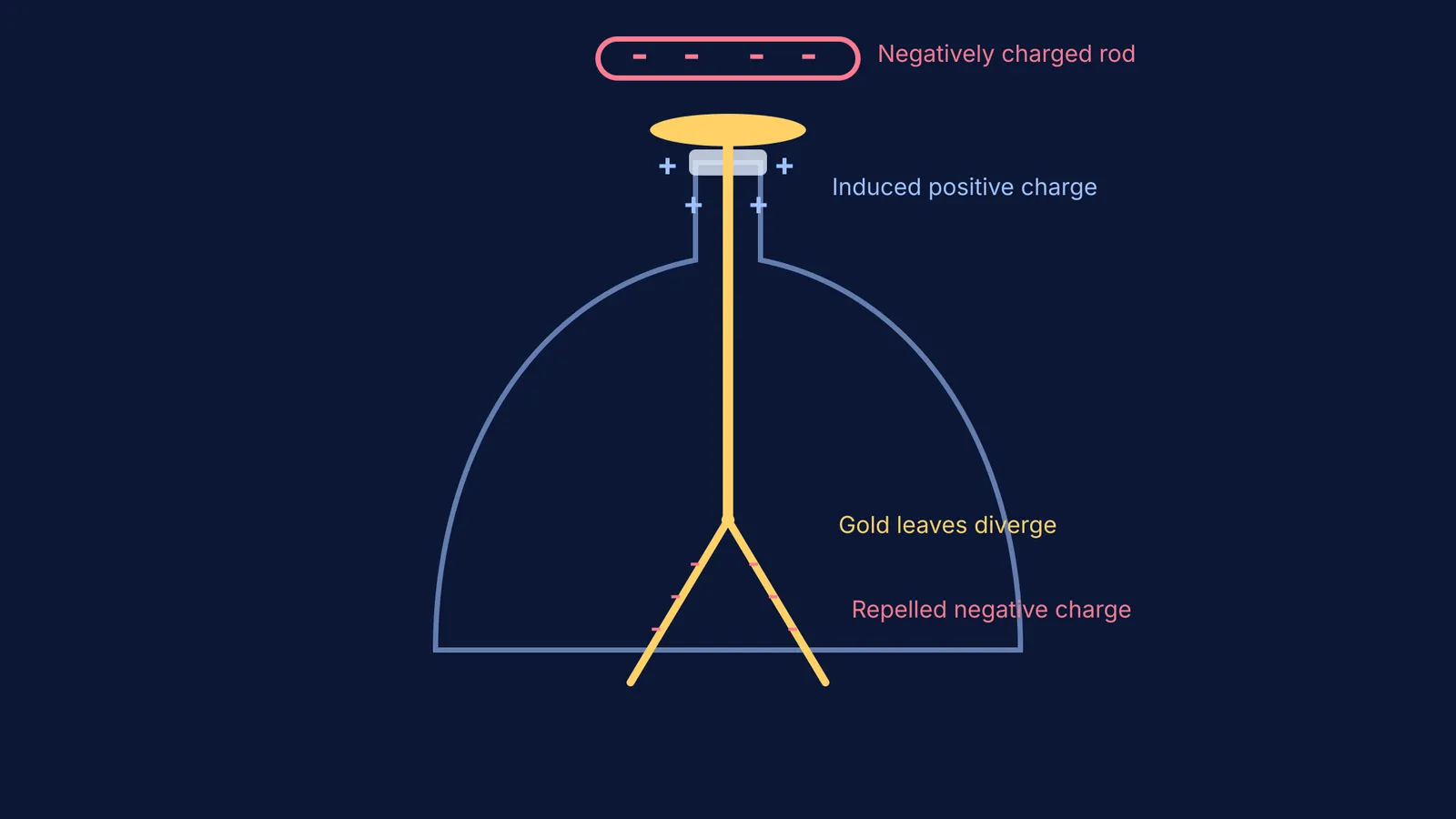
The device relies on extreme lightness to show the tiny forces of static electricity. It was invented by the British scientist Abraham Bennet in 1787. The classic design consists of a vertical brass rod housed inside a glass jar. The top of the rod ends in a metal disc or knob. At the bottom, two incredibly thin, flexible strips of gold leaf hang parallel to each other.
The glass jar protects the delicate leaves from air currents and moisture, while a rubber or plastic plug at the neck stops charge from leaking away. In many designs, you will also see thin strips of tin foil glued to the lower inside of the glass. If the leaves diverge too far, they touch this grounded foil and discharge safely, which prevents the fragile gold from tearing under strong forces.
Why do the leaves diverge?
The electroscope works on a simple rule: like charges repel.
When you touch the top metal disc with a charged object—say, a glass rod rubbed with silk—charge flows from the object down the brass rod and into the gold leaves. Because both leaves receive the exact same type of charge, they push away from each other. This direct transfer of electrons is known as charging by conduction.
Since gold can be beaten into foil that is just a few atoms thick, the leaves have almost no mass. Even the weakest electrostatic repulsion is enough to overcome gravity and make them diverge into an inverted "V" shape. The angle of their divergence tells you the relative strength of the charge: a wider angle means a larger net charge.
How can you find the sign of an unknown charge?
To figure out if an object is positively or negatively charged, you must first give the electroscope a known charge. This creates a baseline to compare against.
This non-contact technique relies on charging by induction. Here is a step-by-step framework to test an unknown charge:
Charge your electroscope positively so the leaves spread apart.
Slowly bring your unknown object near the top disc, but make sure you do not touch it.
Watch the gold leaves carefully as the object approaches.
If the leaves diverge further, the object is positive. It repels more positive charge down the rod, increasing the repulsion at the bottom.
If the leaves collapse slightly, the object is negative. It attracts positive charge up toward the disc, leaving the leaves with less charge to push apart.
If you find the movement of electrons and protons during induction hard to picture, the Fermi Simulation Lab provides interactive models. You can move a charged rod near a virtual electroscope and watch the charges redistribute in real time, making the physics much easier to grasp.
Why do the leaves collapse when touched?
If you touch the metal disc of a charged electroscope with your finger, the leaves instantly drop straight down.
This happens because the human body is a conductor. Touching the disc connects the electroscope to the Earth, creating a path for the charge to escape. The Earth acts as a massive reservoir that can accept or supply as many electrons as needed. If the electroscope had excess electrons, they flow through you and into the ground. If it was missing electrons (meaning it was positively charged), electrons flow up from the ground to neutralize it.
Once the excess charge is gone, the repulsive force vanishes. Gravity simply pulls the gold leaves back together. You see a similar grounding principle when earthing a concentric shell in textbook problems—connecting a conductor to the Earth forces its electrical potential to zero.
What else can an electroscope do?
While mostly used to check the sign of a charge, electroscopes played a surprising role in the history of modern physics. In the early twentieth century, scientists noticed that a fully charged and perfectly insulated electroscope would still slowly discharge and collapse over a few days.
This slow collapse led to the discovery of cosmic rays. High-energy radiation from space constantly passes through the atmosphere, ionizing the air inside the jar. These airborne ions eventually neutralize the gold leaves.
Working through electrostatics problems for the first time can be frustrating. Between calculating the effective g for a charged pendulum bob and balancing forces on point charges, it is easy to get stuck on the math. The Fermi Concept Library maps out each of these ideas into its own lesson, helping you understand the underlying rules before you tackle the equations.


