On this page
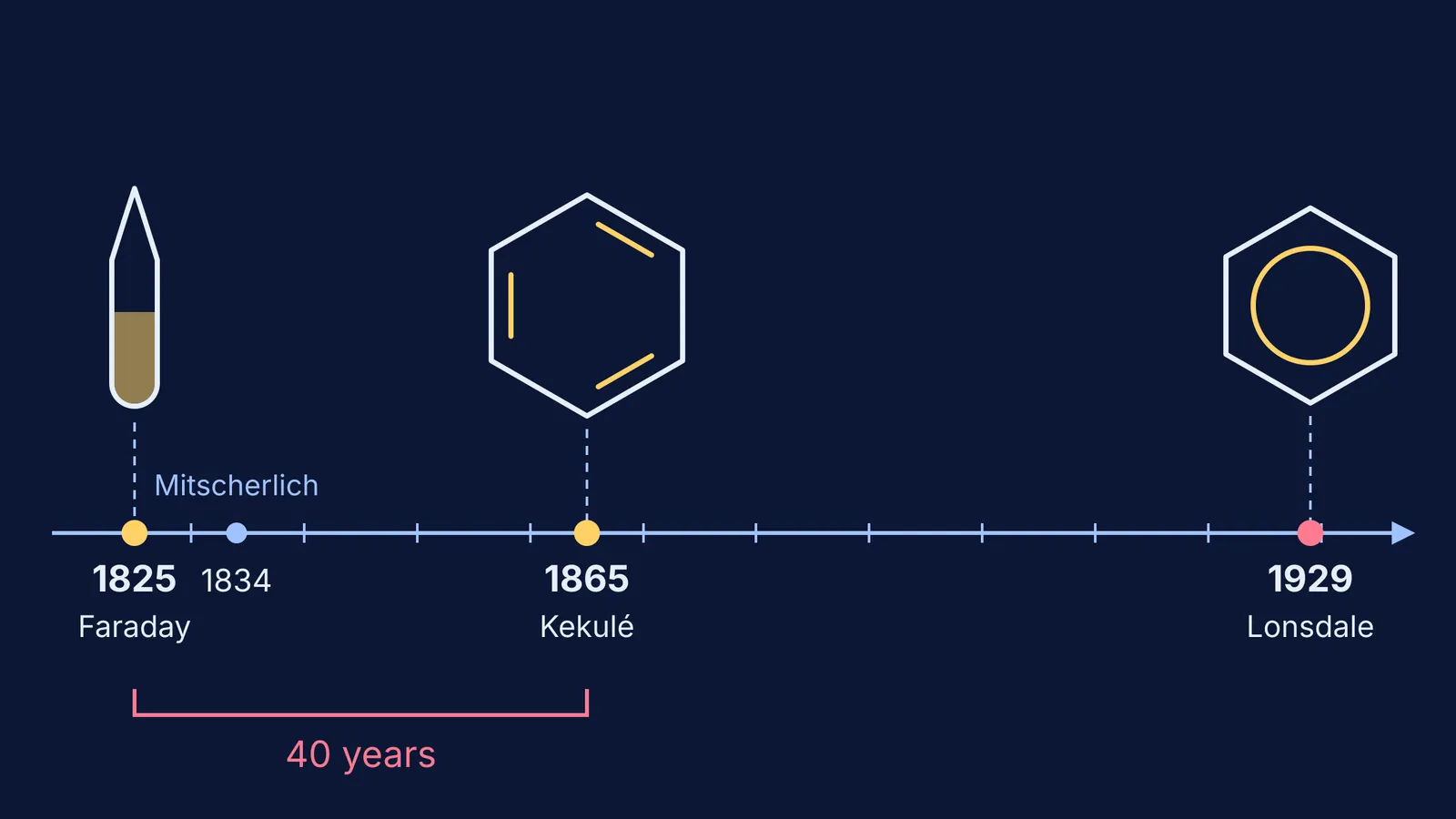
Benzene sits at the centre of much of school organic chemistry. The first person to isolate it was Michael Faraday, working in the basement laboratory of the Royal Institution in London in 1825. His sample, with "bicarburet of hydrogen" scratched on the glass, is on display in the Royal Institution's Faraday Museum.
Where did Faraday's benzene come from?
In the 1820s, some lamps in public and private buildings burned "portable gas". It was made by dropping whale or fish oil into a hot furnace, then compressing the gas and storing it in containers, as the Royal Institution describes.
Faraday's own paper, "On new compounds of carbon and hydrogen", appeared in the Philosophical Transactions of the Royal Society in 1825. He explains that the Portable Gas Company compressed its oil gas to 30 atmospheres, and that an oily fluid condensed in the receiver. He understood that 1000 cubic feet of good gas yielded nearly one gallon of this fluid. A Mr Gordon supplied him with "considerable quantities" of it (full text of the 1825 paper).
How did Faraday isolate benzene?
The fluid was a mixture. It began to boil at 60 °F, and the temperature had climbed to 250 °F before it had all boiled away. Here are his steps, as his 1825 paper describes:
He distilled it, changing the receiver every time the temperature rose by 10 °F, and redistilled the portions many times.
He noticed the boiling point held steady between 176 °F and 190 °F while large amounts of liquid came over.
He put those portions in a freezing mixture. The ones collected at 186 °F and 190 °F went quite hard.
He pressed the solid with chilled blotting paper, then in a Bramah press, to squeeze out the part that stayed liquid.
He distilled the result off caustic lime to remove water.
The Royal Institution says Faraday reported the new compound in a paper to the Royal Society on 16 June 1825.
Why did he call it bicarburet of hydrogen?
Faraday passed the vapour over hot copper oxide and measured the carbon dioxide and water it produced. Across five experiments, the mean result was 11.576 parts carbon to 1 part hydrogen by weight. He blamed the small shortfall on a liquid impurity still in his sample and concluded that the pure compound would give 12 to 1 (1825 paper). In his paper, 12 parts of carbon counts as "two proportionals", so he called it a bi-carburet: two carbons for every hydrogen.
Worked example: get C6H6 from Faraday's own numbers
Use Faraday's figures with today's atomic masses (C = 12, H = 1).
Mass ratio C : H = 12 : 1.
Mole ratio = 12/12 : 1/1 = 1 : 1, so the empirical formula is CH, with a formula mass of 13.
Faraday measured the vapour's density as nearly 40, taking hydrogen as 1 (1825 paper). Molar mass is about 2 × vapour density, so roughly 80 g/mol.
n = 80/13 ≈ 6.2, which rounds to 6. The molecular formula is C6H6.
The modern molar mass of benzene is 78.11 g/mol (Wikipedia: Benzene), so Faraday's vapour density was about 2.4% high. His melting point, very nearly 42 °F (5.6 °C), matches the modern 5.53 °C. His boiling point, 186 °F (85.6 °C) in contact with glass, is about 5.5 °C above the modern 80.1 °C.
What happened between Faraday and Kekulé?
In 1833, Eilhard Mitscherlich made the compound by distilling benzoic acid with lime and called it benzin (Wikipedia: Benzene). His paper, "Ueber das Benzol und die Säuren der Oel- und Talgarten", appeared in the Annalen der Pharmacie in 1834.
In 1865, August Kekulé proposed a ring structure for benzene (Royal Institution): six carbon atoms with alternating single and double bonds (Wikipedia: Benzene). Our story on how Kekulé arrived at the benzene ring picks it up from there.
In 1929, Kathleen Lonsdale used X-ray crystallography on hexamethylbenzene, a crystalline relative, to show the ring is flat and hexagonal (Royal Institution). Read more in how Kathleen Lonsdale proved benzene is flat.
The Royal Institution notes that pure benzene is now used only in controlled industrial processes because it is known to cause cancer (Benzene at 200). This is history to read, not an experiment to try at home.
What can you learn from how Faraday worked?
Three of his habits work in any chemistry problem:
Look for the steady part of the data. He trusted the temperature range where the readings stopped moving.
Purify before you measure. He froze and pressed the sample until it behaved like one substance, and only then analysed it.
Check a result two ways. He backed up his copper oxide results by exploding the vapour with oxygen (1825 paper).
If steps 2 to 4 of the worked example felt shaky, the Fermi Concept Library has a lesson for every concept in chemistry, including empirical and molecular formulae. For practice, the Fermi Problem Library has worked problems with a step-by-step solver that explains the reasoning rather than printing an answer.
Next, see why the ring is so stable in our guide to aromaticity and Hückel's rule.