On this page
In 1969, at J. R. D. Tata's behest, an electrical engineer at Tata Electric Companies was brought in to run a young Tata unit called Tata Consultancy Services. That engineer was Faqir Chand Kohli, and the Computer History Museum's catalogue entry for his oral history describes him as “the Father of the Indian Software Industry”. If you are choosing between computer science and another subject, or wondering how India's IT industry began, his story shows how much of it was built through planning and teaching.
Who was F. C. Kohli?
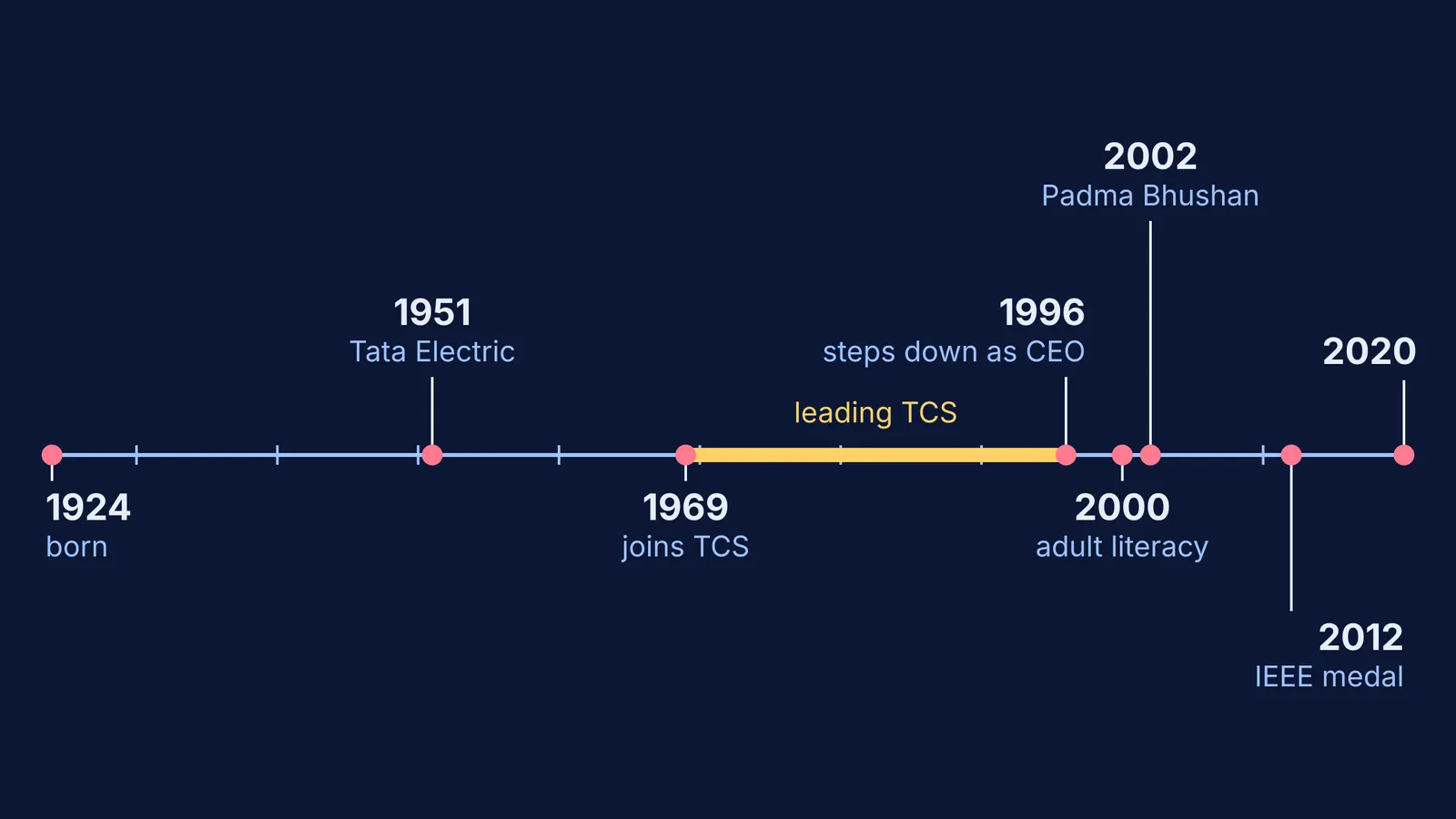
Kohli was born in Peshawar on 19 March 1924 and died on 26 November 2020, aged 96, according to his Wikipedia biography. He went to college in Lahore, then took a BSc (Honours) in electrical engineering at Queen's University in Canada in 1948 and a master's degree at MIT in 1950, as his IEEE history biography records.
He joined Tata Electric Companies in 1951 and brought digital computers into power-system design there, including work on the CDC 3600 mainframe at the Tata Institute of Fundamental Research (Wikipedia). TIFR was also where one of India's first home-built computers was made; you can read how Rangaswamy Narasimhan built TIFRAC.
Why is F. C. Kohli called the father of Indian software?
TCS was set up in 1968 and Kohli joined a year later, according to Tata's heritage article on Kohli. The same article says he recruited “the most promising engineers, chartered accountants, and science and maths postgraduates”. Early work in India included bank reconciliation, payroll and accounting. Abroad, TCS delivered a financial accounting system for a UK housing society, which the article calls the first full software development lifecycle project, and later won a contract that fully used the onsite-offshore model.
During the Y2K work of the 1990s, TCS fixed more than 700 million lines of code, by Tata's account. The same article quotes Kohli on the new revolution in information technology: “If we miss this opportunity, those who follow us will not forgive us.”
Kohli stepped down as CEO in 1996, and he chaired Nasscom, the industry body, in 1994-95, according to The News Minute. He received the Padma Bhushan in 2002 (Wikipedia). In 2012 IEEE gave him its Founders Medal “for early vision and pioneering contributions to the development of the IT industry in India” (ETHW).
How did he push computer education in India?
Kohli treated colleges as part of the industry. He and the TCS team “collaborated deeply with IITs, IIMs, and hundreds of engineering colleges for faculty development, curriculum modernisation and R&D collaboration” (Tata).
In a tribute in Dawn, Sudheendra Kulkarni writes that Kohli helped identify teaching talent for the new IITs and taught some IIT courses himself. As chairman of the board of governors of the College of Engineering, Pune, he twinned it with IIT Bombay, and argued that India “can indeed transform, 50 promising engineering colleges into IIT-like institutions”. Business India's obituary adds that he encouraged IITs and other colleges to start MTech courses in chip design and pressed for computing in Indian languages.
He also took computing beyond colleges. TCS's adult literacy programme, now called Literacy as a Service, launched in 2000 and grew out of an earlier programme whose idea came from Kohli. It teaches reading in nine Indian languages, and more than 24 lakh people have become functionally literate through it, according to Tata's page on the programme.
What can a student learn from F. C. Kohli today?
Here is a four-step plan drawn from his record, with something you can do this term.
Build the base first. Kohli trained in electrical engineering and came to computers through power-system problems. In Class 11, take maths seriously whatever you pick; this guide on choosing Computer Science or Informatics Practices can help.
Point computing at a real job. TCS began with payroll and accounts. Pick one small task at home or school, such as a club's monthly expenses, and write a Python program that does it.
Teach what you learn. Kohli, an industry leader, taught some IIT courses himself. Explain your program to a younger student; the gaps in your own understanding show up fast.
Ask who is left out. His literacy work aimed at adults who could not yet read. Before you call your project finished, ask whether your grandparent could use it in their language.
When a concept in step 2, such as loops, binary or a SQL join, will not make sense, the Fermi Concept Library covers every concept in physics, chemistry, biology, mathematics and computing, each with its own lesson and its place in the map. If you are weighing degrees next, compare BSc Computer Science and BTech CSE before you fill in counselling forms.
Kohli worked at the TCS office until 16 March 2020, a few days before his 96th birthday (Business India). Start your small program this week.