On this page
In short
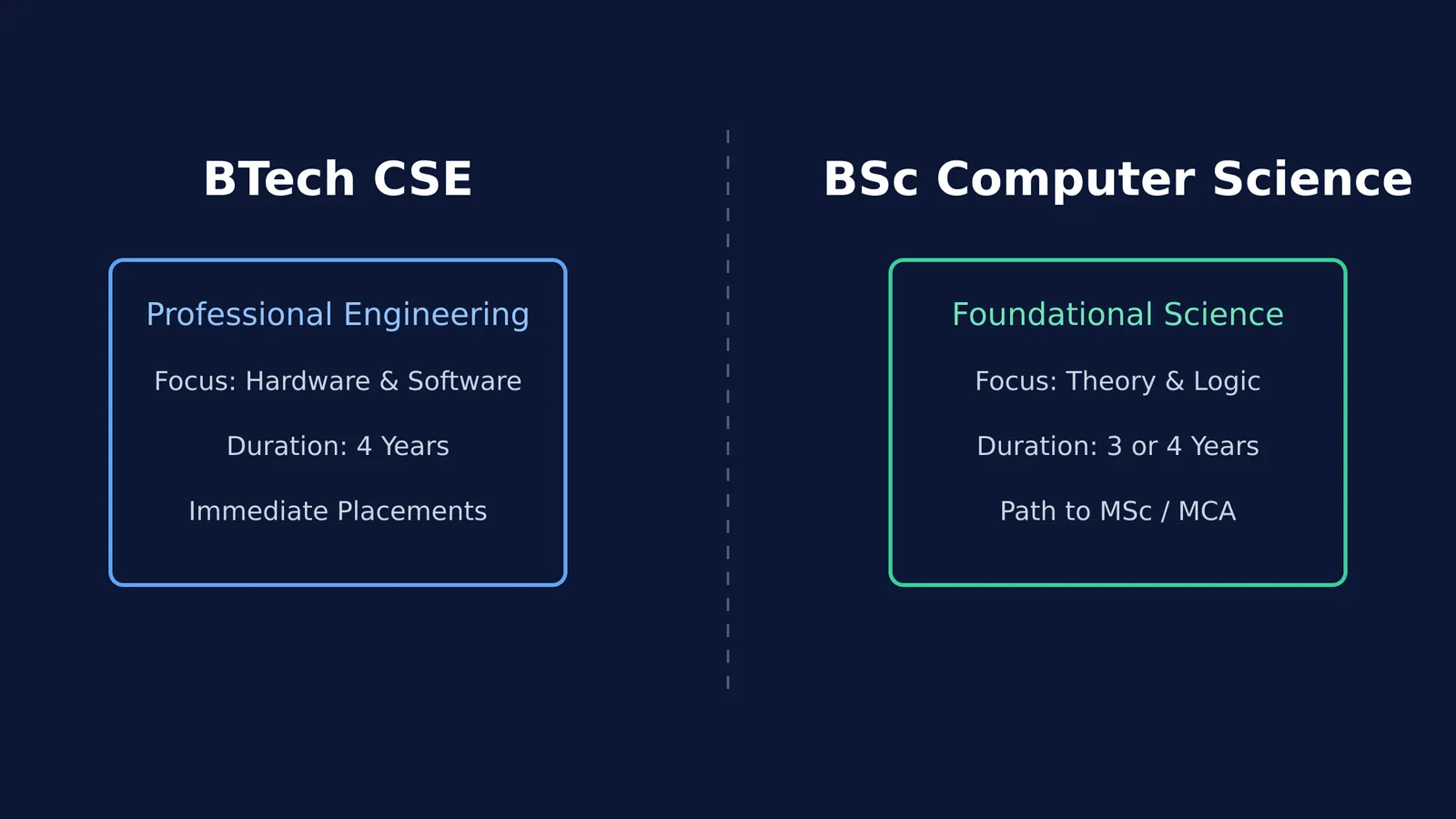
BTech CSE is a professional engineering degree with high starting salaries and strong campus placements. BSc Computer Science is typically a theoretical science degree with lower fees, though the UGC's NEP 2020 framework allows a four-year Honours track.
Choosing between a Bachelor of Science (BSc) in Computer Science and a Bachelor of Technology (BTech) in Computer Science and Engineering (CSE) is a major decision for students in India. Both paths lead to rewarding tech careers, but they take different approaches to learning, overall cost, and immediate job prospects after graduation.
If you are looking ahead to Your first semester at science or engineering college: what changes, understanding the structural differences between these two degrees helps you plan your academic journey and set realistic career expectations.
What is the difference in curriculum?
BTech CSE is a professional engineering degree regulated by the All India Council for Technical Education. The curriculum focuses heavily on practical application, hardware-software integration, and engineering mathematics. Students are required to complete mandatory internships and industry-oriented projects to build a portfolio before they graduate.
BSc Computer Science is a foundational science degree governed by the University Grants Commission (UGC). It emphasises theoretical computer science, mathematical logic, complex algorithms, and data structures. It involves more classroom-based analytical thinking and significantly less hardware engineering than the BTech route.
If you struggle with the intense mathematical or engineering physics concepts in the first year of a BTech, Fermi's AI tutor can help by working out what you already know and building a plan for the session, so you sit down to a clear next step.
Which degree costs more?
The financial commitment differs significantly between the two academic programmes.
BTech CSE is generally a much more expensive professional degree. Annual fees in private engineering colleges are significantly higher than most BSc programmes. Government institutions are subsidised, but they still require a substantial financial investment over the course of the degree.
BSc Computer Science is much more affordable in both government and private colleges. This lower fee structure makes the degree highly accessible and leaves budget room for future postgraduate studies. For students exploring Part-Time Jobs for College Students: Finding the 20-Hour Balance, the BSc schedule is often slightly less rigid than BTech laboratory sessions.
Do BTech CSE and BSc CS have the same job placements?
Right out of college, the tech job market strongly favours the BTech CSE degree.
Major tech companies and large IT service firms run aggressive campus placement drives primarily targeting BTech students. They recruit these graduates for roles such as Software Engineer or DevOps Engineer, offering higher starting salaries due to their practical engineering training.
BSc Computer Science graduates usually enter the industry as Data Analysts, Web Developers, or Technical Support staff. However, this pay gap often closes quickly if the BSc graduate earns a Master of Computer Applications (MCA) or MSc in Computer Science. When practicing for technical coding interviews, the Fermi Problem Library has worked problems with a step-by-step solver that explains the reasoning rather than printing an answer, helping you build strong logical foundations.
What are the paths to higher education?
A BTech CSE is the standard prerequisite for direct entry into most Master of Science (MS) programmes in the United States and MTech programmes in India, as it fulfills the standard duration requirement.
A traditional BSc CS is a widely accepted degree for Master's programmes in the UK and Australia, but students applying to the US may need an extra year of study (such as a postgraduate diploma) to meet their stringent education requirements. If you receive a Conditional offer from a foreign university: what it means, you might be asked to complete specific bridge courses before starting your master's degree.
How should you make your choice?
Use this simple framework to decide between the two:
Choose BTech CSE if you have cleared competitive entrance exams (like JEE Main), want strong campus placement support immediately after graduation, and prefer building applied engineering projects.
Choose BSc CS if your interest lies purely in programming logic and theory, you prefer a merit-based admission without the stress of engineering entrances, or you plan to save money now to invest in an MCA or study abroad later.