On this page
Working while studying is no longer just about gaining extra pocket money; for many, it is an economic necessity. Whether you are tutoring juniors, handling freelance design, or working in retail, a part-time job changes how you approach your week. Balancing the demands of a university curriculum with external work commitments requires a thoughtful strategy to avoid burnout. But how many hours can you work before your grades begin to slip?
Why are more students working?
The financial pressures of college have increased. For students from low-income households, part-time work is often the only way to cover living expenses, pay for study materials, or support their families. Globally, between 43% and 59% of university students hold part-time jobs during their studies (10.54097/4pe1s927), and this trend is growing in India. Beyond financial necessity, there is also a strong drive to build a professional profile early. In a job market that increasingly values practical experience over raw degrees, students are seeking opportunities to demonstrate communication, teamwork, and problem-solving skills before graduation.
Simultaneously, the rise of the gig economy has made flexible work more accessible than ever. Students can now write code, manage social media campaigns, or teach online from their dorm rooms without having to commute to an office. This flexibility allows them to fit work around their lecture schedules and exam periods.
The 20-hour threshold: how much is too much?
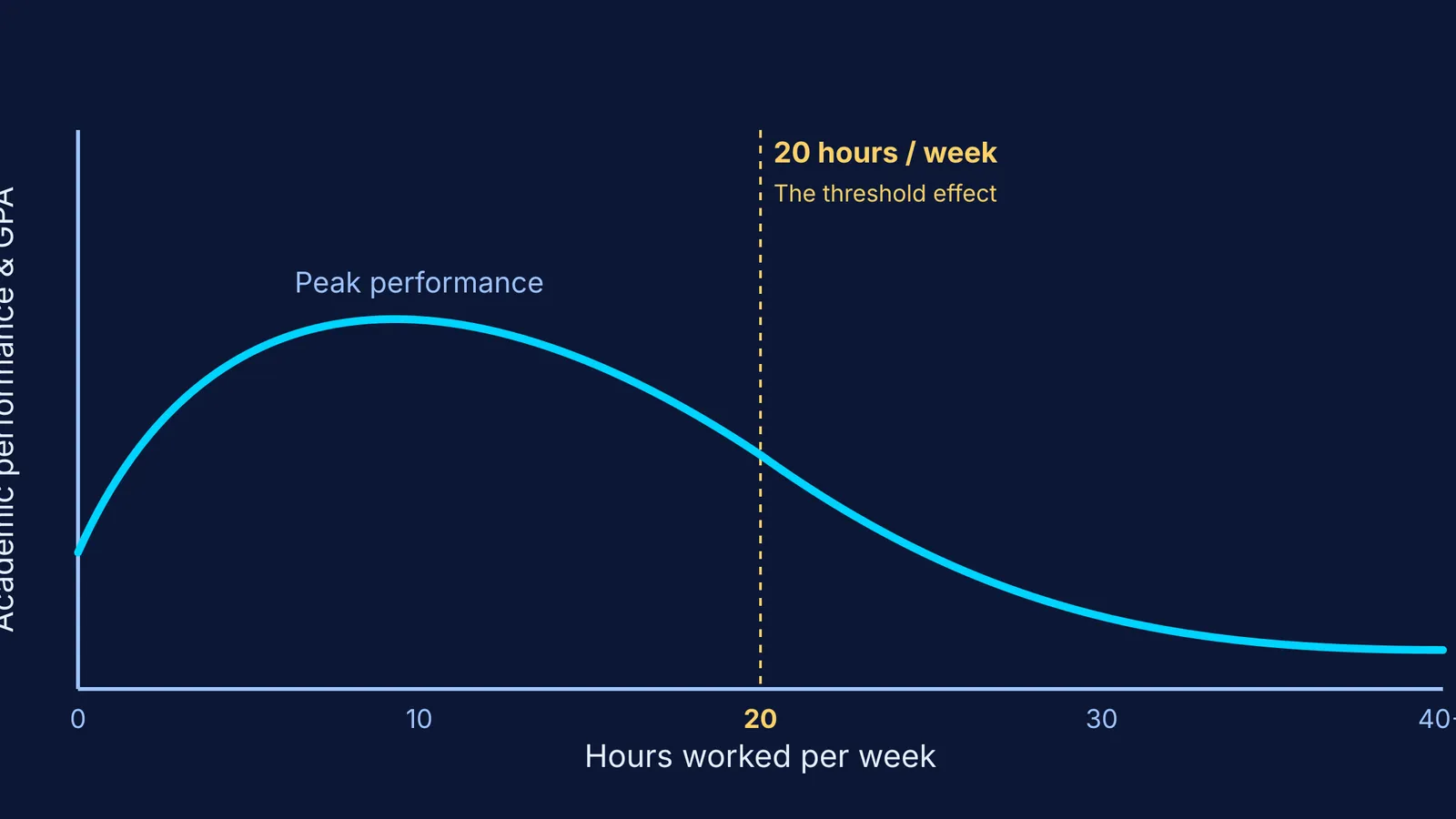
It might seem logical that any time spent working takes away from study time, thereby lowering your grades. However, educational research shows a clear "threshold effect," indicating that the relationship between working hours and academic performance is not a simple straight line.
A review of student employment found a complex, dual impact on academic success (10.54097/4pe1s927). The study notes that "moderate working hours, related work and on-campus employment are beneficial to academic performance." Students working moderate schedules of up to 15 hours a week often develop better time management skills. Because their free time is limited, they are forced to plan their days meticulously and avoid procrastination. This heightened discipline can actually lead to a higher GPA, as they become more efficient at absorbing material during their scheduled study blocks.
However, the picture changes abruptly at the 20-hour mark. Working more than 20 hours a week is strongly associated with increased stress, missed classes, and a significant drop in academic engagement. Once you cross this threshold, work stops building discipline and starts displacing essential study time, leaving you too exhausted to tackle complex coursework.
What are realistic part-time jobs for college students in India?
If you are looking to work while keeping your hours moderate, flexibility should be your primary priority. You need a role that can scale down during midterms and finals.
Private tutoring: Teaching school students remains one of the best-paying and most flexible options. It also reinforces your own foundations in core subjects, which is particularly useful if you are in a STEM field.
Freelancing and gig work: Roles in content writing, graphic design, and web development allow you to set your own hours. You take on only as much work as your current semester allows, building a portfolio of real-world projects along the way.
Campus roles: While less common in India than in some other countries, some institutions offer paid roles as lab assistants, library staff, or campus ambassadors. These jobs respect your academic calendar and keep you integrated into the campus environment.
How can you protect your study time?
When your schedule is packed with both lectures and work shifts, every hour counts. The last thing you want is to spend two hours stuck on a single concept, whether you are calculating the time for a block to slide down a rough incline or reviewing the electron dot structures of covalent molecules.
Block your week: Treat your study blocks with the same respect as your work shifts. Schedule them in your calendar and do not let other activities encroach on that protected time.
Prioritise active learning: Passive reading is too slow when time is tight. Test yourself early and often with practice questions to identify exactly where your gaps are.
Get unstuck fast: You cannot afford to lose an evening searching the internet for clues. This is where an AI tutor helps. Fermi's AI tutor can work out what you already know and build a plan for the session, so you sit down to a clear next step. If you are stuck on a specific question, the Fermi Problem Library has worked problems with a step-by-step solver that explains the reasoning rather than just printing an answer.
Balancing a job and a degree is demanding, but by keeping your hours below the 20-hour threshold and using your study time efficiently, you can build your resume and support yourself without sacrificing your academic success.