

On this page
In the late 1950s, Rangaswamy Narasimhan led the team at the Tata Institute of Fundamental Research (TIFR) to build TIFRAC, India's first indigenous digital computer. Inaugurated in 1960, the machine used 2,700 vacuum tubes and 2,048 words of ferrite core memory, launching India into the computer age.
In the 1950s, electronic digital computers were rare and staggeringly expensive. Building one required vast resources, yet India's scientific establishment—led by Homi J. Bhabha—recognised that the country could not rely solely on imported machines to advance its research. He recruited Rangaswamy Narasimhan, a mathematician who had studied at Caltech and Indiana University, to lead a project to build an Indian computer from scratch.
The result was a monumental achievement in engineering and self-reliance that served as the backbone of Indian computing for a decade.
What was the TIFRAC computer?
Development of the machine began in 1955. A pilot model was operational by 1956, and the full-scale machine was formally commissioned and named TIFRAC (Tata Institute of Fundamental Research Automatic Calculator) by Prime Minister Jawaharlal Nehru in 1960.
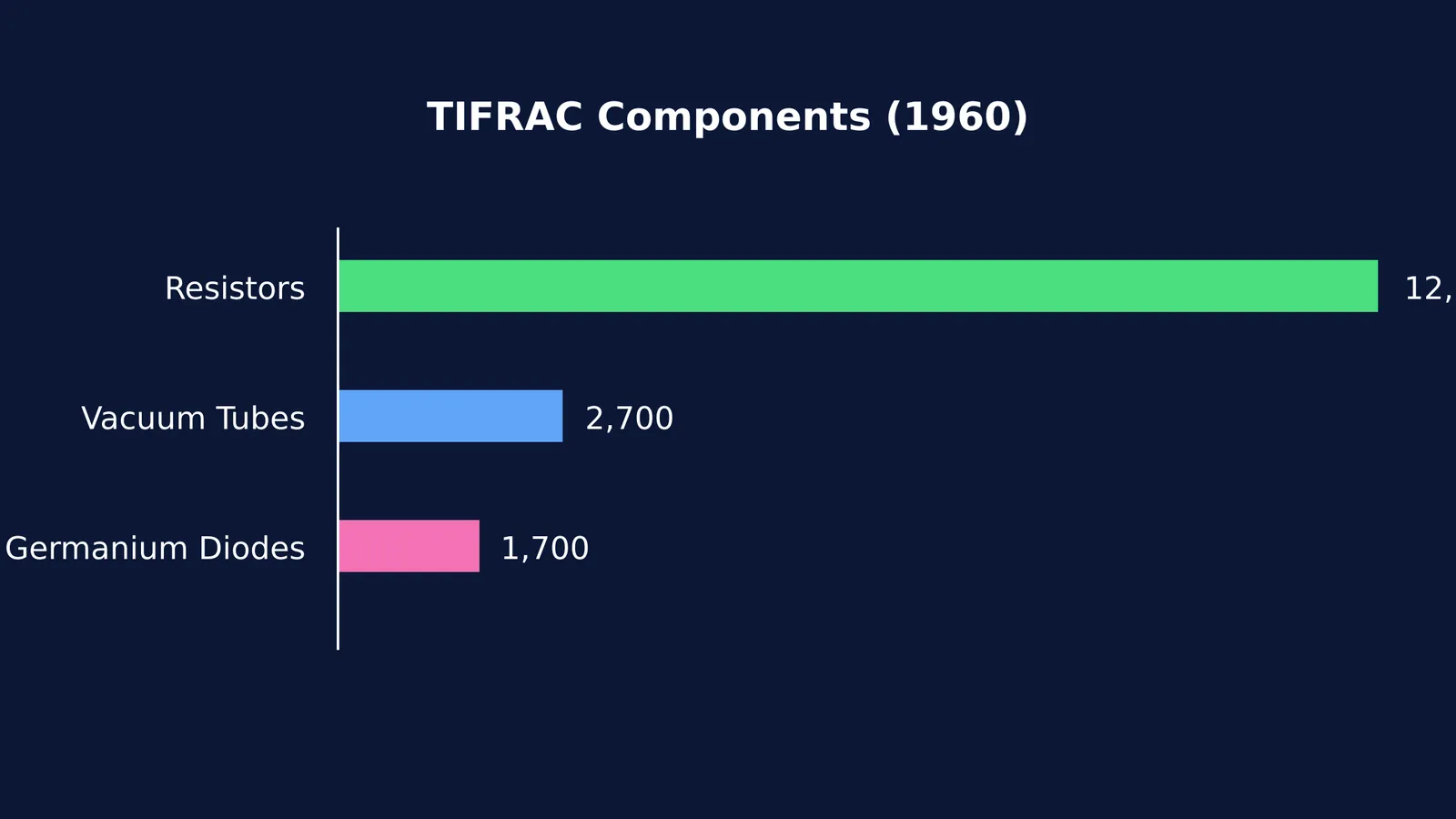
By modern standards, TIFRAC was a behemoth that required significant infrastructure to operate. The main assembly was housed in a massive steel rack measuring 18 feet long, 8 feet high and 2.5 feet deep. It relied on a staggering number of discrete components, including 2,700 vacuum tubes, 1,700 germanium diodes, and 12,500 resistors.
Despite its massive physical footprint, it was technologically ambitious. It was an early adopter of ferrite core memory, featuring 2,048 words of 40-bit memory. A cathode-ray tube (CRT) display was also developed for both analogue and digital readouts of graphs and alphanumeric symbols. The input and output were managed through a manual console, and scientists often had to prepare their programs on punched tape.
Today, learning the logic gates and binary systems that run machines like TIFRAC does not require a room full of vacuum tubes. You can trace these ideas in the Fermi Concept Library, which covers every concept in physics, chemistry, biology, mathematics and computing, each with its own lesson and its place in the map.
How did Rangaswamy Narasimhan shape Indian computing?
Narasimhan was not just the architect of TIFRAC; he became the institutional father of Indian computer science.
The machine he built served as the primary computational workhorse for Indian scientists until 1965, proving that the country could develop complex, high-technology systems independently. However, his vision extended beyond a single machine. In 1965, he founded the Computer Society of India (CSI) and served as its first president.
He was also deeply interested in cognitive science and syntactic pattern recognition. He pioneered the syntactic approach to pattern recognition, proposing that images have an underlying "grammar" much like text. If you are solving complex boolean logic or pattern recognition problems and cannot spot the next step, the Fermi Problem Library has worked problems with a step-by-step solver that explains the reasoning rather than printing an answer.
Narasimhan later directed the National Centre for Software Development and Computing Techniques (NCSDCT), laying the groundwork for India's massive software industry.
How did language and cognitive science influence his work?
After completing the TIFRAC project, Narasimhan turned his attention to how humans process information. He conducted extensive research into language acquisition in children and the role of language in problem-solving. He argued that language behaviour cannot be explained by syntax alone, asserting that knowledge of the world, multi-modal perception and understanding the context play valuable roles in how we use language.
This interdisciplinary approach allowed him to draw fascinating parallels between human vision—specifically retinal image processing—and computer-based syntactic techniques. He was a visionary who understood that the future of computing lay not just in faster calculations, but in bridging the gap between machines and human cognition.
What was the legacy of TIFRAC?
TIFRAC was eventually dismantled and replaced by imported, commercially manufactured machines, which offered greater speed and reliability as solid-state transistors completely replaced the older vacuum tubes. But the team that designed and built it had already changed the country's trajectory forever.
Just as other early machines opened up new horizons—such as Tommy Flowers and Colossus, the codebreaking computer and Konrad Zuse and the Z3: a programmable computer built from relays—TIFRAC proved that Indian engineers could push the boundaries of modern science. It remains a powerful symbol of early scientific independence.


