On this page
Heat a magnet past a certain temperature and it stops being a magnet. In 1925 a young German physicist, Ernst Ising, studied the simplest picture he could find: a row of tiny magnets that can only point up or down. The answer was disappointing, yet the model named after him became one of the main tools for studying phase transitions.
What is the Ising model?
In his 1936 paper on Ising's model, Rudolf Peierls put it simply: N tiny magnets sit on a regular lattice, each pointing one of two ways, and each pair of neighbours pointing opposite ways costs extra energy.
In today's notation, each spin s is +1 or −1, and the energy is E = −J Σ s_i s_j, summed over neighbouring pairs, as set out on the Ising model page. With J positive, aligned neighbours lower the energy; temperature shakes spins at random.
Ising's 1925 paper cites his supervisor Wilhelm Lenz and Pierre Weiss's 1907 work on ferromagnetism; see how Pierre Weiss explained ferromagnetism with magnetic domains.
Who was Ernst Ising?
Ising was born in Cologne on 10 May 1900 and died in Peoria, Illinois, on 11 May 1998, according to a biography hosted by TU Dresden's physics institute. He finished his doctorate at Hamburg in 1924 under Lenz, who suggested the topic; a 2026 editorial in the European Physical Journal B notes that many think it should be called the Lenz-Ising model.
His later life was hard. The same page records that he lost his civil-service job in 1933, later headed a boarding school for Jewish children near Potsdam, emigrated to Luxembourg in 1939 and was made to work for the German army during the occupation. He reached New York in 1947 and was a physics professor at Bradley University from 1948, becoming emeritus in 1976. The EPJ B editorial adds that only then, 23 years after his thesis, did he learn that the "Ising model" had entered the literature; he never returned to active research.
Why does a 1D chain of spins never magnetise?
Check Ising's result on paper with a chain of 10 spins.
All 10 spins up: there are 9 neighbouring pairs, each aligned, so E = −9J.
Flip the last 4 spins: 8 pairs aligned, 1 opposed, so E = −8J + J = −7J. One "wall" between up and down costs 2J.
Flip the last 7 instead: still one wall, still 2J. In one dimension a wall costs the same however big the flipped block is.
Count the options: in a chain of N spins, that wall can sit in any of N − 1 gaps. Heat favours having many options, so for a long chain adding walls pays off at any temperature above zero.
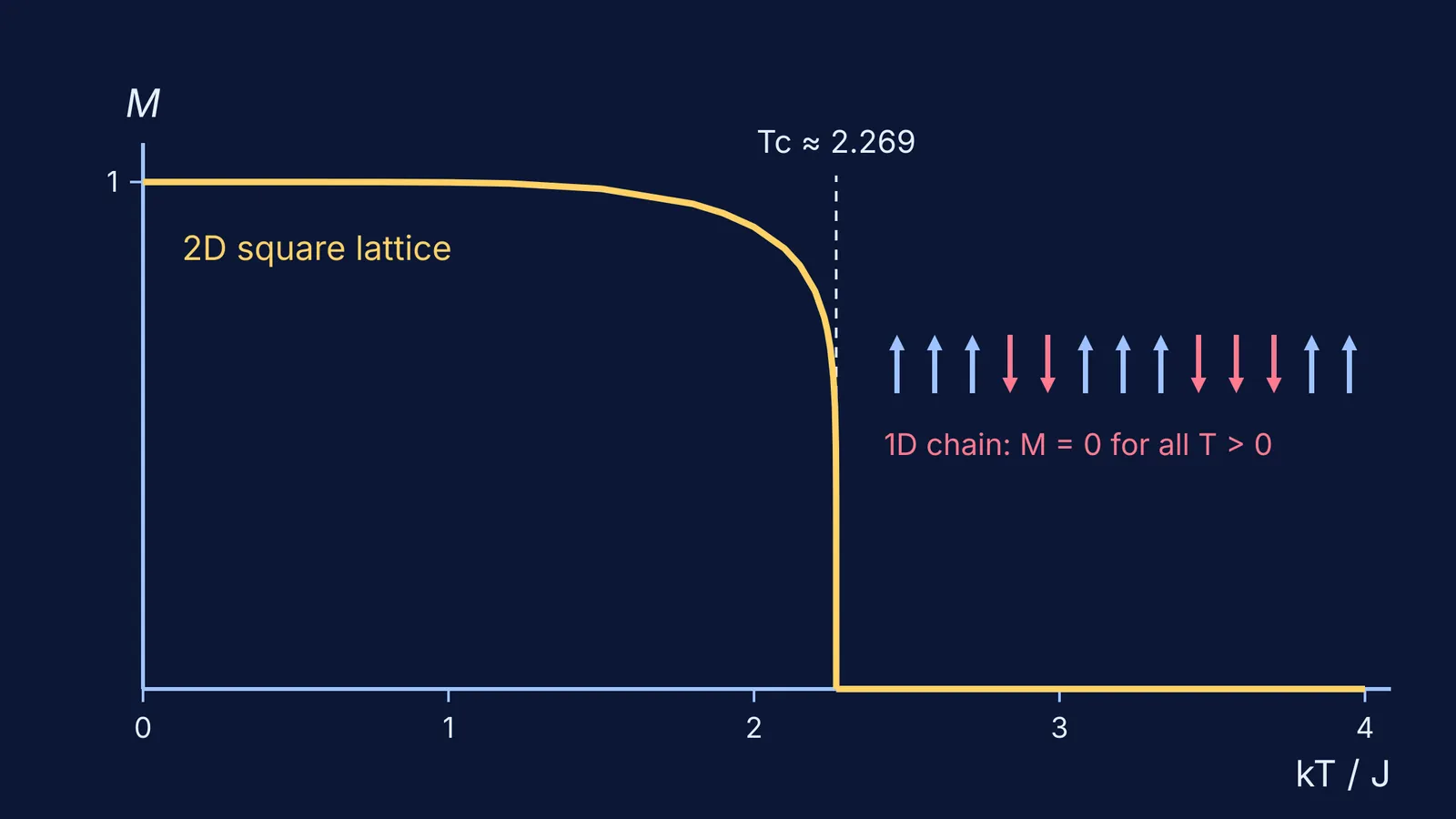
So a long chain breaks into up and down blocks, and the average magnetisation goes to zero. Ising solved the chain exactly and found no phase transition in one dimension.
In two dimensions the counting changes. A flipped square island of side L on a square grid has 4L opposed pairs on its border, so it costs 8JL. Big islands become expensive, and at low temperature order survives. Peierls turned this into a proof in 1936, says the EPJ B editorial.
How did the Ising model become so important?
Lars Onsager's 1944 paper in Physical Review solved the two-dimensional model exactly.
For the square lattice the critical temperature is kTc/J = 2/ln(1 + √2) ≈ 2.269, as given on the square-lattice Ising model page. Kramers and Wannier had already found that temperature in 1941, and C. N. Yang worked out the spontaneous magnetisation in 1952. The three-dimensional model still has no exact solution, according to the EPJ B editorial. Physicists study it with other methods, including Monte Carlo simulations; see how Stanislaw Ulam's solitaire game led to Monte Carlo.
The same editorial quotes physicist Giorgio Parisi's foreword to a recent book on the model:"In theoretical physics, few threads are as deceptively simple and profoundly influential as the Ising model." It has been applied well beyond magnets: to atoms on a lattice (the "lattice gas"), firing neurons and the Hopfield network in machine learning, as the Ising model page describes. Crossref lists more than 3,000 works citing Ising's paper and more than 5,000 citing Onsager's.
The model's critical temperature plays the role of a real magnet's Curie temperature, named after Pierre Curie.
How should you study the Ising model?
Do the 10-spin count above yourself, then try a 3 × 3 grid and count its bonds.
Keep energy (how many neighbours disagree) separate from the number of arrangements (how many ways that can happen).
Sketch magnetisation against temperature for a chain and for a grid, then compare with the figure at the top.
Spins flipping on a grid are easier to see than to read about. Fermi's Simulation Lab has interactive simulations for ideas like that. If terms like spin, domain or Curie temperature are still shaky, the Fermi Concept Library gives each concept its own lesson.