

On this page
When mathematician Stanisław Ulam was convalescing from a serious illness in 1946, he spent much of his time playing a card game called Canfield solitaire. Because he was a mathematician, he naturally tried to calculate the exact probability of winning a hand. However, he found that the pure combinatorial calculations required to determine the odds for a 52-card deck were far too complex Wikipedia. Rather than getting lost in abstract mathematics and formulas, he decided to just lay the game out repeatedly, play it through, and count how often he won.
This simple insight—using repeated random trials to estimate a complex answer when analytical math fails—became the foundation of modern probabilistic simulation. It changed how researchers solve difficult, messy problems in physics, chemistry, and applied mathematics.
What is the history of the Monte Carlo method?
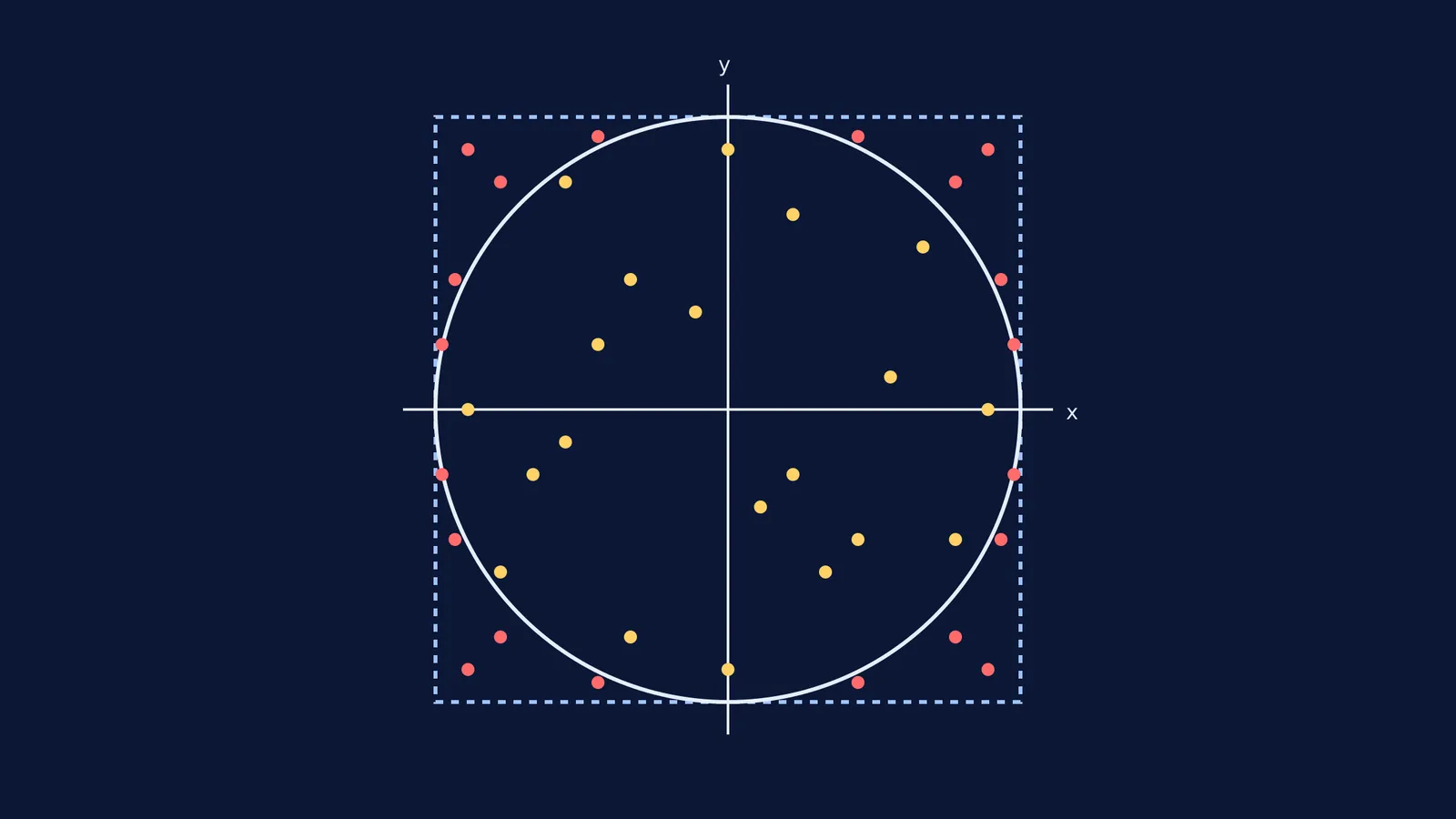
The Monte Carlo method is a computational algorithm that relies on repeated random sampling to obtain numerical results. It was formally invented in 1946 by Stanisław Ulam while he was working on nuclear projects at the Los Alamos National Laboratory Wikipedia. The physicists there were stuck trying to solve complex deterministic equations for neutron diffusion in fission reactions, finding the traditional algebraic methods completely unworkable.
Ulam shared his statistical sampling idea with John von Neumann, who quickly saw its potential for the newly developed electronic computers. In the spring of 1948, von Neumann and his colleague Nicholas Metropolis programmed the ENIAC computer to run the first fully automated Monte Carlo calculations Wikipedia. Metropolis gave the new method its code name, inspired by Ulam's uncle, who was known to routinely borrow money from relatives to gamble at the famous Monte Carlo Casino in Monaco.
How did playing Canfield solitaire lead to a breakthrough?
Ulam's breakthrough came from realising exactly when to stop attempting a pure mathematical proof. He later recounted the moment of inspiration clearly: "I wondered whether a more practical method than 'abstract thinking' might not be to lay it out say one hundred times and simply observe and count the number of successful plays" Wikipedia.
Instead of trying to find an exact algebraic formula for those 52 cards, he built a simulation.
When you are preparing for exams, you often hit a very similar wall. You might stare at a tricky physics problem, trying desperately to recall the perfect formula or the analytical path. If you cannot find it, you might be tempted to leave the page blank and move on. Ulam's insight shows that sometimes, running a mental or visual simulation is significantly more powerful than searching for the right equation. This is where Fermi Simulation Lab helps; it provides interactive simulations for the ideas that are easier to see than to read, letting you observe the physics as it happens in real time.
Why does abstract thinking sometimes fail?
Combinatorial calculations grow exponentially, which is why calculating the exact odds for a 52-card deck was too hard even for a world-class mathematician.
In your physics and chemistry studies, you will find that some systems are just too messy for simple equations. A projectile in a perfect vacuum is easy to calculate, but once you add realistic air resistance, the equations become tangled. Rather than getting stuck, you can break the problem into tiny time steps and simulate what happens in each one. If you want to see how this works in practice, reading about Learning projectile motion with a simulation: 6 predictions shows how observing physical outcomes can confidently bypass the need to memorise complex formulas.
How to apply the Monte Carlo approach to your exam prep?
You do not need an ENIAC supercomputer to use Ulam's practical philosophy in your studies. When you are stuck on a difficult numerical problem, shift your entire strategy from pure calculation to rough estimation and trial.
Here is a practical framework to use when the standard analytical method fails you:
Estimate the extremes: What happens if the mass is exactly zero? What if the angle is 90 degrees? Establishing the physical boundaries often eliminates three wrong options immediately.
Plug in easy numbers: If a variable-heavy problem is confusing you, substitute x = 1 and y = 2. Run your own mental simulation with real numbers to see how the system behaves.
Draw the states: Sketch the initial state and the final state on your rough paper. This gives you a visual count of what is happening, much like laying out the cards on a table.
Use step-by-step reasoning: If you are still unsure how to reach the final equation after estimating, the Fermi Problem Library has a step-by-step solver that explains the reasoning rather than printing an answer.
Sometimes, an effective way to solve a hard problem is not to think harder, but to just run the experiment and observe the results. That shift in perspective changed how we compute everything from fluid dynamics to global finance, and it can change how you tackle your next exam paper. You can explore more about this fundamental shift by reading What PhET research says interactive physics simulations are good for.


