

On this page
Many biology textbooks show a row of tiny curled embryos: fish, chick, pig, human, looking almost the same. That picture traces back to Ernst Haeckel, a German zoologist who championed Darwin's ideas. His claim was catchy, and wrong in the way he meant it.
What did Haeckel mean by "ontogeny recapitulates phylogeny"?
Haeckel proposed the biogenetic law in 1866, in his book *Generelle Morphologie der Organismen*, according to the Embryo Project Encyclopedia at Arizona State University. Ontogeny is the development of one individual; phylogeny is the evolutionary history of its lineage.
The biogenetic law says that the stages an embryo passes through replay, in order, its species' past adult forms. On this view a human embryo briefly "is" a fish, then something like a reptile.
What did Haeckel's embryo drawings get wrong?
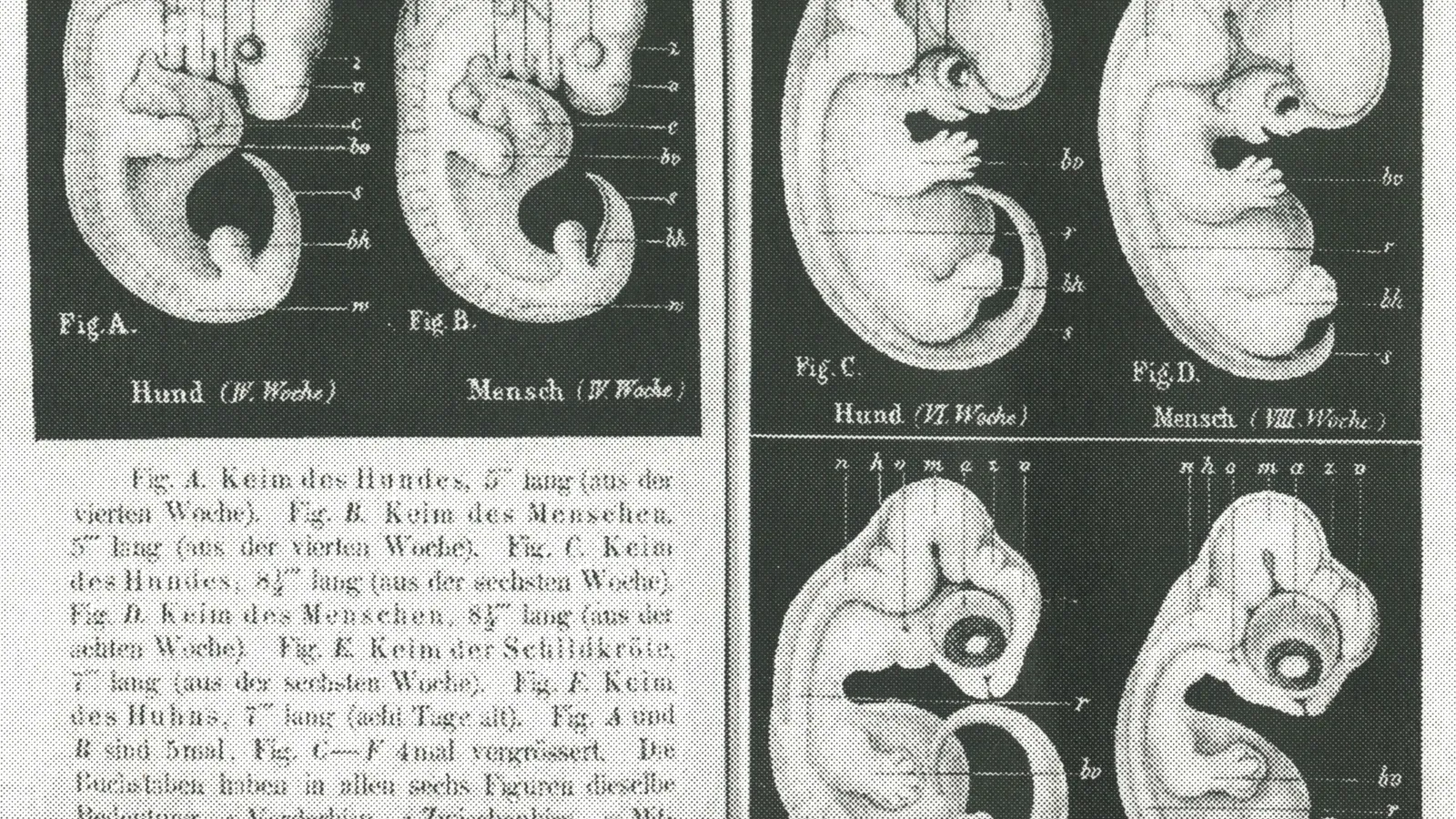
Haeckel backed the law with drawings, and they were the problem.
One picture, three animals. In his 1868 *Natural History of Creation*, Haeckel had a single wood-engraving block printed three times to stand for the embryos of three different species, as the University of Cambridge's Visible Embryos exhibition by historians Tatjana Buklijas and Nick Hopwood records.
Similarity exaggerated. His 1874 *Anthropogenie* set eight vertebrate embryos side by side at three stages, as The Scientist describes. The anatomist Franz Keibel tried to recreate Haeckel's drawings from his own specimens and concluded that Haeckel had exaggerated how similar the embryos were, notes the Embryo Project Encyclopedia.
Real embryos differ more. Michael Richardson and colleagues compared actual vertebrate embryos at the tailbud stage, a supposedly conserved stage Haeckel drew as near-identical, and found more than 10-fold variation in greatest length (Anatomy and Embryology, 1997). They found the closest resemblance between vertebrate embryos below the level of the whole subphylum, and concluded there is no highly conserved embryonic stage shared by all vertebrates.
Was it fraud? Historians still argue. The National Center for Science Education reports that historian Robert Richards described the figures as the best illustrations available at the time, while Richardson's photos suggest Haeckel "took considerable license" with the earliest embryos. A 2002 review by Richardson and Gerhard Keuck in Biological Reviews calls some criticisms of the drawings legitimate, and adds that Haeckel did not necessarily hold the strict version of recapitulation usually pinned on him.
Do human embryos really have gill slits?
No. Human embryos have pharyngeal arches, ridges on the side of the neck region that appear in the fourth week of development, according to Kenhub's anatomy library. In fish, the same kind of structures support gills. In you, the first arch builds the upper and lower jaw and two middle-ear bones (malleus and incus), and the second contributes the stapes and the muscles of facial expression (Kenhub).
So a human embryo never has a fish's gills. Humans and fish share an embryonic starting kit from a common ancestor, and each lineage builds something different from it.
What does embryology really show?
The pattern that survived is closer to Karl Ernst von Baer's: embryos of related animals diverge from one another as development goes on, rather than climbing through ancestral adult forms (Embryo Project Encyclopedia). We cover the two side by side in embryological evidence: Haeckel vs von Baer, and von Baer's own story in how Karl Ernst von Baer discovered the mammalian egg.
Modern biology refines this into the hourglass model: embryos of a group differ more early and late in development than in the middle (Kalinka et al., Nature 2010). That narrow middle is called the phylotypic stage.
Gene data now back the hourglass. Across six fruit-fly species, gene expression was most conserved during the mid-embryo phylotypic period (Kalinka et al., Nature 2010). In zebrafish, the phylotypic stage expresses the evolutionarily oldest set of genes, with younger genes used earlier and later, and comparisons with flies and nematodes showed the same pattern (Domazet-Lošo and Tautz, Nature 2010). They note the stage, once read as ancestral replay, is now thought to reflect developmental constraints.
How do you write this in an exam answer?
Use this four-line plan for a 3-mark "embryological evidence" question:
State the claim: Haeckel's biogenetic law says ontogeny recapitulates phylogeny.
Give the observation: vertebrate embryos share features such as pharyngeal arches and a tail that adults may lack.
Give the correction: von Baer argued that embryos do not pass through the adult stages of other animals; they resemble other embryos, not other adults.
Give the conclusion: shared embryonic features point to common ancestry.
Before you trust any "embryos replay evolution" diagram, check:
Does it compare embryos with embryos, or with adults?
Is it a drawing or a photograph?
Does it show one "identical" stage, or differences early and late?
If phylotypic stage, pharyngeal arch and homology still blur together, the Fermi Concept Library gives each biology concept its own lesson and its place in the map, so you can see how they connect.
Haeckel's tidy row of embryos lasted because it was easy to remember. The real story is messier, and embryos are not marching towards a goal either: read why evolution is not goal-directed.


