On this page
On a hot Sunday evening in July 1893, a young man named James Cornish was stabbed in the chest during a fight in a bar on Chicago's South Side. He was carried to a small hospital that had opened two years earlier in a converted house. The surgeon who founded it, Daniel Hale Williams, did something most doctors of his day would not do: he opened the chest and repaired the damage close to the heart. Cornish lived.
What happened in the 1893 operation?
A detailed modern account is an essay by physician Gregory Schneider in The Pharos (Spring 2021), built on earlier medical-history papers and on Williams's own case report. Here is the sequence it gives.
9 July, 7:30 p.m.: Cornish, aged 24, arrives at Provident Hospital alert and talking. Williams chooses close observation, the standard care of the time, because leading authorities had ruled out surgery near the heart.
10 July, morning: Cornish has severe chest pain and is going into early shock. Williams decides to operate, with six physician colleagues, four White and two Black, watching and assisting.
In the operation: through a wide incision, Williams finds the heart muscle only slightly injured and a tear in the pericardium about 1¼ inches long. He washes the area with saline and closes the tear with a continuous stitch of fine catgut, then closes the chest.
Recovery: over 51 days there are complications, including fluid around the heart; on 2 August doctors drain 80 ounces of bloody fluid. There is no infection, and Cornish is discharged in good condition on 30 August.
Blood transfusion was not possible during the operation, as Columbia Surgery's history of the case notes.
Was it the first open-heart surgery?
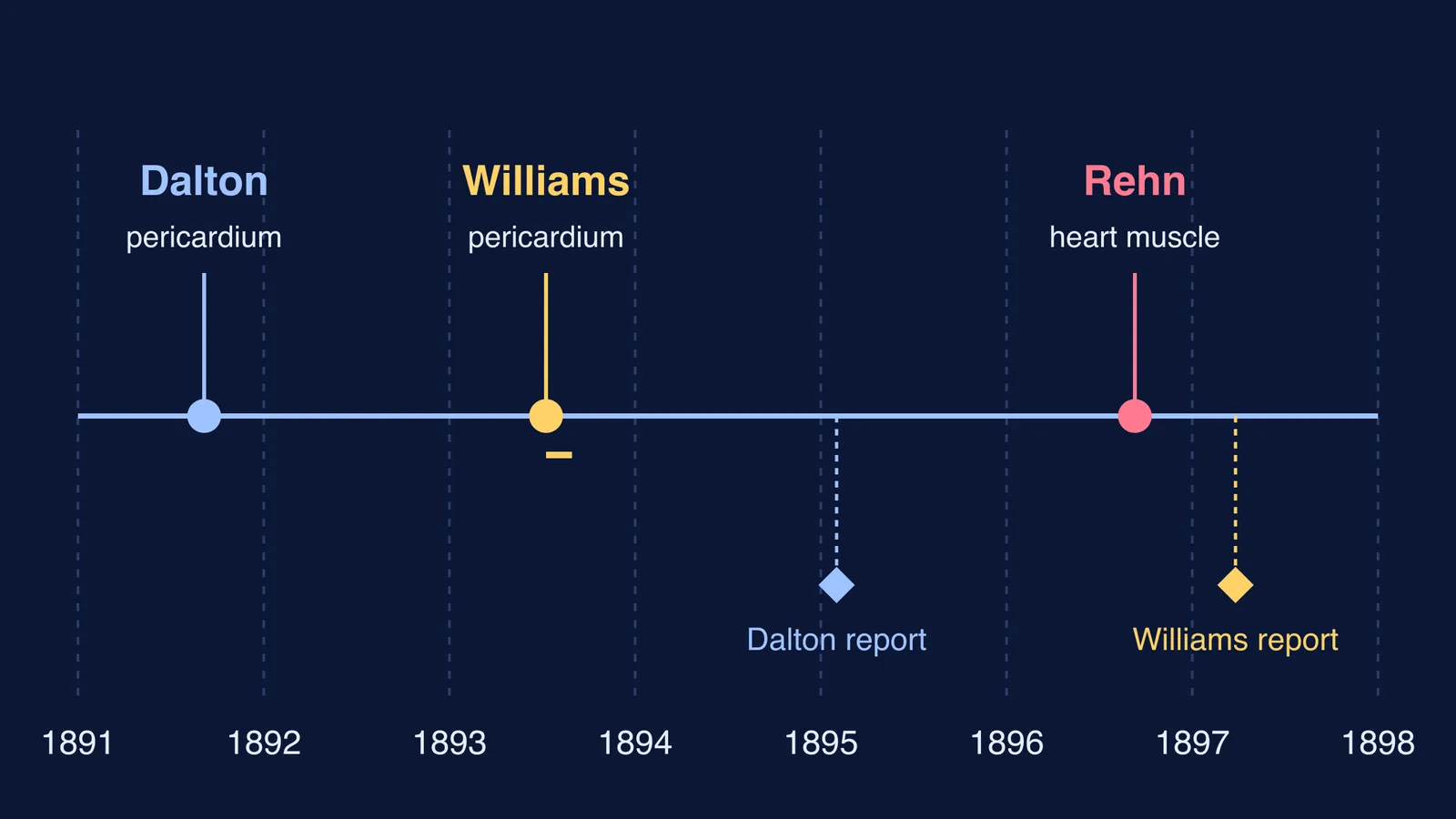
Not quite, and the honest answer is more interesting than the myth. Williams published the case in the Medical Record on 27 March 1897 under a title that says exactly what he did: "Stab Wound of the Heart and Pericardium—Suture of the Pericardium—Recovery—Patient Alive Three Years Afterward" (The Pharos). He knew of no earlier case.
One existed. On 6 September 1891, Henry Dalton repaired the stabbed pericardium of a 22-year-old man at City Hospital in St. Louis, Missouri. Dalton presented the case at a medical meeting in November 1894 and published it in Annals of Surgery in February 1895, so it was still unpublished when Williams operated. HISTORY calls Williams's operation the second known successful pericardium suture in the United States.
Stitching the beating heart muscle itself came later. Ludwig Rehn, a surgeon in Frankfurt, repaired a stab wound to the heart by direct suture in 1896, according to a 2012 paper in the Journal of Medical Biography.
So a fair sentence is: Williams performed one of the earliest successful operations on the sac around the heart, three years before Rehn's heart-muscle suture. Sources even disagree on how long Cornish lived afterwards, so we go with what Williams himself wrote: alive three years later.
Who was Daniel Hale Williams?
According to The Pharos, Williams was born in Hollidaysburg, Pennsylvania, on 18 January 1856 and graduated from Chicago Medical School in 1883. In Chicago, Black doctors found it very hard to get admitting privileges at hospitals, and Black women were turned away from the local nurse training schools. So he raised money from White and Black Chicagoans and opened Provident Hospital on 4 May 1891, with 12 beds, a mixed staff and a nurse training school.
He later ran Freedmen's Hospital in Washington, helped found the National Medical Association in 1895, and in 1913 became a charter member of the American College of Surgeons, its only Black physician at the time. He died on 4 August 1931.
How do you check a "first" claim yourself?
Use Williams's story as a worked example. Ask four questions.
First at what, exactly? Pericardium repair, heart-muscle suture and open-heart surgery with a heart-lung machine are three different achievements.
First where? First in Chicago, first in the US and first in the world can have different answers.
Done or published? Dalton operated first but published later. Note both dates.
What does the original report say? Williams's own title names the pericardium. When a modern summary says more than the original, trust the original.
Applied here, you get a sentence a biology teacher will accept: "In 1893 Daniel Hale Williams successfully repaired a stab wound of the pericardium, two years after Henry Dalton's similar operation."
What can a biology student take from this?
The operation makes more sense once you can picture the parts. Our explainer on the heart's four valves and where they sit is a good place to start. For another doctor who took a risk with the heart, read about Werner Forssmann's heart catheter experiment. And for a surgeon who changed a different risky operation, see Theodor Kocher's work on thyroid surgery.
If words like pericardium, ventricle and coronary artery blur together, the Fermi Concept Library gives each biology concept its own lesson and shows where it sits in the map of the subject. Then retell the 1893 operation in five sentences, using the right word for each layer Williams cut through.