On this page
On the morning of 27 August 1885, a sixth-year medical student in Lima used a lancet to push blood from a boy's skin growth into his own arm. Daniel Alcides Carrión was 26. Thirty-nine days later he was dead, and his case had linked two very different Peruvian illnesses, as CDC medical officer Myron Schultz recounts in a 2010 profile in Emerging Infectious Diseases.
Who was Daniel Alcides Carrión?
Carrión was in his sixth year at the Facultad de Medicina in Lima and had spent the previous three years studying verruga peruana for the original thesis his degree required, Schultz writes. As a boy travelling between school in Lima and his home in Cerro de Pasco, a mining town high in the Andes, he had seen people with verrugas. He later told a classmate he hoped "to make an important contribution to aching humanity".
Two illnesses puzzled Peruvian doctors at the time:
Verruga peruana: crops of disfiguring, wart-like skin growths, usually not dangerous.
Oroya fever: fever and anaemia, often fatal. It is named after an 1871 outbreak among workers building the railway to La Oroya, in which at least 4,000 men died within a few weeks, a 2014 review in PLOS Neglected Tropical Diseases records.
What did Carrión do to himself in 1885?
Carrión wanted to know how verruga began, before the skin growths appeared, because its early fever was easily confused with other illnesses such as malaria. Schultz describes the day: at the Dos de Mayo Hospital, a 14-year-old patient, Carmen Paredes, had a verruga on his right eyebrow. With help from a young ward physician, Dr Chávez, Carrión inoculated his arm with blood taken from it.
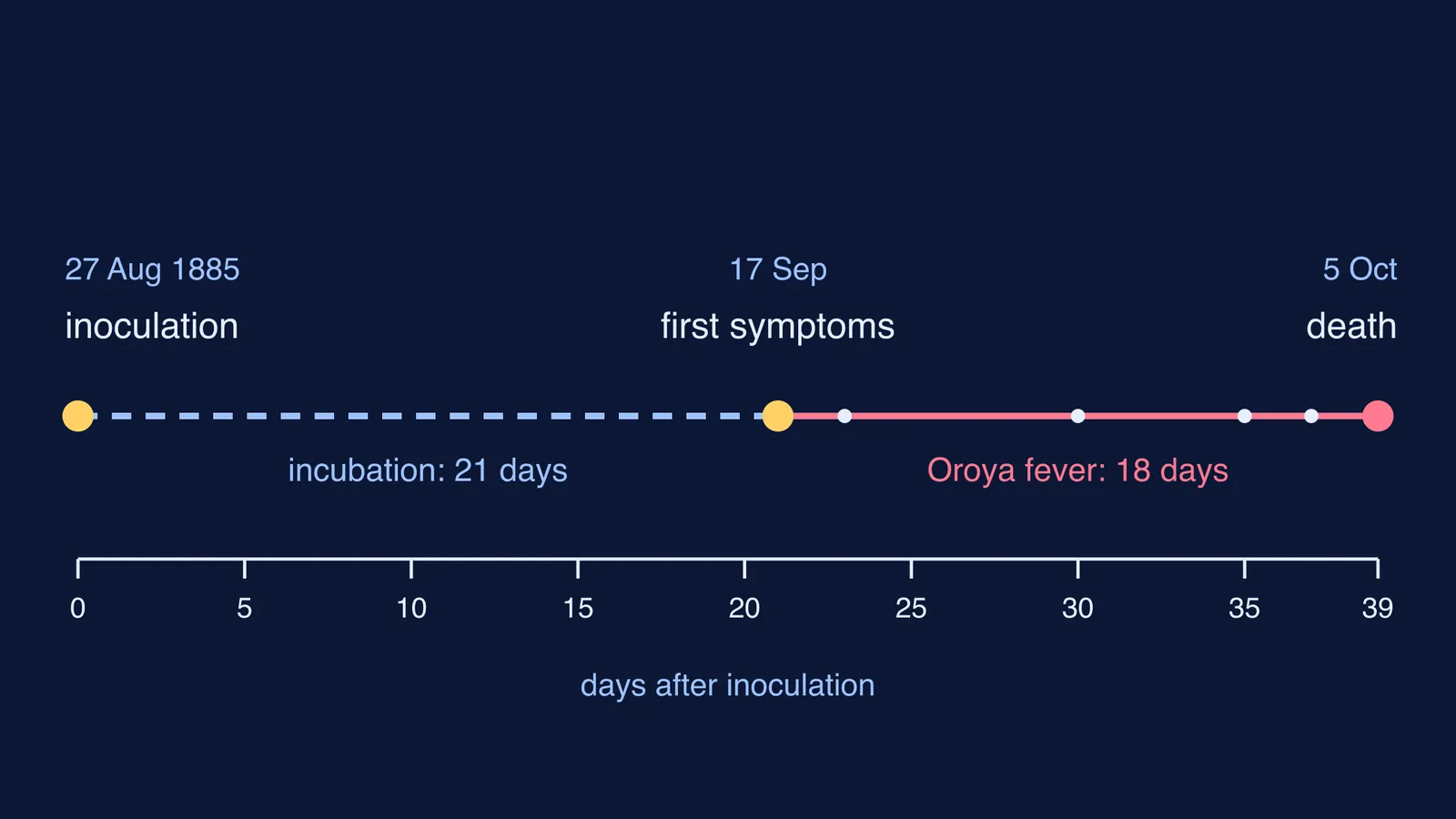
The course of his illness, from the diary as Schultz reports it:
Day 0 (27 August): the inoculation.
Day 21 (17 September): first discomfort and pain in his left ankle.
Day 23: fever, chills and pain in his bones and joints.
Day 30 (26 September): too weak to write, so his classmates keep the diary.
Day 37 (3 October): delirious.
Day 39 (5 October): a coma, then death at 11:30 pm.
He had expected the early stage of verruga. Instead his friends watched, amazed, as anaemia took hold far faster than they expected.
Did Carrión set out to prove the diseases had one cause?
Not quite. Schultz points out that Carrión had not, as is often said, set out to prove a single cause; he meant to study how verruga starts. The insight came because, gravely ill, he saw what an unexpected result meant.
It was also a sample of one, and nobody could yet see the germ. Laboratory work over the following decades filled that gap.
What causes Carrión's disease today?
In 1905 Alberto Barton saw bacteria inside the blood cells of Oroya fever patients, the PLOS review notes.
In 1929 Hideyo Noguchi's team reported in the Journal of Experimental Medicine that, of the blood-sucking insects they tested from the affected districts, phlebotomus sandflies were the only kind in which they could detect Bartonella bacilliformis.
Lutzomyia sandflies are the only known vector, and the disease is endemic in Andean valleys 600 to 3,200 m above sea level, says a 2019 review in Parasites and Vectors.
That review notes case-fatality rates as high as 88% in the Oroya fever phase, and around 10% for patients given timely antibiotics.
Both forms are now called Carrión's disease. Peruvians celebrate the day of his death, 5 October, as the Día de la Medicina Peruana, and the national university in Cerro de Pasco carries his name, Schultz writes.
How can you use Carrión's reasoning in biology?
Biology often hides one cause behind two different pictures. Here is a four-question check, worked through with Carrión's disease.
Same place? Do both forms turn up in the same areas? Verruga and Oroya fever cluster in the same Andean valleys.
Same person over time? Can one form follow the other in a single patient? In the 2019 review, the acute fever phase typically comes before the chronic skin phase.
Can one produce the other? Carrión's inoculation took material from a verruga and produced Oroya fever.
Same agent, same route? Barton found the bacterium in blood, and Noguchi's team traced it to sandflies.
If you can answer all four with evidence, "one cause, two pictures" is a strong explanation. If you can only answer one, as Carrión could, you have a lead, not a proof.
For more medical pioneers, read about Werner Forssmann's 1929 heart catheter self-experiment and Carlos Finlay and the mosquito that spreads yellow fever, another insect-borne disease. If words like vector, reservoir or anaemia still feel shaky, the Fermi Concept Library gives every biology concept its own lesson and its place in the map, so you can see how they connect. To keep the microbes straight, our bacteria vs virus difference table is a good next stop.