

On this page
Throughout the nineteenth century, yellow fever terrified tropical ports across the Americas. Known as "yellow jack" or black vomit, the disease struck suddenly with acute fever, jaundice, and severe haemorrhage. Medicine was divided between two orthodoxies: miasma theory, which blamed poisonous vapours from filth, and contagionism, which blamed direct contact or contaminated clothing (fomites). Neither explained why a quarantined ship stayed healthy while a nearby street suffered an epidemic, or why hospital ward staff caring for patients rarely fell ill.
Why did Carlos Finlay suspect mosquitoes spread yellow fever?
Dr. Carlos Juan Finlay (1833–1915), a Cuban physician trained at Philadelphia's Jefferson Medical College, observed yellow fever during clinical practice in Havana. Examining tissue pathology, he realized yellow fever was fundamentally an intravascular infection damaging blood vessels without primary respiratory or digestive lesions. Finlay reasoned that if neither air nor touch could introduce the pathogen into circulation, transmission required an intermediate biological vector equipped to pierce skin and transfer blood directly.
On 14 August 1881, Finlay presented his paper, "The Mosquito Hypothetically Considered as the Agent of Transmission of Yellow Fever," to the Havana Academy of Sciences (Chaves-Carballo, 2005). He specifically named the common domestic mosquito *Culex fasciatus* (today classified as *Aedes aegypti*).
Finlay formulated three essential conditions for propagation (Chaves-Carballo, 2005; PMC1451274):
A yellow fever patient whose blood contains the infectious agent.
A female mosquito that bites the patient and draws blood.
The mosquito's survival long enough to bite a susceptible person.
This formulation anticipated modern vector epidemiology, much like how Alphonse Laveran identified the malaria parasite inside human erythrocytes around the same period.
Why did the medical establishment reject Finlay's theory for twenty years?
Despite his insight, the medical establishment greeted Finlay's 1881 paper with skepticism and ridicule, dismissively labelling him the "Mosquito Man" (Faerstein and Winkelstein, 2010). Between 1881 and 1900, Finlay conducted 102 experimental inoculations on human volunteers using captive mosquitoes to prove transmission (Chaves-Carballo, 2005). Yet almost none developed severe disease.
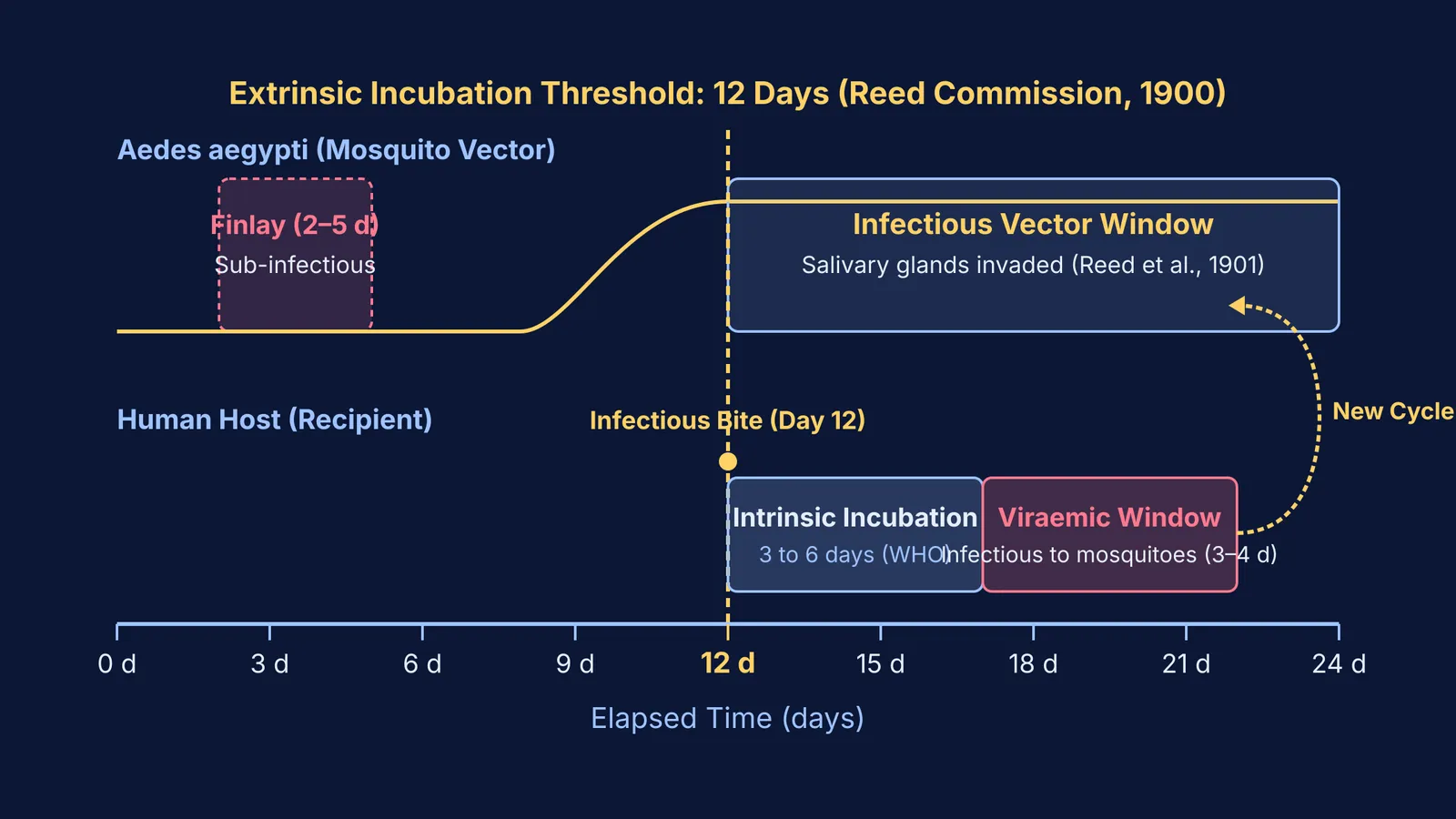
The stumbling block was a biological mechanism unknown to nineteenth-century science: the extrinsic incubation period. When an *Aedes aegypti* mosquito feeds on a patient during the initial 3 to 4 days of symptoms, as documented by the World Health Organization, the virus enters the insect's gut. But the mosquito cannot transmit the virus immediately. The pathogen must replicate, penetrate the midgut wall, circulate through haemolymph, and reach the salivary glands—requiring twelve or more days at tropical temperatures (Reed, Carroll, and Agramonte, 1901). Because Finlay applied mosquitoes to volunteers only 2 to 5 days after feeding on a patient, the insects inoculated negligible viral amounts, conferring mild immunity rather than full-blown illness.
How did the 1900 Yellow Fever Commission prove Finlay right?
In 1900, during the American military occupation of Cuba, yellow fever threatened thousands of soldiers. The U.S. Army appointed a Yellow Fever Commission in Havana led by Major Walter Reed, alongside James Carroll, Aristides Agramonte, and Jesse Lazear (Reed, Carroll, and Agramonte, 1901). After autopsies failed to find a bacterial culprit, the commissioners visited Finlay, who shared his twenty-year records and *Aedes aegypti* eggs from his colony.
Informed by Henry Rose Carter's epidemiological observations on time delays between household cases, Lazear kept infected mosquitoes alive for more than 12 days before testing them on volunteers (Reed, Carroll, and Agramonte, 1901). Carroll contracted severe yellow fever and survived; Lazear was bitten in the wards on 13 September 1900 and died on 25 September 1900.
To confirm transmission experimentally, Reed established Camp Lazear:
Building 1 (The Fomite Test): Volunteers slept for 20 consecutive nights in an unventilated wooden room filled with sheets, blankets, and clothes soaked in black vomit from yellow fever patients. Screened from mosquitoes, not a single volunteer contracted the illness (Reed, Carroll, and Agramonte, 1901).
Building 2 (The Mosquito Test): In a well-ventilated room divided by wire mesh, volunteers exposed to infected mosquitoes developed yellow fever, while those protected on the other side stayed healthy.
The commission's February 1901 report credited Finlay's discovery (Reed, Carroll, and Agramonte, 1901). Chief Sanitary Officer William Gorgas promptly launched mosquito control across Havana—destroying larvae in domestic water containers, oiling stagnant pools, and screening patient wards. Havana yellow fever deaths dropped from 310 in 1900 to 18 in 1901, and reached 0 in 1902 (Chaves-Carballo, 2005). Gorgas later replicated this sanitation program in Panama, enabling completion of the Panama Canal.
This victory proved that vector eradication halts epidemics decades before Max Theiler developed the 17D yellow fever vaccine, and paralleled breakthroughs where Carlos Chagas identified the triatomine bug vector for American trypanosomiasis.
What does Finlay's discovery teach us about vector-borne diseases?
For biology students preparing for competitive exams like NEET-UG, Finlay's work demonstrates that understanding transmission requires evaluating the complete life cycle of pathogen, vector, and host.
The Vector Transmission Assessment Framework
When analysing vector-borne diseases, evaluate four checkpoints:
Host Viraemic Window: Determine when the host carries high viral concentrations. In yellow fever, acute viremia occurs during the initial 3 to 4 days of symptoms (World Health Organization).
Vector Competence: The pathogen must survive midgut digestion, cross into the haemolymph, and reach salivary tissue.
Extrinsic Incubation Period: Account for the temperature-dependent replication delay before the insect becomes infective.
Transmission Interruption: Target breeding sites to break transmission without requiring individual chemotherapy.
Mastering how physiological pathways, vector ecology, and pathogen life cycles connect can feel challenging when revising broad syllabus chapters. The Fermi Concept Library covers every concept in physics, chemistry, biology, mathematics and computing, each with its own lesson and its place in the map. For dynamic epidemiological models where vector mortality and incubation lags are clearer when visualized in motion, the Fermi Simulation Lab provides interactive simulations for the ideas that are easier to see than to read.


