

On this page
In July 1831, on a farm called Walnut Grove in Rockbridge County, Virginia, Cyrus Hall McCormick showed the public a machine that cut wheat while a horse pulled it. Virginia's Department of Historic Resources records that the reaper was successfully demonstrated in July 1831 and patented in 1834.
Who invented the mechanical reaper, and when?
The short answer is McCormick, but the full answer is a team. His father, Robert McCormick, had spent more than two decades tinkering with a reaper before giving up, and Cyrus built on that work with the aid of Jo Anderson, an enslaved man held by the family, according to the McCormick reaper article on Wikipedia.
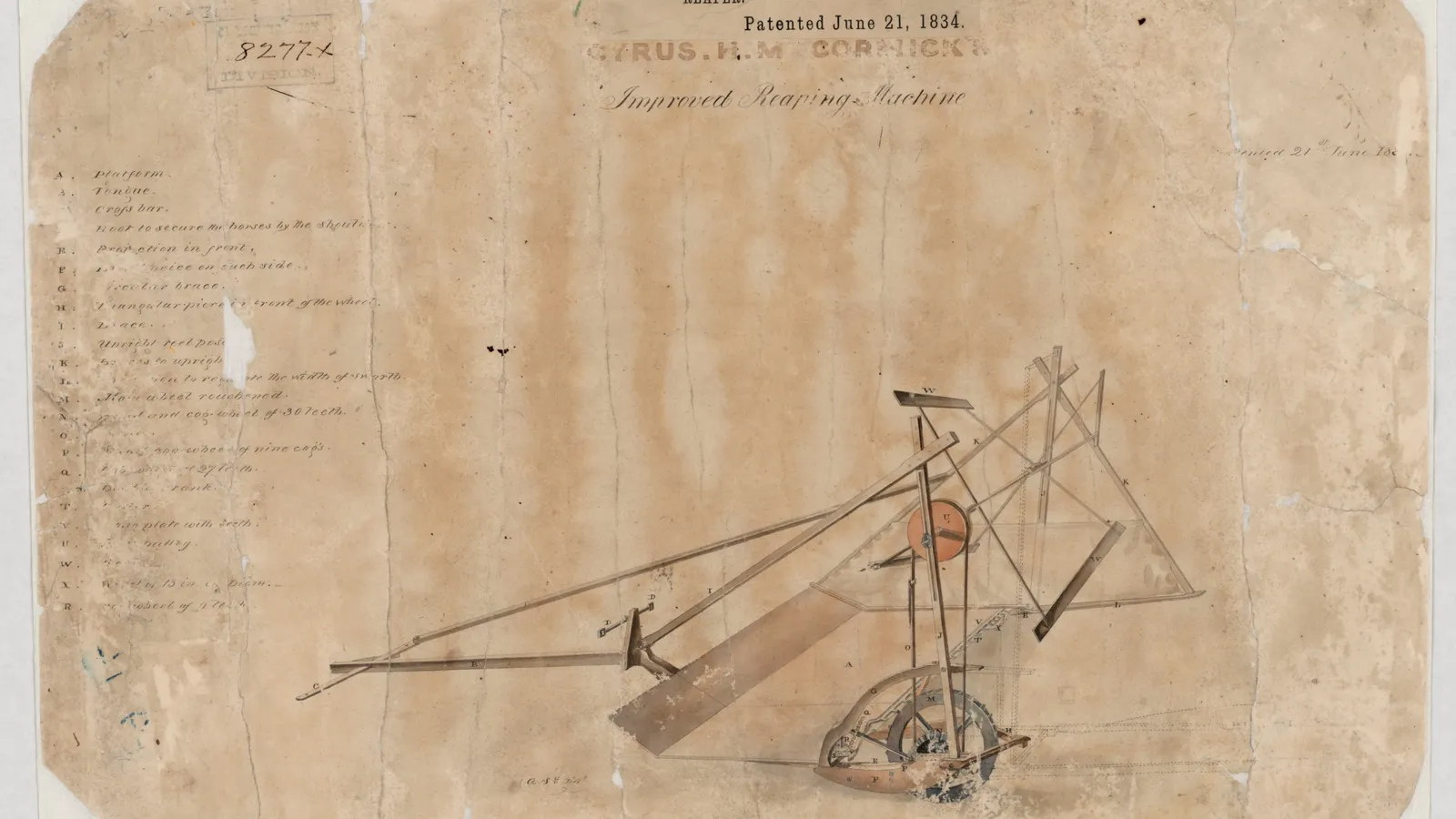
According to the Lemelson-MIT Program, Cyrus built, field-tested, remodelled and demonstrated the machine within six weeks, before the 1831 harvest was over. He then spent about ten years improving it. The patent drawing, dated 21 June 1834, is held by the US National Archives and is public on Wikimedia Commons.
McCormick was not alone: Obed Hussey patented a rival reaper in 1833, a year before McCormick's patent.
How did McCormick's reaper work?
The 1834 design had four main parts, as described in the McCormick reaper article, which draws on the patent, and in the Gale Encyclopedia of US Economic History:
A main drive wheel that turned as the horse pulled the machine along; the knife was linked to it.
A cutter bar with fingers, through which a knife slid back and forth, driven by a crank.
A reel above the platform that held the standing grain against the knife and threw it back onto the platform.
A divider at the front that separated the strip being cut from the grain left standing, and a platform that caught the cut stalks for a worker to collect with a rake.
How much faster was the reaper than a sickle?
One classic schoolbook account of inventors, reproduced on MainLesson, says it was a good day's work for one person to cut and bind half an acre of wheat with a sickle, and that a strong man with a cradle could cut two to two and a half acres a day, with a second man following to bind the sheaves.
The Gale Encyclopedia of US Economic History says the reaper raised average output from two or three acres a day to ten acres a day, and replaced as many as eight to ten workers.
For a 10-acre wheat field, those figures give:
With sickles at half an acre per person per day, cut and bound: 10 ÷ 0.5 = 20 person-days.
With cradles at about 2.5 acres a day: 10 ÷ 2.5 = 4 days of cradling, plus a second person binding behind each cradler, so about 8 person-days.
With one reaper at about 10 acres a day: about 1 machine-day, plus the people raking and binding.
Timing mattered as much as speed. The Lemelson-MIT Program notes that because reaping was much slower than sowing, farmers had to limit their crop to what they could reap in a season. The reaper moved that limit. Virginia's historic register entry puts it this way: it let a farmer reap as much grain as he could sow.
What did the reaper change for farm labour?
A lesson from Oklahoma Ag in the Classroom, which cites a USDA Economic Research Service history, says that in 1830 it took 250 to 300 labour hours to produce 100 bushels of wheat, when the crop was cut with a sickle and threshed with a flail.
The Lemelson-MIT Program notes that in 1831 about 90% of the US population was involved in farming, and that today only 2% produce more food than the country can consume. The reaper was one machine among many in that shift. In 1847 McCormick and his brother Leander founded the McCormick Harvesting and Machine Company in Chicago, according to the Virginia Department of Historic Resources.
The change was not painless. Machines were expensive, and from the 1860s many Minnesota farmers took out loans to buy them, so a bad year could leave a family in serious debt, as the Minnesota Historical Society shows.
How to study an invention like this
For any machine in history or physics, ask four questions.
What job did people do by hand before, and how slowly?
Where does the energy come from (person, horse, steam, electricity)?
What mechanism changes that energy into the motion the job needs?
Who gained, and whose work changed or disappeared?
For question 3, watching the motion helps. The Fermi Simulation Lab has interactive simulations for ideas that are easier to see than to read, and the Fermi Concept Library gives each physics concept its own lesson, which is useful if wheel and axle or work and power still feel shaky.
Read how Jethro Tull's seed drill changed planting in 1701, see how the same wheel-and-gear ideas appear in how bicycle gears make climbing easier, or, if farm machines interest you as a career, look at agricultural engineering: farm machinery, irrigation and PSU roles.


