On this page
Christopher Polhem (1661–1751) was a Swedish engineer who taught machine design the way children learn to read: letters first, then words. His letters were small wooden models, each showing one simple way to change one motion into another. Tekniska museet's record of one model says he created the set "in the years just before 1700" and that the models were intended to serve as an educational tool.
What was Polhem's mechanical alphabet?
The mechanical alphabet was the name given to a collection of wooden models showing simple principles of motion conversion, according to Tekniska museet's story on Polhem.
By 1779 the set numbered 80 pieces. That year Jonas Norberg, superintendent of the Royal Model Chamber in Stockholm, described it as "all familiar simple motions to the number of 80 pieces", according to the museum's Royal Model Chamber record on DigitaltMuseum. The same record says 32 models survive in Tekniska museet's collection. Another 13 are at the Falun Mining Museum, notes Wikipedia's article on Polhem.
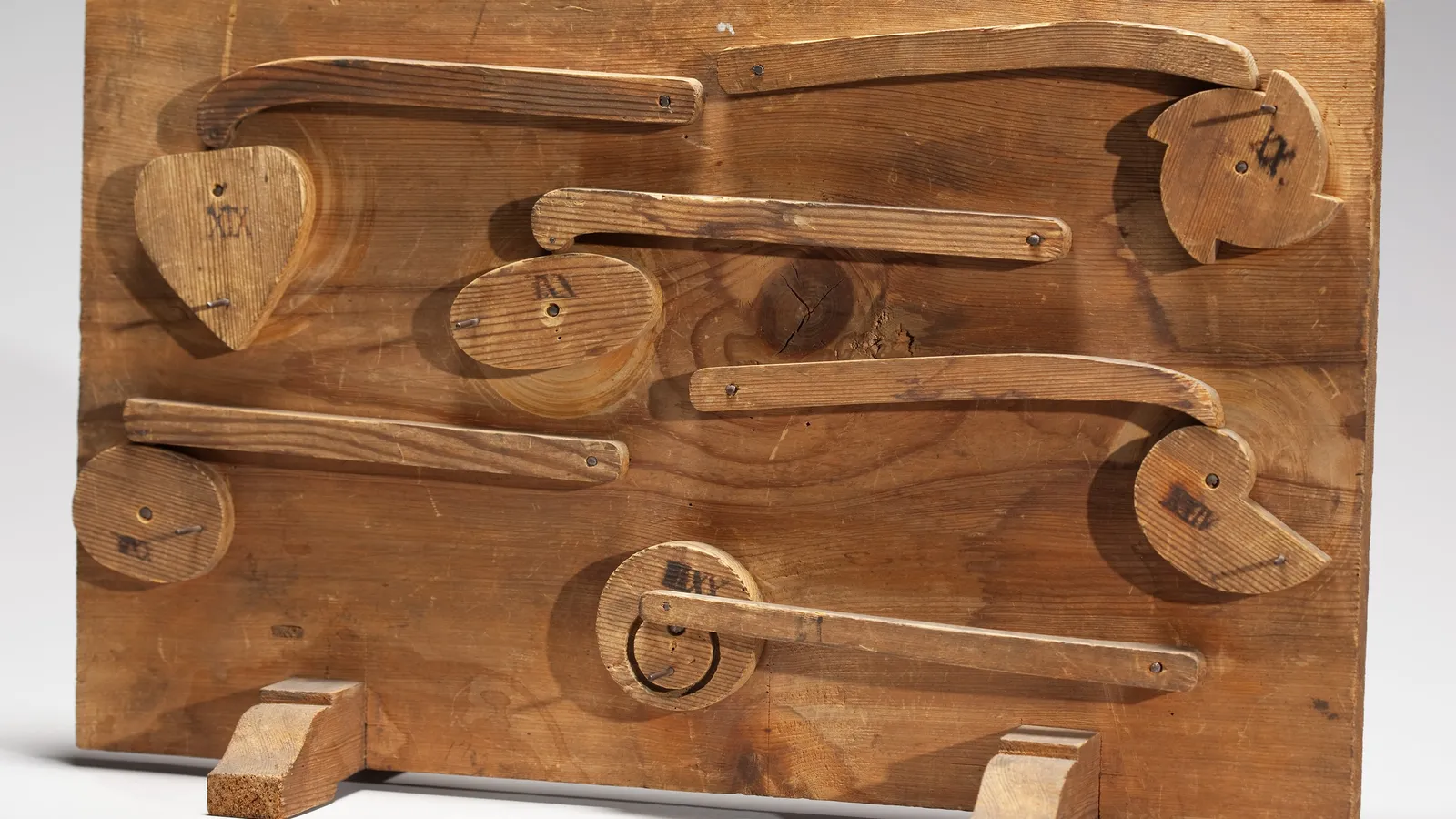
Models carry Roman numerals, like letters in a sequence. One board holds six cam mechanisms, numbered XIX to XXIV, as its Wikimedia Commons file record.jpg) shows.
Why did Polhem teach machine design with models?
Polhem founded the Laboratorium mechanicum in Stockholm in 1697. Its aim, says Tekniska museet, was "to teach, research and demonstrate to visitors everything that could be achieved within technology and engineering." Part of the method was "to illustrate all of the machinery elements that every engineer should be familiar with."
His pupil Carl Johan Cronstedt explained the thinking in 1729. In the museum's English translation on the Royal Model Chamber record, he wrote: "As necessary as it is for a book mind, to be able to promptly remember all the words required to compose a sentence and writing, it is also as necessary for a Mechanicus to have all simple movements familiar and promptly remembered." Norberg's 1779 note gives the payoff: the models helped young engineers "when they are at a loss as to the power or motion which may be most conveniently applied to their Mechanical Inventions."
After Polhem's death the collection became part of the Royal Model Chamber, and in 1925 it was deposited at the newly established national museum, according to Tekniska museet's model record. The Laboratorium mechanicum has since become KTH Royal Institute of Technology, says Wikipedia.
How does Polhem's model XV turn rotation into back-and-forth motion?
The museum's catalogue entry for model XV says the rotation of a wheel with teeth on only half its rim is turned into a back-and-forth motion of a bracketed arm. The museum's photo of the model.tif) shows how: a crank turns the wheel inside an oval frame, with a toothed rack along the top inside edge and another along the bottom.
Here is why it works:
For half a turn, the toothed half meshes with the top rack, and the frame slides one way.
The teeth then reach the bottom rack. The bottom of a turning wheel moves opposite to its top, so the same crank direction now pushes the frame back.
In each half turn, the frame moves by the length of toothed rim that passes it: half the pitch circumference, which is πr.
If the wheel had a pitch radius of 2 cm (an example value), the stroke would be π × 2 ≈ 6.3 cm each way, and one full turn of the crank gives one complete back-and-forth.
Teeth on half the rim mean one rack lets go just as the other takes hold. Put teeth on more than half, and both racks would be gripped at once and pushed opposite ways, so the frame would jam.
How can you build your own mechanical alphabet?
You do not need a workshop, just a notebook and a week.
Day 1: Start a notebook page for each letter: rotation to back-and-forth, back-and-forth to rotation, rotation to rotation (faster, slower or turned through 90°), and a straight pull to a lift.
Day 2: Find one real example of each at home. A door handle turns and slides a latch; a bicycle chain carries rotation from pedals to wheel.
Day 3: Sketch each with arrows for input and output motion, and mark the part that stays fixed.
Day 4: Build one in cardboard. Our guide to simple machines at home with a spool pulley and ruler lever is a good place to start.
Day 5: Under each sketch, write a one-line rule, like the stroke of πr for model XV.
Days 6–7: Find one textbook problem that uses each letter. The three classes of levers is a quick first entry.
If a mechanism is hard to picture from a still drawing, the Fermi Simulation Lab has interactive simulations for ideas that are easier to see than to read. When a letter rests on a concept you have not met yet, the Fermi Concept Library gives every physics concept its own lesson.
For a letter far older than Polhem's set, read how an Archimedes screw lifts water.