

On this page
A thread spool, a 30 cm ruler and a pile of school books are enough to show a child how a crane, a see-saw and a wheelchair ramp work. These are three classic simple machines, and each fits on a dining table. The point is the moment your child feels one setup is easier and asks why.
What does a simple machine actually do?
A simple machine is a device that can multiply the force you apply, often at the expense of the distance through which you apply it, according to the OpenStax College Physics textbook. The same text defines mechanical advantage as the output force divided by the input force.
The catch: OpenStax notes that a machine cannot do more work than the energy put into it. So when a job feels lighter, something else gives, and in all three builds that something is distance.
There is also a reason to let children push and pull rather than just watch. In a 2015 study in Psychological Science, Carly Kontra, Sian Beilock and colleagues found that a brief physical experience of the forces involved in angular momentum improved university students' quiz scores. That study was about college physics, not toys, but it supports the habit of putting the force in your child's hands.
How do you make a pulley with a spool?
Push a pencil through an empty thread spool and rest the pencil ends on two stacks of books. Tie a cup with a few coins to a string, run it over the spool, and pull the other end down.
The load rises as your child pulls down, but it does not feel lighter. OpenStax explains that an ordinary pulley has a mechanical advantage of 1; it changes the direction of the force, not its size.
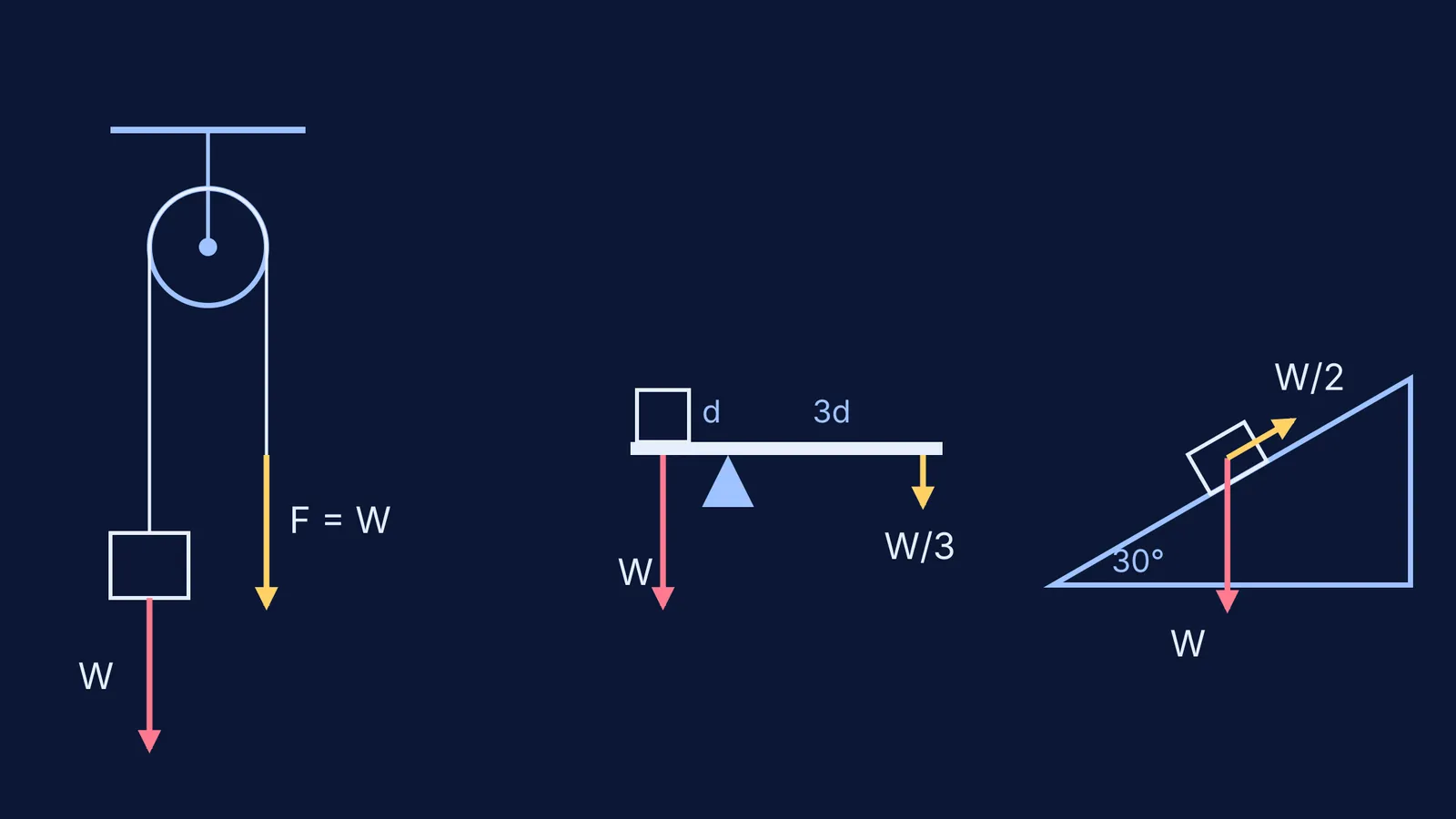
Now the upgrade. Tie one end of the string to a chair back, hang the cup from the spool's pencil so the spool sits in a loop of string, and pull the free end up. Two strands now hold the load, and the pull should feel roughly half as hard (a bit more, since the spool rises too). The OpenStax text says the mechanical advantage of a pulley system is approximately the number of strands pulling up on the load. Mark the string with a pen and your child will see the price: to lift the load 10 cm, they pull about 20 cm of string.
How do you make a lever with a ruler?
First balance the empty ruler on a round pencil. It should rest near the 15 cm mark, its middle, so the ruler's own weight is shared equally on both sides. Use identical coins, such as ₹1 coins, as weights.
Worked example: with the pivot at the 15 cm mark, stack three coins centred on the 11 cm mark, which is 4 cm from the pivot. Now ask your child to predict where one coin must go to balance them. The lever rule in OpenStax says the forces balance when each force times its distance from the pivot is equal, so one coin should balance at 12 cm from the pivot, the 27 cm mark. Three coins times 4 cm equals one coin times 12 cm.
If it is a few millimetres off, that is a good conversation: ask whether the coins are exactly centred, and what else pushes down on the ruler.
How does a ramp with books show force?
Lean a tray on a stack of books. Hook a rubber band to a toy car, lift the car straight up to the stack's height and note how far the band stretches. Then pull the car slowly up the ramp to the same height and compare.
The band should stretch less on the ramp, because the pull needed is smaller. OpenStax notes that pushing a cart up a slope is easier than lifting it straight up, yet the work done is the same if friction is negligible. The car travels further along the ramp to gain the same height. Add a book to make the ramp steeper and the stretch grows again.
If the car sticks or jerks instead of rolling smoothly, that is friction at work, which we cover in our post on explaining friction with toy cars.
What should you say while your child builds?
A short script for school-age children:
"Which way feels easier? Try both."
"If it is easier, what did you have to do more of?"
"Where do you see this outside our house?" (a well pulley, a see-saw, the ramp at a railway station)
"What would you change to make it even easier, and what would that cost you?"
Keep the coins and spools in one box; our guide to building a home science kit has a list. For more toys made from household scraps, read about Arvind Gupta and his toys from trash.
If an older child wants to see ideas like these on screen, the Fermi Simulation Lab has interactive simulations for the ideas that are easier to see than to read. Start with the spool, though.


