On this page
Until 1877, oxygen was one of the "permanent gases". Chemists thought hydrogen, oxygen, nitrogen and carbon monoxide could not exist as liquids at all, according to historian Faidra Papanelopoulou's study of Cailletet in Notes and Records of the Royal Society. Then, in one December, two men showed the idea was wrong. They worked separately and used different methods. Their story is also the clearest way into one hard idea in your gas-laws chapter: critical temperature.
Who first liquefied oxygen, and when?
The dates come from Papanelopoulou's 2013 paper:
2 December 1877: Louis Cailletet wrote to the chemist Henri Sainte-Claire Deville. He said he had liquefied carbon monoxide and oxygen.
3 December 1877: Deville deposited the letter in a sealed envelope with the Académie des Sciences in Paris.
22 December 1877: The Académie received a telegram from Raoul Pictet in Geneva. It said oxygen had been liquefied under 320 atmospheres and 140 degrees of cold.
24 December 1877: Both results were presented to the Académie.
Pictet reported first, but the Académie gave priority to Cailletet because of his sealed letter. The paper also notes there was no priority dispute between the two men. So the fair answer to "who first liquefied oxygen" is: both, independently, a few days apart. Cailletet's earlier sealed letter gave him priority on paper.
How did Cailletet liquefy oxygen?
Cailletet's method used sudden expansion. In Papanelopoulou's account, oxygen sat in a thick glass tube inside a steel cistern, with mercury between the two vessels. A hydraulic pump forced water in, which pushed the mercury up and squeezed the gas to 300 atm. He cooled the tube to −29 °C. Then he opened a valve, the mercury dropped suddenly, and the gas expanded in an instant.
A gas that expands quickly does work and has no time to take in heat, so it cools. Cailletet calculated a drop of about 200 °C. Inside the tube he saw a thick mist, which he identified as condensed oxygen. He could not yet collect it as a pool of liquid.
How did Pictet's cascade method work?
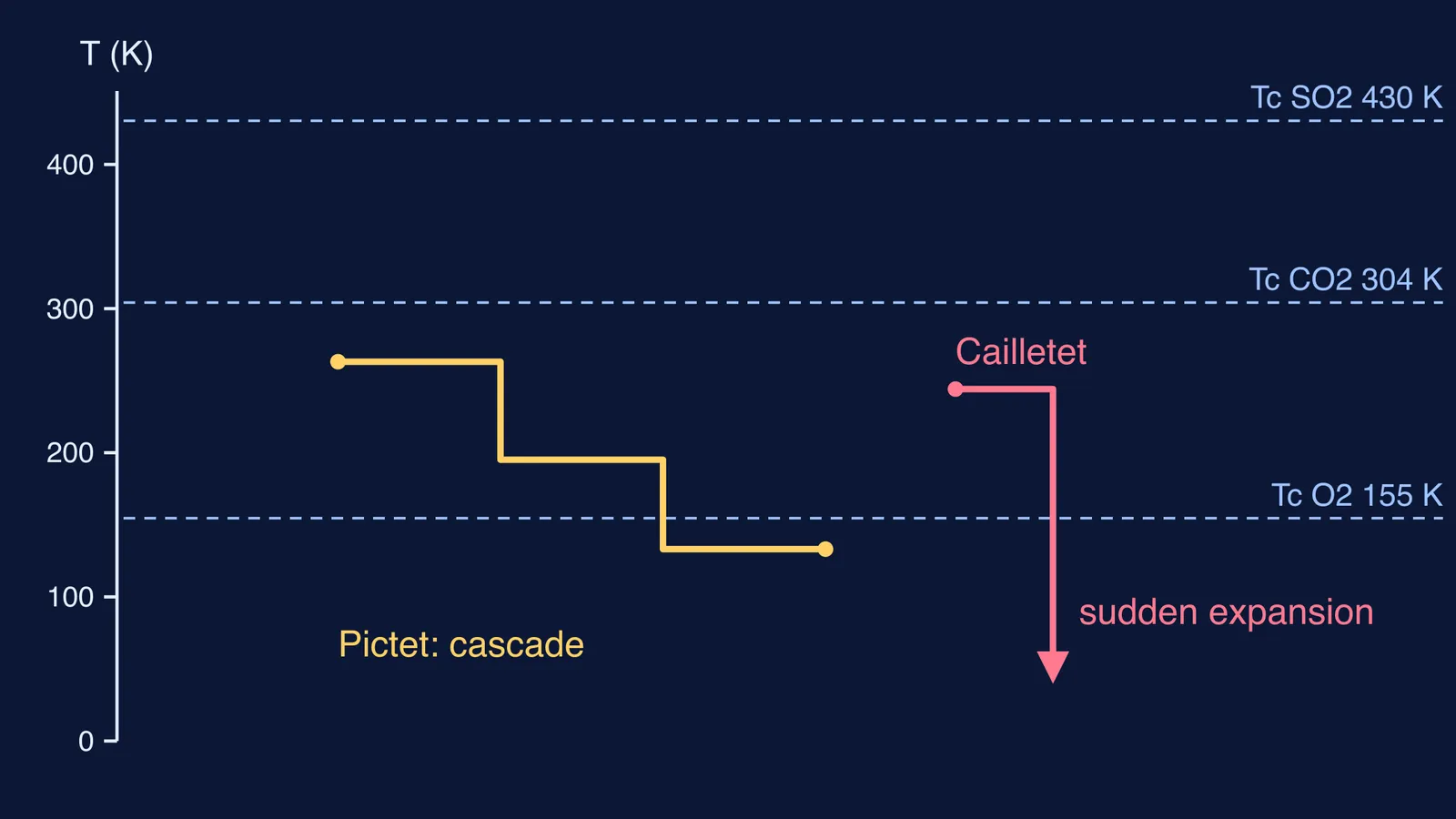
Pictet cooled oxygen step by step. The Encyclopedia.com entry on Pictet describes three refrigeration cycles in series, using media with successively lower critical temperatures: sulfur dioxide first, then carbon dioxide, then oxygen. Each liquid, as it evaporated, cooled the next gas enough to liquefy it.
The Wikipedia summary of Pictet's apparatus puts the sulfur dioxide stage near −10 °C and the carbon dioxide stage near −78 °C. The pre-cooled, compressed oxygen was then released through a valve. His telegram reported 320 atmospheres and 140 degrees of cold.
In short: Pictet used a ladder of cold, and Cailletet used one sudden drop.
Why does critical temperature decide which method works?
Thomas Andrews showed in his 1869 Bakerian Lecture that gas and liquid states are continuous. The key idea for us is simple: above a gas's critical temperature, no amount of pressure will turn it into a liquid (Papanelopoulou, 2013). That is why squeezing oxygen harder never worked.
The NIST Chemistry WebBook lists oxygen's critical temperature as 154.58 K, which is about −118.6 °C. Its critical pressure is 50.43 bar, and it boils at 90.2 K.
Worked example: check each method.
Convert to kelvin by adding 273.15.
Pictet: −140 °C is 133.15 K. That is below 154.58 K, and 320 atm (about 324 bar) is well above 50.43 bar. Liquid is possible.
Cailletet before expansion: −29 °C is 244.15 K. That is above 154.58 K, so 300 atm alone cannot do it. Only the expansion, which he calculated at about 200 °C of cooling, could take the gas below the line.
Pictet's ladder: NIST gives critical temperatures of 304.18 K for carbon dioxide and 430.34 K for sulfur dioxide. Each rung sits lower than the one before, which is exactly the rule the cascade needs.
Read more on Thomas Andrews and the discovery of critical temperature, critical temperature and gas liquefaction for exams and the Joule-Thomson effect and how expanding gases cool.
A three-question check for any liquefaction problem
Where is the gas relative to its critical temperature? If it is above, pressure alone will fail, whatever the number.
What brings it below? A colder liquid (a cascade) or the gas doing work as it expands.
Once below, is the pressure high enough? Compare it with the critical pressure, in the same units.
If the jump from gas to liquid is hard to picture, the Fermi Simulation Lab has interactive simulations for ideas that are easier to see than to read. To revise it alongside the other gas-law ideas, each concept in the Fermi Concept Library has its own lesson and shows where it fits in the map.
Next time a textbook says a gas "cannot be liquefied", ask the 1877 question: at what temperature?