

On this page
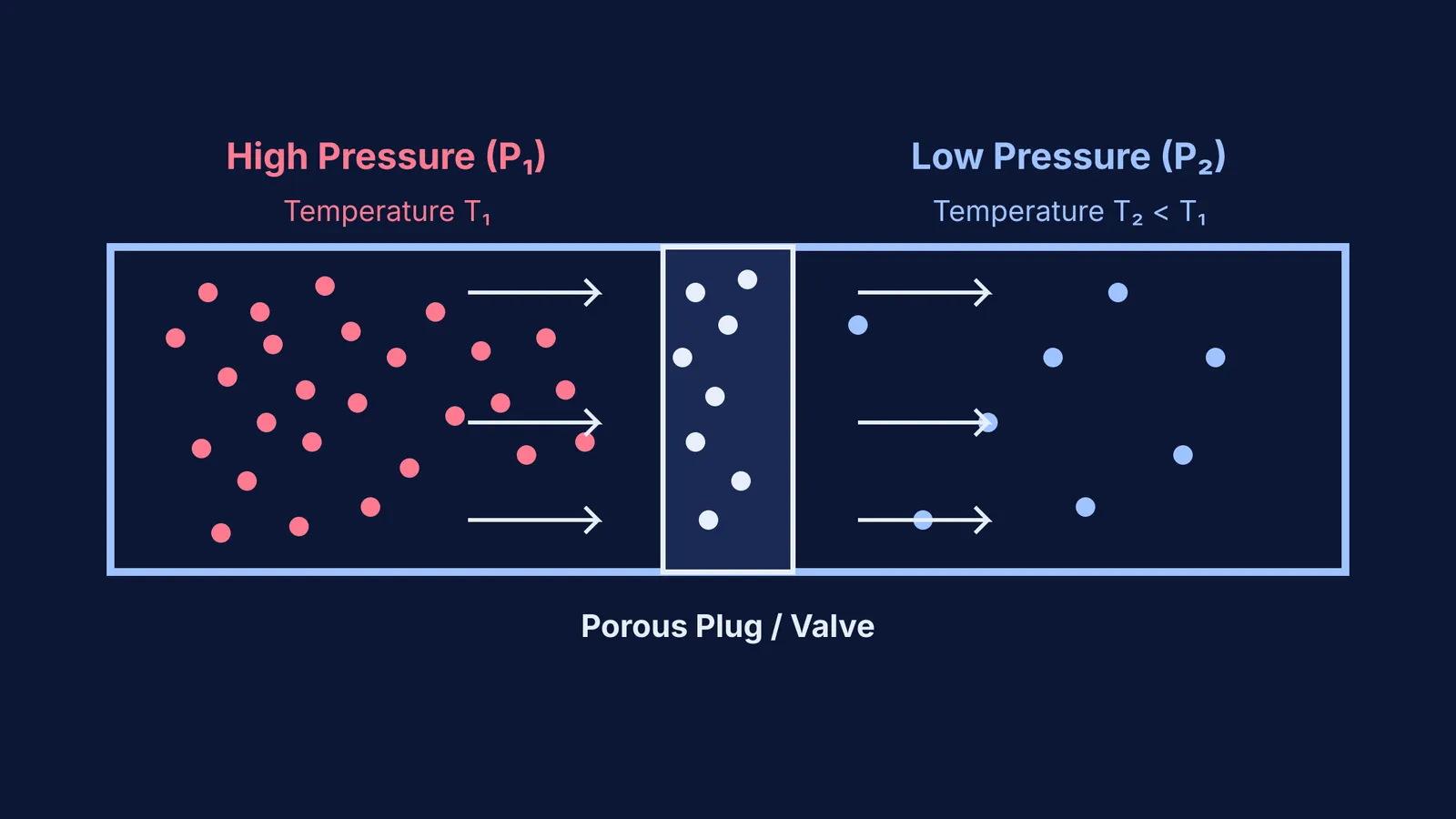
In thermodynamics, expanding a gas does not always mean its temperature stays the same. In 1852, James Prescott Joule and William Thomson (later Lord Kelvin) demonstrated that when a real gas is forced through a porous plug or a throttling valve, its temperature changes 1.
This phenomenon, now called the Joule-Thomson effect, is an isenthalpic process, meaning the total enthalpy of the gas remains constant. Unlike the free expansion of an ideal gas, where the temperature never drops because ideal gases have no intermolecular forces, the Joule-Thomson effect relies entirely on the behaviour of real molecules in the physical world.
What is the Joule-Thomson effect?
To understand the effect, you have to picture the original experiment. Joule and Thomson forced a continuous stream of gas through a porous plug made of cotton wool or silk. The plug acted as an obstruction, allowing the gas to expand slowly and steadily from a region of high pressure into a region of lower pressure. The entire setup was thermally insulated so that no heat could enter or escape.
They observed that for most common gases, this simple throttling process resulted in a measurable drop in temperature 1. Because the expansion is insulated and no mechanical work is done on the outside environment (unlike pushing a piston), any change in temperature must come from the internal properties of the gas itself.
Why does an expanding gas cool?
The temperature drop during a Joule-Thomson expansion comes down to the microscopic forces between molecules. Real gas molecules exert attractive van der Waals forces on one another. The physical nature of these particles—a concept dating back to the first estimate of molecule size—means they prefer to stay close together.
When the gas passes through a valve and expands into a lower-pressure region, the distance between the individual molecules increases. Pulling them apart requires energy to overcome those attractive van der Waals forces. Since the system is insulated and no heat is added, the gas must use its own internal kinetic energy to do this internal work. Because the kinetic energy of the molecules dictates the temperature of the gas, a drop in kinetic energy directly translates to a drop in temperature 1.
If you are struggling to picture these microscopic forces in thermodynamics, the Fermi Simulation Lab has interactive simulations for the ideas that are easier to see than to read.
Does every gas cool when expanding?
No, a gas will only cool if it starts out below its maximum inversion temperature. This is the exact temperature threshold at which the Joule-Thomson coefficient flips its sign from positive (cooling) to negative (heating) 1.
If a gas is expanded while already above its inversion temperature, it actually warms up. This happens because, at very high temperatures, repulsive forces and the flow work done by the gas pushing itself through the valve dominate the attractive forces. At standard room temperature (around 298 K or 25 °C), common gases behave differently:
Nitrogen has a maximum inversion temperature of about 621 K (348 °C) 1. Because room temperature is well below 621 K, nitrogen cools upon expansion.
Oxygen has a maximum inversion temperature of about 764 K (491 °C), meaning it also cools 1.
Helium and hydrogen have inversion temperatures of approximately 40 K and 202 K, respectively 1. At room temperature, they are far above their thresholds and will heat up if forced through a valve.
For exam questions that ask you to evaluate these isenthalpic conditions, the Fermi Problem Library provides worked problems with a step-by-step solver that explains the reasoning rather than printing an answer.
How does this liquefy air?
Because nitrogen and oxygen make up the vast majority of our atmosphere and cool when throttled at room temperature, the Joule-Thomson effect is the engine behind the Linde-Hampson cycle. This is the standard industrial method for producing liquid air.
In this cycle, air is first compressed to a high pressure, which naturally heats it up. The hot, high-pressure air is then passed through a heat exchanger to cool it back down to room temperature. Next, the air is allowed to expand through a throttling valve. Because the air is starting below its inversion temperature, the Joule-Thomson effect causes it to cool dramatically.
The resulting cold air is then routed back over the incoming pipes to pre-cool the next batch of high-pressure air before it even reaches the valve. Through these repeated, compounding cycles, the temperature of the air drops further and further until it reaches its boiling point and finally condenses into a liquid.
Identify the process: The gas must be pushed through a porous plug or narrow valve, meaning the total enthalpy stays constant (H₁ = H₂).
Check the starting point: Compare the initial temperature to the inversion temperature of the specific gas in the problem.
Determine the outcome: The gas cools if it starts below the inversion temperature, but it warms if it starts above it.


