On this page
Georges-Louis Leclerc, Comte de Buffon, was born on 7 September 1707 in Montbard, France, and died in Paris on 16 April 1788, according to his MacTutor biography. He is remembered mostly as a naturalist: keeper of the Jardin du Roi from 1739 and author of the many-volume Histoire naturelle.
What did Buffon ask about a dropped needle?
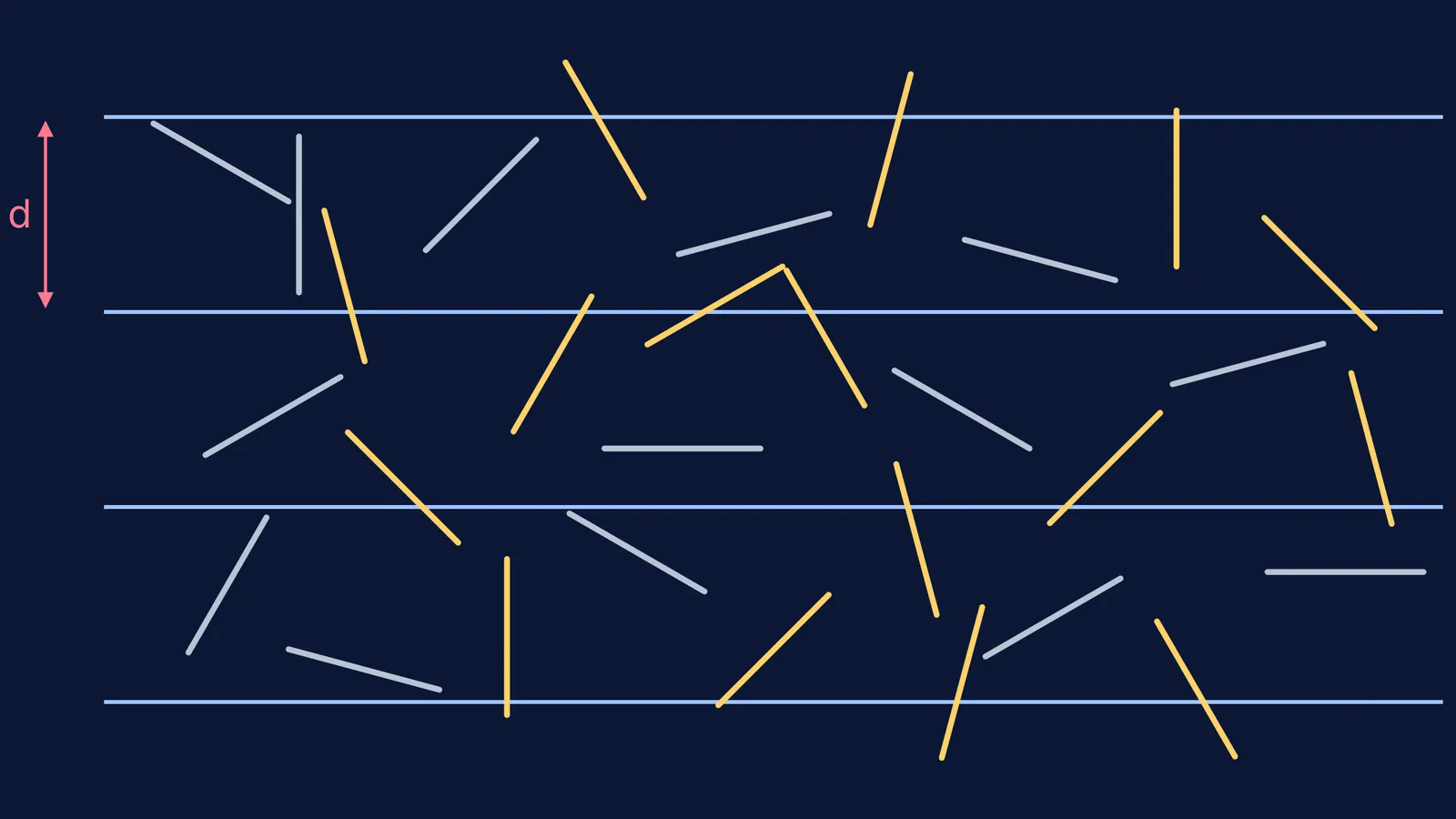
His question was simple. Rule a floor with parallel lines a distance d apart. Drop a needle of length l at random. How likely is it to land across a line?
Wolfram MathWorld records that Buffon first posed the problem in 1733 and reproduced it with a solution in 1777, in his Essai d'arithmétique morale. The MacTutor biography describes him throwing sticks over his shoulder onto a tiled floor and counting how often they fell across the lines between the tiles.
For a needle no longer than the gap, the probability of crossing a line is 2l/(πd) (MathWorld).
Why does pi show up when you drop a needle?
Call the distance from the midpoint to the nearest line x. It can be anything from 0 to d/2, all values equally likely.
Call the angle θ. By symmetry you only need 0 to π/2, again all equally likely.
Half the needle reaches a distance (l/2) sin θ towards the line, so it crosses when x ≤ (l/2) sin θ.
All possible landings fill a rectangle of area (d/2) × (π/2) = πd/4. The crossing landings fill the area under the curve (l/2) sin θ from 0 to π/2, which is l/2.
Probability = (l/2) ÷ (πd/4) = 2l/(πd).
Pi enters through the angle, not any circle: a random direction is spread evenly over a half-turn, and a half-turn is π radians. Step 4 is a Class 12 definite integral: sin θ from 0 to π/2 integrates to 1.
How do you estimate pi with Buffon's needle at home?
You need a large sheet of paper, a ruler and 10 identical matchsticks or toothpicks. The numbers below are our own arithmetic, using the formula from MathWorld.
Measure a stick. Say it is 4 cm long.
Rule parallel lines 5 cm apart, so l = 4 and d = 5. The chance of a crossing is 8/(5π), about 0.51.
Drop all 10 sticks from about 30 cm without aiming. Count the sticks touching a line, pick them up and repeat 10 times, for 100 drops.
Suppose 51 crossed. Then π ≈ (2 × 4 × 100) ÷ (5 × 51) = 800 ÷ 255 ≈ 3.14.
Expect a rough answer. With 100 drops the crossing count typically wobbles by about 5 either way (the standard deviation, √(100 × 0.51 × 0.49) ≈ 5), and 46 or 56 crossings give about 3.48 or 2.86. A ten times smaller error needs about a hundred times as many drops: to be typically within 0.01 of π, roughly 95,000. That slow settling is the law of large numbers at work, which our post on Jacob Bernoulli and the law of large numbers explains with coin tosses.
Why did Lazzarini's 1901 result look too good?
In 1901 the Italian Mario Lazzarini reported dropping a needle 2.5 cm long on lines 3 cm apart 3,408 times, with 1,808 crossings, as Antonio J. Durán describes on the Universidad de Sevilla mathematics blog. Put those numbers into the formula and you get 355/113 = 3.1415929, correct to six decimal places.
That is far too neat. By our arithmetic, 3,408 drops should give about 1,808 crossings on average, with a spread of about 29 either way, and Durán notes that one crossing more or fewer would have given 3.1398 or 3.1433. Also, 3,408 = 16 × 213 and 1,808 = 16 × 113, so choosing when to stop makes 355/113 easy to hit.
Lee Badger examined the experiment in "Lazzarini's Lucky Approximation of π" (Mathematics Magazine, 1994, DOI 10.1080/0025570X.1994.11996194). Durán's verdict: "either Lazzarini was very lucky or, more likely, he cheated."
What does Buffon's needle teach you for JEE probability?
Buffon's method is geometric probability: treat every outcome as a point in a region, then divide the favourable area by the total area. The same move solves problems like picking two numbers at random from 0 to 1 and asking how likely their sum is below 1.
Name the random quantities (here, x and θ).
Check each is equally likely across its range.
Draw the region, shade the favourable part, compute areas.
Check the answer lies between 0 and 1.
Most wrong answers come from a wrong sample space, not wrong algebra; our post on five probability reasoning mistakes in JEE maths covers the usual traps. If you keep setting up the region wrongly, the Fermi Problem Library has worked problems with a step-by-step solver that explains the reasoning rather than printing an answer. For ideas easier to see than to read, try the Fermi Simulation Lab. For an exact route to pi instead of a random one, read about Madhava of Sangamagrama and the infinite series for pi.