On this page
Every cell in your body carries a nucleus, but a skin cell and a nerve cell do very different jobs. In the 1950s nobody knew whether that was because cells lost genes as they specialised, or simply switched some off. Robert Briggs and Thomas King built the first experiment that could test it in a vertebrate, and they did it with frog eggs, glass needles and a lot of patience.
What did Briggs and King do in 1952?
Their paper, Transplantation of living nuclei from blastula cells into enucleated frogs' eggs, appeared in the Proceedings of the National Academy of Sciences in May 1952, from the Institute for Cancer Research and Lankenau Hospital Research Institute in Philadelphia. The idea itself was older: the German embryologist Hans Spemann had described such a transfer in his 1938 book, but had no way to carry it out, as the Embryo Project's history of nuclear transfer explains.
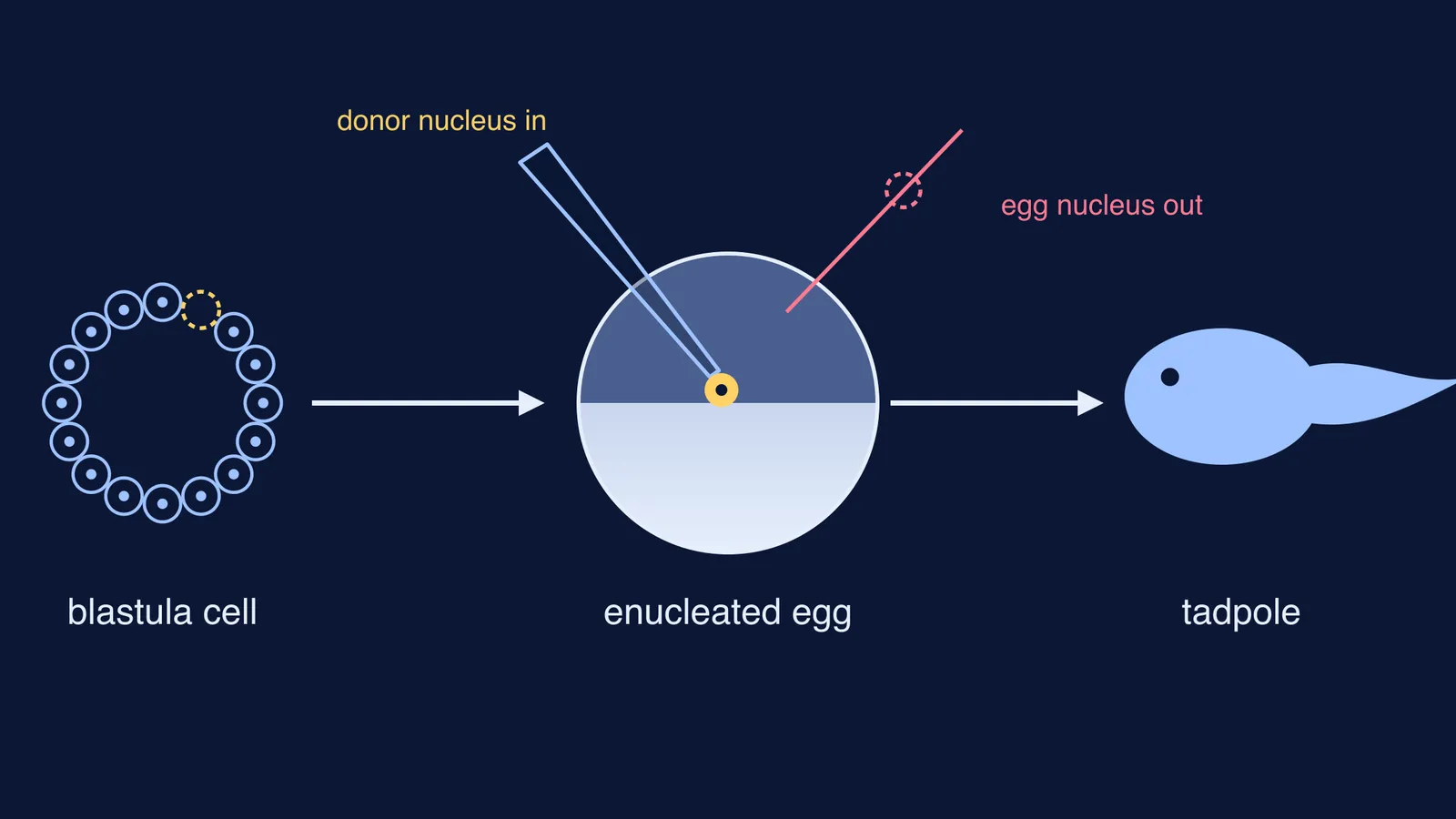
The Embryo Project's account of the 1952 paper describes the method in four moves:
Prick an unfertilised egg of the leopard frog, Rana pipiens, with a glass needle to activate it.
Remove the egg's own nucleus with a needle, leaving an enucleated egg.
Open an early embryo (a blastula), suck a single cell into a fine glass micropipette, which breaks the cell's surface.
Inject the contents, including the donor nucleus, into the empty egg.
Some of those eggs developed into viable tadpoles, as the Embryo Project's biography of Thomas King records. Before this, nuclear transfer had only been done in single-celled amoebae, according to the Embryo Project's account of the paper.
How often did it work, and what went wrong later?
Looking back fifty years on, John Gurdon and John Byrne wrote in their PNAS review, The first half-century of nuclear transplantation, that in Briggs and King's experiments blastula nuclei supported normal tadpole development in up to 40% of all tests.
The same review records the catch. Nuclei from later embryos (gastrulas) were markedly less successful, and endoderm nuclei from tail-bud embryos gave only abnormal development. Briggs and King read this as a sign that nuclei change for good as cells specialise. According to the Embryo Project's biography of Gurdon, they concluded that a nucleus from an adult cell could not produce normal development.
How is this different from Gurdon's cloning?
Gurdon used the same basic method on a different frog, the African clawed frog Xenopus laevis, and kept pushing to older donor cells. By 1962 he had produced tadpoles from nuclei of gut cells taken from swimming tadpoles, as the Embryo Project's Gurdon biography records. Gurdon and Byrne's review notes that nuclei from fully differentiated gut cells of feeding tadpoles gave fertile adults in about 1% of nuclear transfers: rare, but enough to show those nuclei still held the genes needed to make a whole frog.
So the two results fit together. Briggs and King showed the technique works and that success falls as donor cells age. Gurdon showed that a specialised nucleus can still direct normal development, so the fall reflects how hard it is to reprogram such a nucleus rather than genes being lost. Gurdon shared the 2012 Nobel Prize in Physiology or Medicine with Shinya Yamanaka for work on cloning and pluripotent stem cells, per the same biography. Decades on, Dolly the sheep was cloned with the same idea, using nuclei from cultured adult mammary gland cells, as Gurdon and Byrne note.
If you want the difference between this kind of reproductive cloning and the gene cloning in your textbook, our post on gene cloning versus reproductive cloning sets them side by side.
How do you read an experiment like this one?
Board questions and NEET-UG assertion-reason items often test whether you can say what an experiment actually showed. Here is a four-line frame, filled in for Briggs and King.
Question: Do nuclei lose genes as cells specialise?
Set-up: Put a donor nucleus into an egg with no nucleus of its own, so any development must come from the donor.
Result: Blastula nuclei gave normal tadpoles; nuclei from later stages mostly did not.
Limit: A failure can mean the genes are gone, or that the egg could not reprogram the nucleus. The experiment alone cannot tell which.
That last line is exactly where Gurdon came in. Practise the same frame on two older experiments: Hans Driesch's sea urchin embryos, which asked a similar question about early cells, and Robert Brown's naming of the cell nucleus, where this whole story starts.
If words like blastula, differentiation or totipotency are still fuzzy, the Fermi Concept Library gives each concept in biology its own lesson and shows where it sits in the map, so you can fill the gap before tackling the experiment questions.
Next time you revise development or biotechnology, write the four-line frame for one experiment from memory. If you can state its limit, you understand it.