

On this page
In November 1831 the Linnean Society of London heard a long paper by a Scottish botanist on how orchids are fertilised. Partway through, he described something far smaller: a round spot inside each surface cell of an orchid leaf. Robert Brown gave that spot the name we still use, the nucleus.
How did Robert Brown discover the cell nucleus?
Brown was not hunting for the nucleus. His paper, “On the Organs and Mode of Fecundation in Orchideae and Asclepiadeae”, was about pollination and seeds. It was read on 1 and 15 November 1831 and printed in 1833 in volume 16 of the Transactions of the Linnean Society of London, pages 685 to 738. Only after the seeds did he turn to “the cellular tissue”.
He wrote that in each epidermal cell of a great part of the orchid family, “a single circular areola, generally somewhat more opake than the membrane of the cell, is observable.” It was granular and slightly convex, with no fixed place in the cell, though often near the centre. Then came the naming line: “This areola, or nucleus of the cell as perhaps it might be termed, is not confined to the epidermis.”
Born in Montrose, Scotland, in 1773, he sailed with Matthew Flinders’ Investigator expedition in 1801 and collected Australian plants until 1805, according to the Royal Botanic Garden Edinburgh, which notes he is best known for Brownian motion, found by watching pollen grains in water.
What exactly did Brown see in the orchid cells?
The original paper lets you follow his reasoning:
One per cell. He stressed that “only one areola belongs to each cell”.
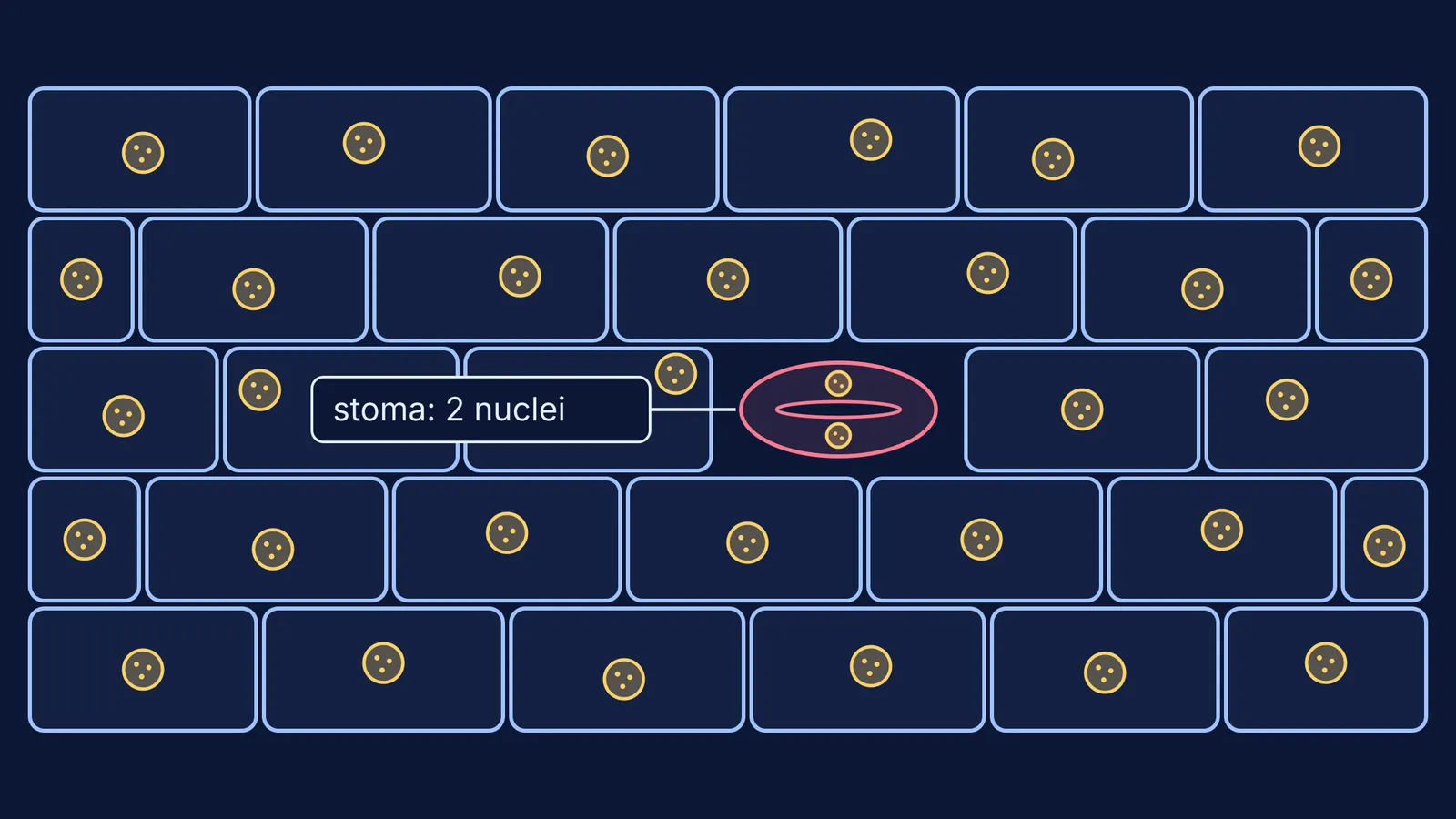
Two in each stoma. Leaf pores always showed two areolas, one on each side, so he argued a stoma is made of two cells: the pair of guard cells you draw today.
Not only on the surface. He found it in hairs, inner tissue and the stigma.
Not only in orchids. It was clear in lilies, irises and spiderworts (Tradescantia), and, in very few cases, in the skin of dicots.
One exception, reported honestly. In the stigma of the orchid Bletia he often saw a second areola, and said so.
In a footnote he described pressing a Tradescantia hair cell until its nucleus came out whole, and watching granules stream inside the cell through a lens magnifying 300 to 400 times.
Was Robert Brown the first to see the nucleus?
Not quite, and he said so. In the same paper he pointed to earlier figures by Meyen, Purkinje and Adolphe Brongniart that showed the spot, but noted that “so little importance seems to be attached to it” that the captions did not always mention it. Only Bauer, drawing the Bletia stigma, had noticed it more closely. Brown added the claim that it is a regular part of the cell, and a name. The NCERT Class 11 Biology textbook puts it simply: Leeuwenhoek first saw and described a live cell, and “Robert Brown later discovered the nucleus.”
How did the nucleus lead to cell theory?
The NCERT chapter dates the next steps. Matthias Schleiden studied plants in 1838, Theodor Schwann studied animal cells in 1839, and together they formulated cell theory. Rudolf Virchow added in 1855 that new cells form from pre-existing cells (Omnis cellula-e cellula).
Brown’s nucleus helped join the two halves. As The Scientist tells it, over dinner in Berlin in 1837 Schleiden told Schwann about Brown’s nucleus. Schwann recognised a similar structure in notochord cells, and the two then saw nucleated animal cells much like plant ones.
For the modern side of the story, read our explainers on why viruses are an exception to cell theory and how a bacterial nucleoid differs from a true nucleus.
How can you study like Brown and remember this for exams?
Brown’s method fits five steps you can use in any practical, from an onion peel slide to a cheek-cell mount:
Look at many cells, not one, before generalising.
Count. “One per cell” is a pattern you can test.
Use the pattern to infer. Two nuclei in a stoma meant two cells.
Write down exceptions, as he did for Bletia.
Name what you see, and credit who saw it first.
For revision, keep this four-line timeline:
1831: Brown names the nucleus (printed 1833)
1838: Schleiden, plant cells
1839: Schwann, animal cells; cell theory
1855: Virchow, new cells from pre-existing cells
A model two-mark answer: “Robert Brown observed a single round, granular body in the epidermal cells of orchid leaves and in 1831 named it the nucleus of the cell. He found it in many plant families, which later supported the cell theory of Schleiden and Schwann.” Add more names with our list of biology scientists and their discoveries.
If the nucleus, chromosomes and cell division still feel like separate facts, the Fermi Concept Library gives every biology concept its own lesson and its place in the map, so you can see how they connect.


