

On this page
Every living cell stores genetic instructions, but how it packages that DNA depends on the kind of cell it is. The division between a nucleoid and a nucleus is the defining line between the two great domains of life: prokaryotes and eukaryotes.
Here is how the naked DNA region of a bacterium compares to the membrane-bound nucleus of an animal or plant cell, and why this structural difference determines how fast a cell can grow and divide.
What is the difference between a nucleoid and a nucleus?
The primary difference lies in structure and isolation.
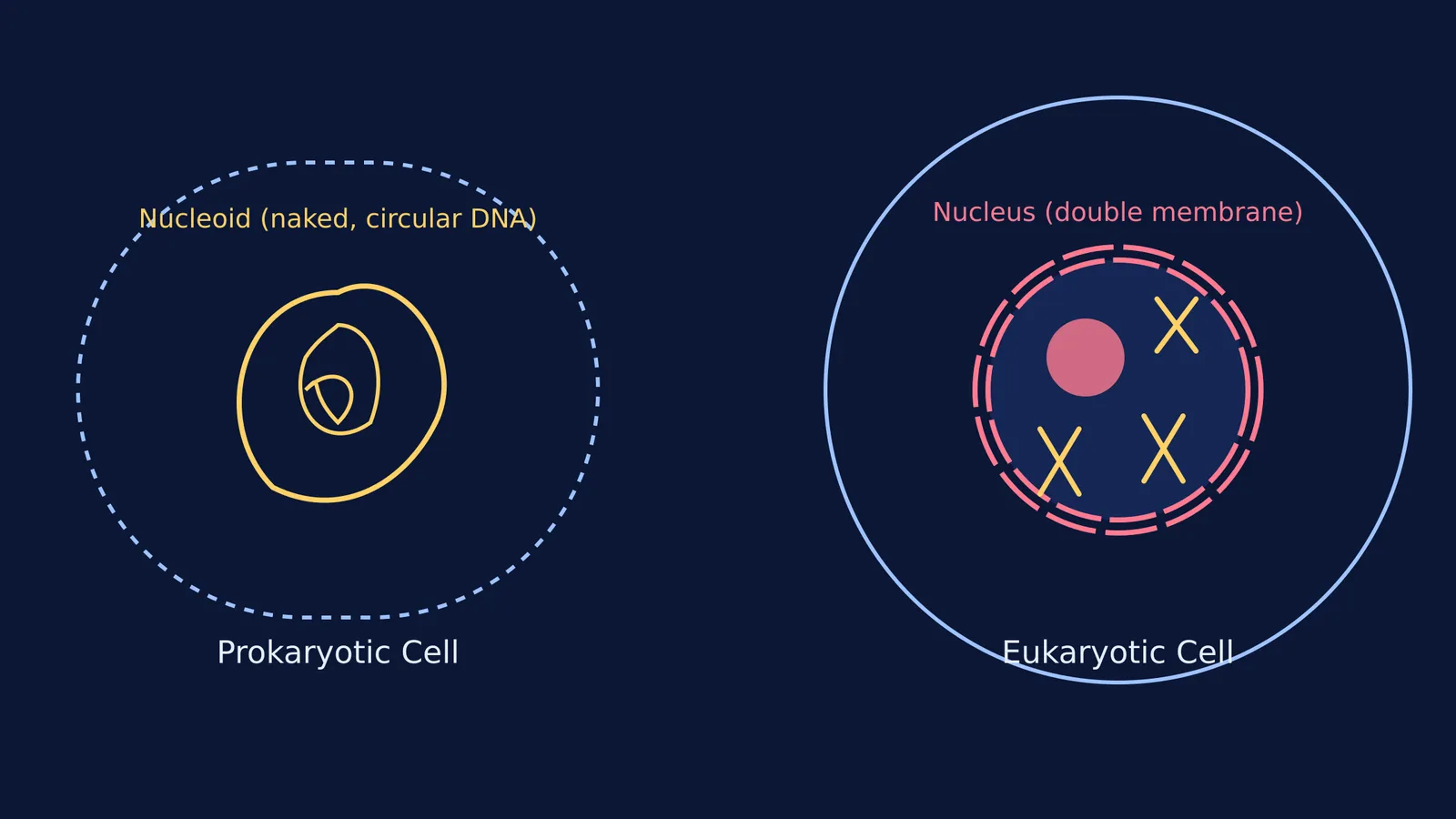
A nucleus is a distinct, membrane-bound organelle found in eukaryotic cells (such as those in plants, animals and fungi). It is completely enclosed by the nuclear envelope, a double membrane structure dotted with highly selective nuclear pores. These pores act as gatekeepers, tightly controlling which molecules—like RNA and proteins—are allowed to enter or exit. In many eukaryotic cells, the nucleus is large enough to occupy about 10% of the cell volume). Inside this protected space, DNA is wrapped tightly around histone proteins and organized into multiple linear chromosomes. You will also often find a dense structure called the nucleolus inside, which is responsible for building ribosomes.
A nucleoid is an irregularly shaped region within a prokaryote (like a bacterium or an archaeon) where its genetic material gathers. It is not an organelle and has no membrane. Because there is no physical barrier, the DNA sits directly in the cytoplasm, exposed to the cell's internal fluid. A typical prokaryote carries its genetic code on a single, continuous circular chromosome rather than the multiple linear strands found in eukaryotes.
Why do prokaryotes have a nucleoid instead of a nucleus?
Prokaryotes are built for speed and efficiency. Because they have no nuclear membrane isolating their genes, transcription (the process of copying DNA into RNA) and translation (reading that RNA to build proteins) can happen simultaneously in the exact same space. The moment an RNA strand begins to form, ribosomes can attach to it and start assembling proteins. This direct contact allows a bacterium to react to its environment and reproduce much faster than a eukaryotic cell could manage.
Cellular size is another major factor. Eukaryotic cells are typically 10,000 times larger by volume than prokaryotic cells. A large eukaryotic cell needs a highly structured, isolated nucleus to manage a massive, complex genome safely without it tangling or suffering chemical damage from the busy cytoplasm. A tiny bacterium, with its streamlined genome and very high surface-area-to-volume ratio, simply does not need that level of elaborate compartmentalization.
How is DNA packed inside a nucleoid?
Even without a nucleus, a bacterium still has to fit a remarkably long DNA molecule into a microscopic space. If you were to stretch out the circular chromosome of *E. coli*, it would be much longer than the cell itself.
To make it fit, a prokaryote's DNA is vigorously supercoiled and condensed by a factor of 1,000 compared to its relaxed state. Instead of the specialized histones that eukaryotes use, prokaryotes rely on nucleoid-associated proteins (NAPs). These architectural proteins bend, bridge and organize the DNA loops into distinct functional domains. Despite this extreme compaction, the nucleoid still takes up a substantial fraction of the bacterium's interior volume, continuously shifting shape as the cell grows.
Exam checklist: nucleoid vs nucleus
When comparing the two structures in an exam setting, check off these four points to ensure your answer is complete:
Membrane: Does it have a nuclear envelope? (Nucleus: Yes, a double membrane. Nucleoid: No, it is membrane-free.)
Chromosome type: Is the DNA linear or circular? (Nucleus: Multiple linear chromosomes. Nucleoid: A single circular chromosome.)
Packaging proteins: What wraps the DNA? (Nucleus: Histone proteins. Nucleoid: Nucleoid-associated proteins, or NAPs.)
Location and contact: Where is it located? (Nucleus: Safely separated from the cytoplasm. Nucleoid: Located directly in the cytoplasm.)
Seeing the whole cell
Memorising biological differences is far easier when you can picture exactly how the structures work together. If you find it hard to hold all the microscopic parts of a cell in your head for an exam, the Fermi Concept Library holds every concept in physics, chemistry, biology, mathematics and computing, each with its own lesson and its place in the map.
If you are revising cell biology and genetics, you might also find these helpful:


