

On this page
When scientists talk about cloning, they are usually referring to one of two very different processes. While one happens routinely in laboratories worldwide to produce medicines, the other remains rare, highly inefficient, and ethically debated.
What is gene cloning vs reproductive cloning?
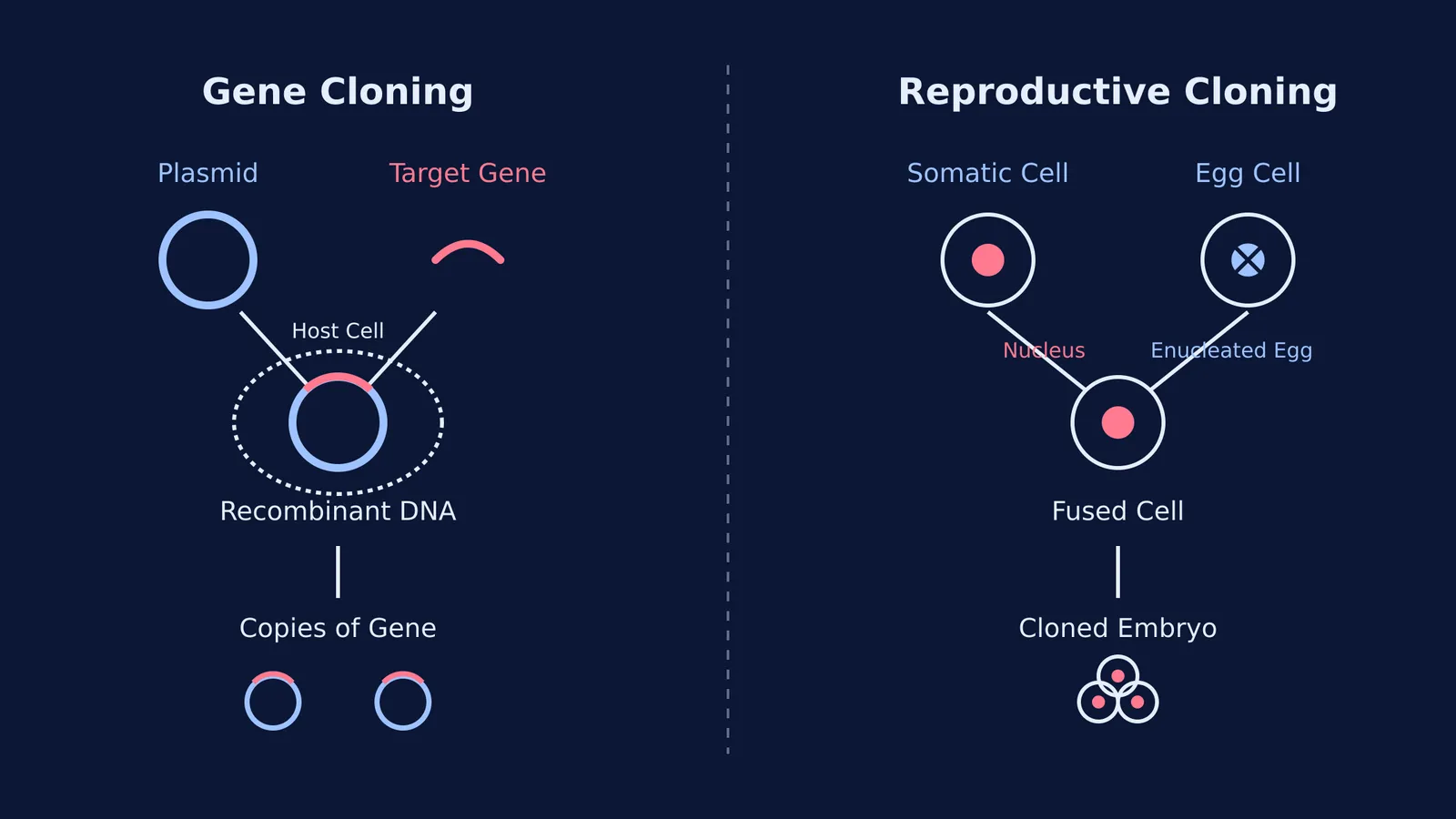
According to the National Human Genome Research Institute, gene cloning is the process of making copies of genes or segments of DNA (NHGRI). It does not create a living organism. Instead, it multiplies a specific piece of genetic material so scientists can study it, test it, or use it to produce proteins on an industrial scale.
Reproductive cloning, on the other hand, is the process that produces copies of whole animals (NHGRI). The goal here is to create an exact genetic duplicate of an existing living organism. While gene cloning is a foundational tool in almost every molecular biology lab, reproductive cloning is strictly regulated and largely confined to specialised agricultural and conservation research.
How does gene cloning work?
Gene cloning relies on carrier molecules called vectors, such as plasmids, which are small, circular DNA molecules found naturally in bacteria. Researchers cut open the plasmid using restriction enzymes and insert a target gene, creating what is known as recombinant DNA.
This engineered vector is then placed back into a host cell. Because bacteria divide and multiply rapidly, the host cell acts as a biological factory, copying the inserted gene along with its own DNA every time it divides.
This technique is the backbone of modern biotechnology. It is used to produce vital medicines, such as making human insulin by rDNA, where the genes for human insulin are cloned into bacteria to produce safe, reliable insulin for diabetics. Gene cloning has become standard practice because it is efficient and essential for genetic engineering; without it, developing gene therapies or sequencing genomes would be impossible. If you are preparing for biology exams and find molecular pathways tricky to picture, the Fermi Concept Library maps out every concept with its own lesson.
How is reproductive cloning done?
Reproductive cloning bypasses the need for plasmids and bacteria. Instead, it uses a completely different method known as Somatic Cell Nuclear Transfer (SCNT). A mature somatic cell, such as a skin or udder cell, is taken from the animal that the scientists wish to copy. Its DNA-containing nucleus is extracted and inserted into an unfertilised egg cell that has had its own nucleus removed (NHGRI).
Once the empty egg and the donated nucleus are fused together—often stimulated by an electrical current to simulate fertilisation—the resulting embryo begins to divide. It is then implanted into a surrogate mother to develop naturally. This technique builds on early amphibian research, notably John Gurdon and the frog cloned from a gut cell.
What happened to Dolly the cloned sheep?
Dolly the sheep was the first mammal ever cloned from an adult somatic cell in 1996, proving definitively that SCNT could work in mammals. However, the process remains incredibly inefficient; Dolly was the only live birth out of 277 cloned embryos (NHGRI).
Even when reproductive cloning is successful, the cloned animals often suffer from adverse health effects. These can include abnormally large birth sizes, defects in vital organs such as the heart and liver, immune system deficiencies, and premature aging. Dolly herself died at age six, which is roughly half the typical 12-year lifespan of a sheep of her breed (NHGRI). Scientists believe this was partly because her cells had shorter-than-normal telomeres, the protective caps on the ends of chromosomes.
A practical checklist for exam questions
In biology exams, you are frequently asked to distinguish between different biotechnology applications. If you are struggling with these distinctions, Fermi's AI tutor can hold a line of reasoning across a whole session and check your understanding as it goes. Use this quick checklist to identify which type of cloning a question is asking about:
Look at the target: Is the question asking about multiplying a DNA fragment or producing a whole animal?
Identify the carrier: The mention of plasmids, bacteriophages, or host bacteria points directly to gene cloning.
Spot the method: If the question describes removing a nucleus from an egg cell and replacing it with a somatic nucleus, it is describing SCNT for reproductive cloning.
Check the application: Creating transgenic animals and molecular diagnosis: ELISA and PCR uses often begins with gene cloning to isolate the target DNA before it is ever introduced into a host organism.
By keeping these differences clear, you can easily tackle questions on the tools, techniques, and ethics of modern biotechnology.


